All species › Passerines › Tyrant flycatchers and allies › Black-and-white Tody-Flycatcher
Black-and-white Tody-Flycatcher | Poecilotriccus capitalis
Zwart-witte todietiran | Titirijí pío | Maria-picaça
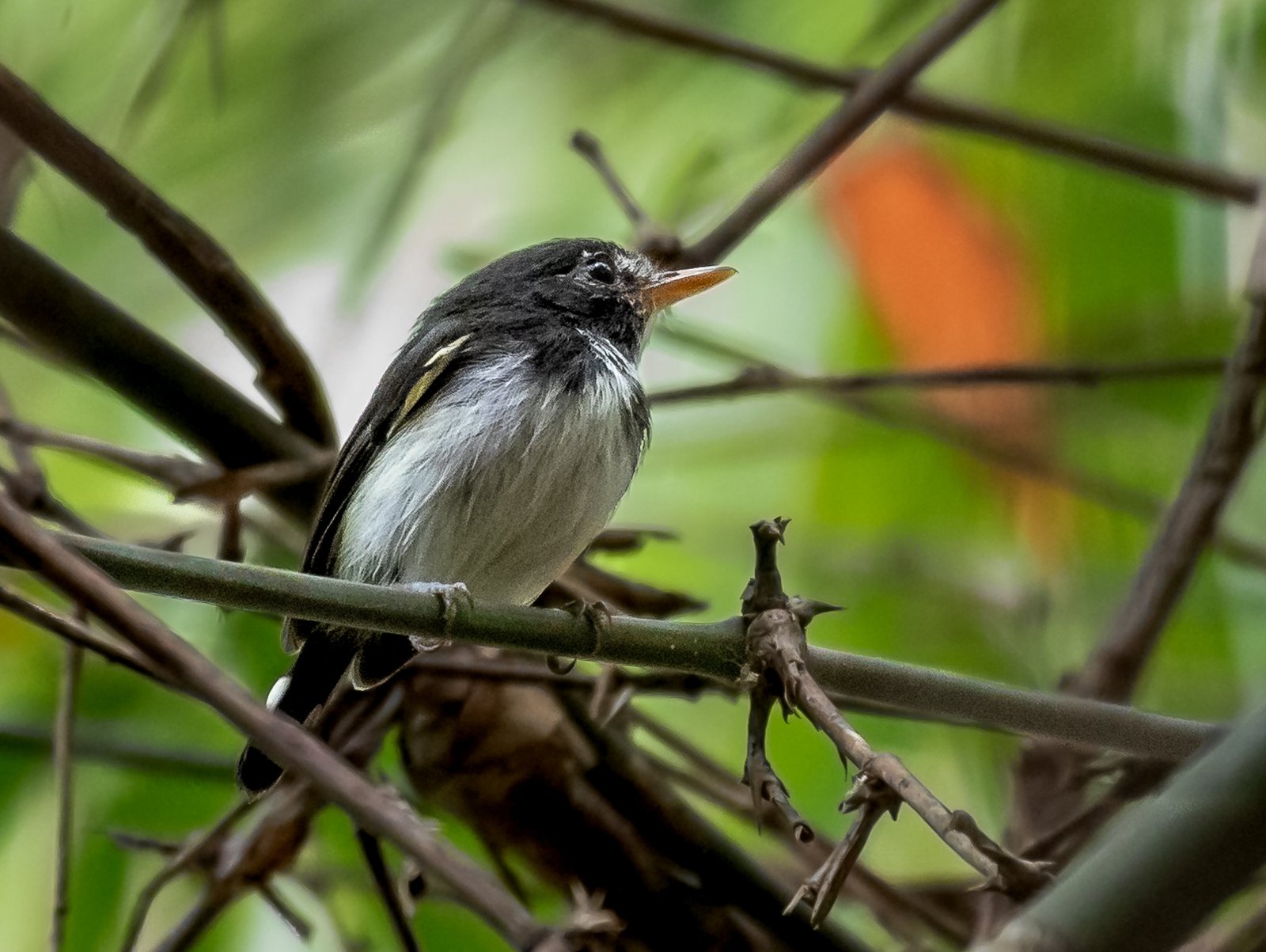
The Black-and-white Tody-Flycatcher is a small tyrant in which the sexes differ strongly: the male is glossy black and white, the female has a chestnut crown and a grey face. It lives in dense vegetation at forest edges at the foot of the eastern Andes and has a patchy range.
Voice
A fast, sharp tik, t-r-r-r-r-r-ew; when agitated a more explosive tk, tk, tk, whey-whey-whey-whuh.
Recording: Juan Freile — CC BY-NC-SA 4.0 · xeno-canto
Identification
9.5 cm, with a flat, broad bill and a fairly short tail. The male is glossy black on the head and upperparts, with a small white spot above the lores and a white eye-ring; the throat and underparts are white, with black streaks on the sides of the breast that sometimes form a narrow band, and a pale yellow wash on the flanks. The female has a chestnut crown, a grey face with buff lores and eye-ring, and an olive back. Both sexes have blackish wings with broad, pale yellow edges to the tertials.
Confusion species
Common Tody-Flycatcher Todirostrum cinereum has yellow underparts and a pale iris and lives mainly in open country. Black-headed Tody-Flycatcher Todirostrum nigriceps has a black head but an olive back and yellow underparts, and stays high in the canopy. The female may recall Rufous-crowned Tody-Flycatcher Poecilotriccus ruficeps, which lives higher in the mountains and has a white or buff cheek with a black border.
Habitat
Edges of humid lowland and foothill forest, along roads and small streams, with a strong preference for vine tangles and bamboo; also secondary forest without bamboo. Between about 250 and 1350 m. It forages low to mid-height in dense vegetation for insects.
Where the bird is most at home, classified by the vegetation units of the Andes and the west coast.


Range and movements
Colombia: eastern Nariño, Putumayo and Amazonas. Ecuador: locally along the eastern base of the Andes. Peru: along the eastern Andean slope south to San Martín and northern Loreto, with an isolated population in Cusco. Bolivia: unknown or barely known. Outside the guide area in a few small populations in Brazilian Amazonia.
- Resident
- dark = core range, pale = thinly spread
How and when to look
Search bamboo and vine tangles along roads through foothill forest on the eastern side of the Andes, for example in Ecuador and northern Peru; listen for the fast tik, t-r-r-r-ew.
Conservation status
Least Concern. The species is local and uncommon, but its range is large and it tolerates secondary vegetation.
Scientific name
Poecilotriccus capitalis | (Sclater, 1857)
Sclater described the species in 1857 as Todirostrum capitale; because it was later moved to another genus, the author and year stand in brackets. The genus Poecilotriccus was introduced in 1884 by Berlepsch. The genus name comes from Greek poikilos, 'variegated, pied', and trikkos, a small unidentified bird, used in ornithology for tyrant flycatchers. The species name comes from Latin capitalis, 'of the head', for the striking head. The specimen the first description was based on came from Río Napo, Ecuador.