All species › Passerines › Tyrant flycatchers and allies › White-cheeked Tody-Flycatcher
White-cheeked Tody-Flycatcher | Poecilotriccus albifacies
Witwangtodietiran | Titirijí cariblanco | Ferreirinho-de-cara-branca
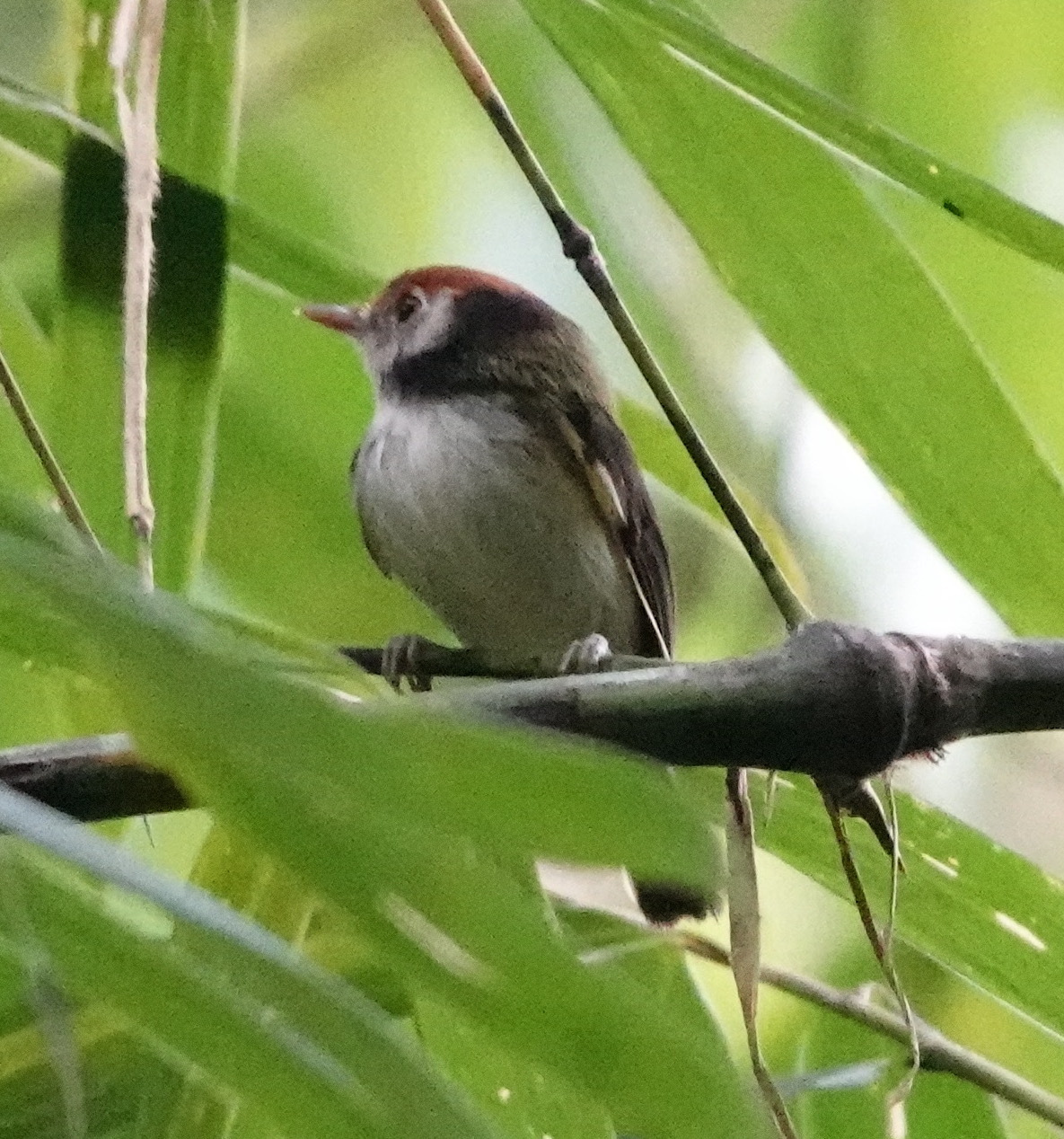
The White-cheeked Tody-Flycatcher is a small tyrant of dense bamboo forest in south-western Amazonia. It is almost entirely tied to stands of Guadua bamboo and therefore occurs very locally. The male has a rufous crown and white sides to the head.
Voice
Short, dry rattles and ticking notes, low in the bamboo.
Recording: Richard E. Webster — CC BY-NC-SA 4.0 · xeno-canto
Identification
9.5 cm, with a flat bill and a fairly short tail. The male has a rufous crown and white sides to the head; a black nape band extends into two narrow black stripes towards the eye and along the cheek. The upperparts are olive-green, the wings and tail black, the tertials edged white. The underparts are white, with black sides to the breast. The female is duller, with a dark grey neck and cheeks and broad olive wing edgings.
Confusion species
Rusty-fronted Tody-Flycatcher Poecilotriccus latirostris has an ochre face, a grey crown and greyish underparts, and lives in scrub at forest edges. Black-and-white Tody-Flycatcher Poecilotriccus capitalis has a black head and back without white head sides. Flammulated Bamboo Tyrant Hemitriccus flammulatus also lives in bamboo, but is brown with a streaked breast.
Habitat
Dense stands of Guadua bamboo in humid lowland and foothill forest, up to about 1050 m. It forages in pairs low to mid-level in the bamboo for insects, which it picks from stems and leaves with short sallies.
Where the bird is most at home, classified by the vegetation units of the Andes and the west coast.


Range and movements
Peru: very local in the south-east, in southern Madre de Dios and north-eastern Cusco, possibly also in Puno. Bolivia: very local in the north, in Pando. Absent from Colombia, Ecuador and the Galápagos. Outside the guide area in western Brazil (Acre).
- Resident
- dark = core range, pale = thinly spread
How and when to look
Search extensive bamboo forest in the foothills of Madre de Dios and Cusco; listen for dry rattles low in the bamboo and wait for a bird to show briefly.
Conservation status
Least Concern. The species is local and depends on bamboo forest, so deforestation in south-western Amazonia can affect the population.
Scientific name
Poecilotriccus albifacies | (Blake, 1959)
Blake described the species in 1959 as Todirostrum albifacies; because it was later moved to another genus, the author and year stand in brackets. The genus Poecilotriccus was introduced in 1884 by Berlepsch. The genus name comes from Greek poikilos, 'variegated, pied', and trikkos, a small unidentified bird, used in ornithology for tyrant flycatchers. The species name comes from Latin albus, 'white', and facies, 'face', for the white cheeks. The specimen the first description was based on came from Boca del Río Colorado, Madre de Dios, Peru.