All species › Passerines › Tyrant flycatchers and allies › Lulu's Tody-Flycatcher
Lulu's Tody-Flycatcher | Poecilotriccus luluae
Lulu's todietiran | Titirijí de Lulu | Ferreirinho-de-lulu
Lulu's Tody-Flycatcher is a small tyrant with a rufous head, described only in 2001 and endemic to a small area in the Andes of northern Peru. It lives in dense bamboo and scrub in humid montane forest south of the Marañón River. The species is also known as Johnson's Tody-Flycatcher.
Voice
The song is a descending, whinnying chatter. Also a rising, staccato rattle and a soft, frog-like note.
Recording: GABRIEL LEITE — CC BY-NC-SA 4.0 · xeno-canto
Identification
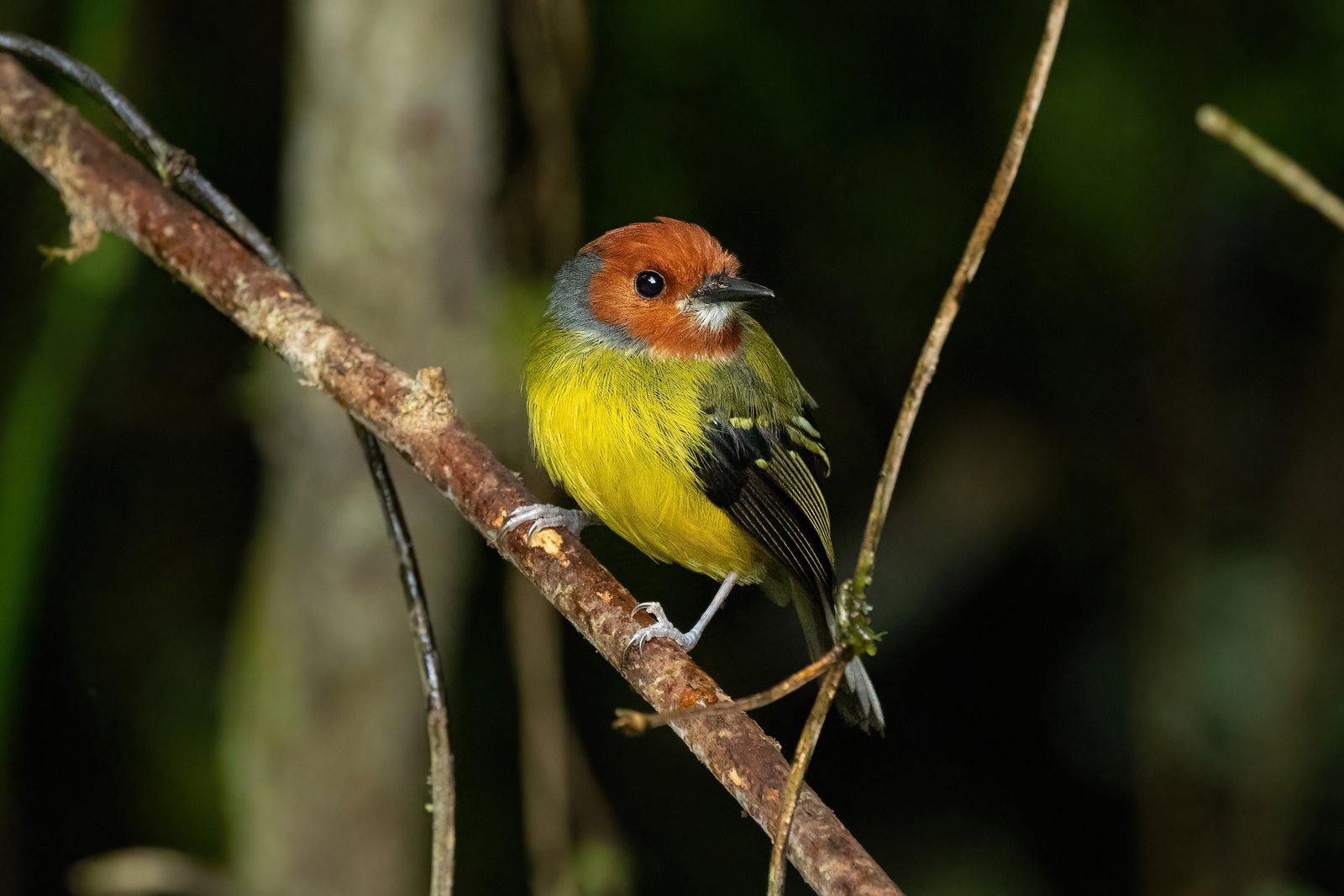
9.5 cm, with a flat bill and a fairly short tail. The entire head and throat are pale rufous to cinnamon, with a grey band across the nape; the chin is white. The back is yellowish olive-green. The wings are black with yellowish edgings and two narrow, pale wing bars. The breast is yellowish olive-green, the rest of the underparts orange-yellow to ochre-yellow. The sexes are alike.
Confusion species
Rufous-crowned Tody-Flycatcher Poecilotriccus ruficeps has only a rufous crown with a black rear border, white or buff cheeks and a whitish throat, and lives north of the Marañón. Ochre-faced Tody-Flycatcher Poecilotriccus plumbeiceps has a grey crown and an ochre face.
Habitat
The understorey of humid montane forest, strongly tied to dense bamboo, also secondary forest and scrub at forest edges, between about 1850 and 2900 m. It forages in pairs low in the vegetation for insects.
Where the bird is most at home, classified by the vegetation units of the Andes and the west coast.


Range and movements
Peru: endemic to the north, south of the Marañón, in southern Amazonas and western San Martín. Absent from Colombia, Ecuador, Bolivia and the Galápagos. Does not occur outside the guide area.
- Resident
- dark = core range, pale = thinly spread
How and when to look
Search bamboo along forest edges and roads through montane forest in southern Amazonas at 2000–2800 m, for example along the road from Pomacochas to Abra Patricia; listen for the descending, whinnying song.
Conservation status
Least Concern. The species was earlier considered Vulnerable and later Endangered; the population is now estimated at a few thousand adult birds and appears stable. Its small range makes it sensitive to deforestation.
Scientific name
Poecilotriccus luluae | Johnson & Jones, 2001
Johnson & Jones described the species in 2001 and placed it straight away in the genus where it still stands. The genus Poecilotriccus was introduced in 1884 by Berlepsch. The genus name comes from Greek poikilos, 'variegated, pied', and trikkos, a small unidentified bird, used in ornithology for tyrant flycatchers. The species name honours Lulu May Von Hagen, in recognition of her support of research in avian genetics. The specimen the first description was based on came from Near Corosha, Amazonas, Peru.