All species › Passerines › Tyrant flycatchers and allies › Rufous-crowned Tody-Flycatcher
Rufous-crowned Tody-Flycatcher | Poecilotriccus ruficeps
Roodkruintodietiran | Titirijí capirrufo | Ferreirinho-de-coroa-ruiva
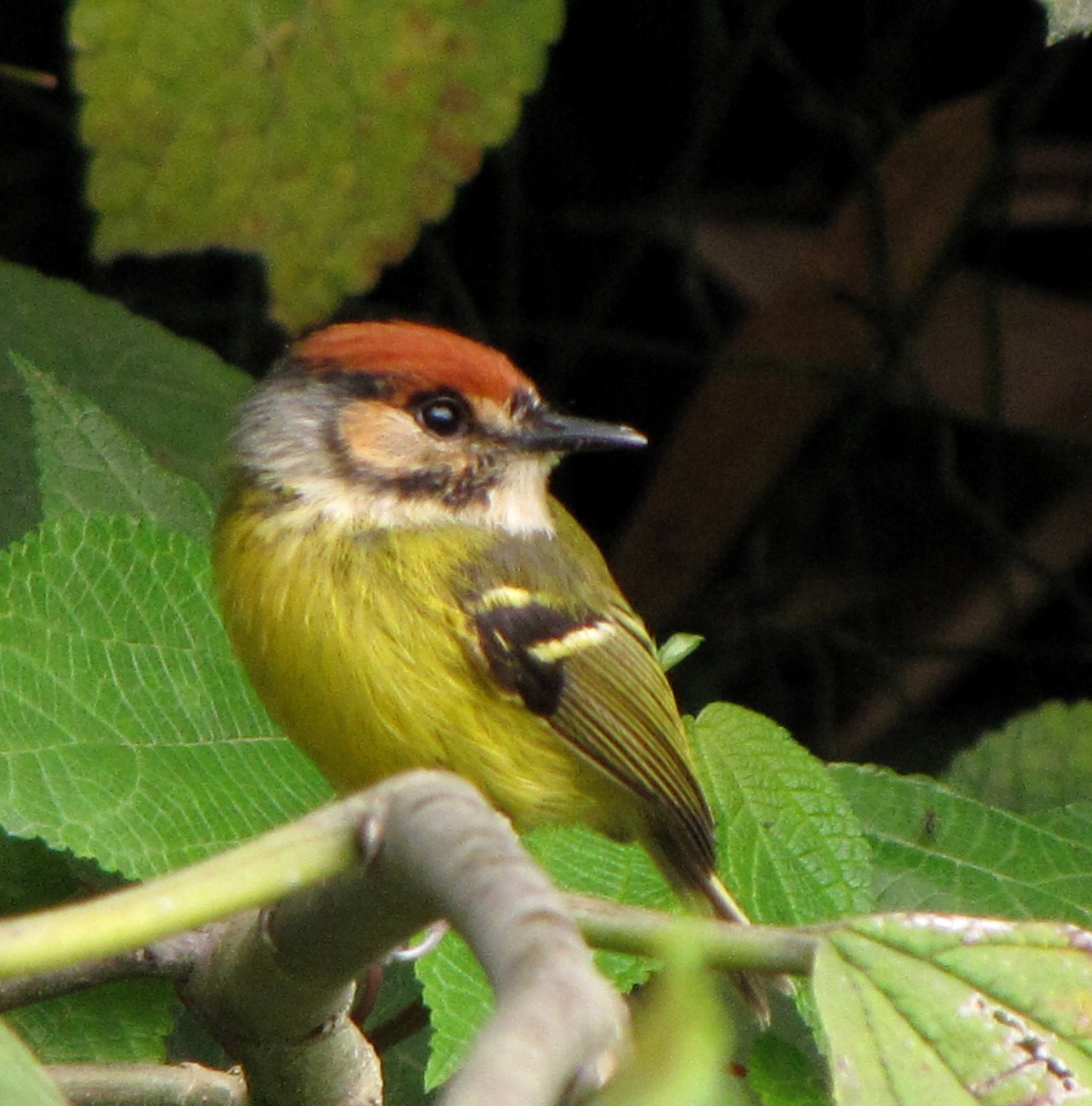
The Rufous-crowned Tody-Flycatcher is a small, multicoloured tyrant of montane forest edges in the northern Andes. It lives in dense, shrubby growth and bamboo and usually stays low, but gives itself away by its dry, rattling call. The rufous crown with a black rear border is a clear feature.
Voice
A dry, rapid rattle, often introduced by a single tick, like pt-trrrr; pairs often answer each other.
Recording: Alonso Quevedo — CC BY-NC-SA 4.0 · xeno-canto
Identification
9.5 cm, with a flat bill and a fairly short tail. The crown is rufous, bordered black at the rear and followed by a grey nape band. The cheeks are white to buff, with a narrow black border along the rear. The throat is whitish, the breast yellowish with a grey or olive wash, the belly yellow. The back is olive-green, the wings black with two yellow wing bars. The colour of the cheeks varies by region. The sexes are alike.
Confusion species
Lulu's Tody-Flycatcher Poecilotriccus luluae has an entirely rufous head without a black border or grey nape band, and lives only in northern Peru south of the Marañón. Ochre-faced Tody-Flycatcher Poecilotriccus plumbeiceps has a grey crown and an ochre face, and lives further south. Rusty-fronted Tody-Flycatcher Poecilotriccus latirostris has only a rufous forehead and face and lives in the lowlands.
Habitat
Dense growth at forest edges, clearings in cloud forest, scrub, bamboo and hedgerows in the montane zone, roughly between 1600 and 3000 m, locally higher up to the treeline. It forages in pairs low in the vegetation for insects, which it picks from leaves with short sallies.
Where the bird is most at home, classified by the vegetation units of the Andes and the west coast.


Range and movements
Colombia: in the montane zone of all three Andean ranges. Ecuador: on both slopes of the Andes and locally in the inter-Andean valleys. Peru: only in the north, north of the Marañón, in Piura and Cajamarca. Absent from Bolivia and the Galápagos. Outside the guide area in western Venezuela.
- Resident
- dark = core range, pale = thinly spread
How and when to look
Walk along cloud-forest edges and roads with dense growth and bamboo at 2000–2800 m and listen for the dry rattle; the birds often come out briefly onto an open twig.
Conservation status
Least Concern. The species also lives in secondary growth and tolerates small-scale farmland with hedgerows and copses.
Scientific name
Poecilotriccus ruficeps | (Kaup, 1852)
Kaup described the species in 1852 as Tod[iramphus] ruficeps; because it was later moved to another genus, the author and year stand in brackets. The genus Poecilotriccus was introduced in 1884 by Berlepsch. The genus name comes from Greek poikilos, 'variegated, pied', and trikkos, a small unidentified bird, used in ornithology for tyrant flycatchers. The species name comes from Latin rufus, 'rufous', and -ceps, 'headed', for the rufous crown. The specimen the first description was based on came from Probably Bogotá, Colombia (trade skin).