All species › Passerines › Tyrant flycatchers and allies › Bran-colored Flycatcher
Bran-colored Flycatcher | Myiophobus fasciatus
Roesttiran | Mosquerito pechirrayado | Filipe
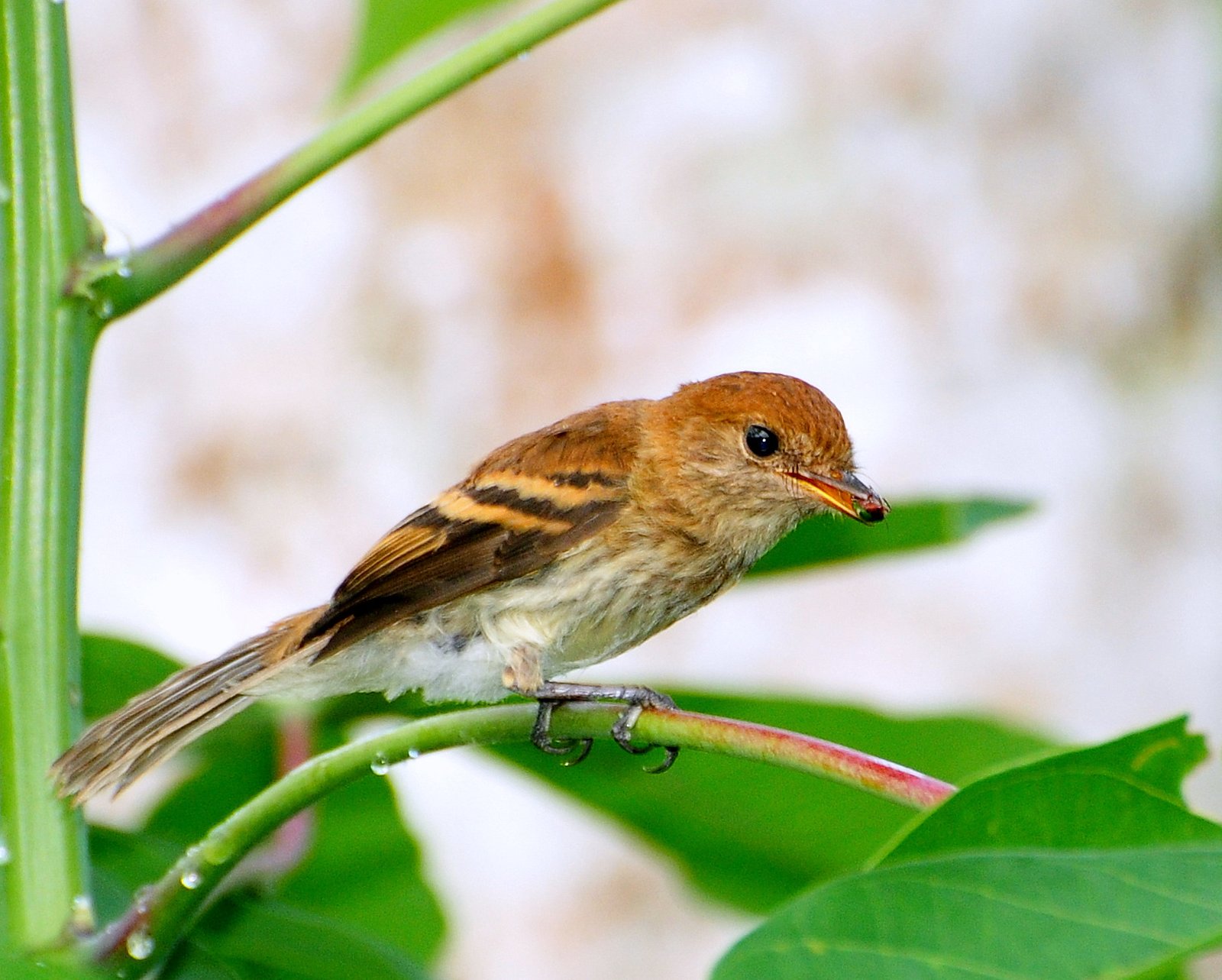
The Bran-colored Flycatcher is a small, warm rufous-brown tyrant flycatcher with a streaked breast, found in scrub and rank growth over much of tropical South America. In the guide area it lives both east of the Andes and in the dry western lowlands of Peru, where the birds are noticeably more rufous. Southern birds partly move north in the austral winter.
Voice
A series of short, slightly descending whistles, roughly tew-tew-tew-tew, and a short pit as a call.
Recording: JAYRSON ARAUJO DE OLIVEIRA — CC BY-NC-SA 4.0 · xeno-canto
Identification
12.5 cm, with a short, broad bill whose lower mandible is pale. The upperparts are warm rufous-brown to cinnamon-brown, the wings darker with two pale ochre wing bars. There is a small, usually concealed yellow or orange crown patch. The underparts are whitish, with brown streaks on the breast and flanks. Birds of western Peru are more uniformly rufous, with less streaking. The sexes are alike.
Confusion species
Olive-chested Flycatcher Myiophobus cryptoxanthus is more olive-brown above and has a yellowish belly and a less sharply streaked breast. Fuscous Flycatcher Cnemotriccus fuscatus is larger and longer-tailed, with a clear pale supercilium and an unstreaked breast. Euler's Flycatcher Lathrotriccus euleri has a grey, unstreaked breast and lives inside forest.
Habitat
Scrub, rank growth, overgrown pastures, riverside thickets and young secondary growth, from the lowlands to about 2000 m, locally higher in dry valleys. It keeps low and often hidden in dense foliage and catches insects with short sallies. The nest is a small cup in the fork of a shrub.
Where the bird is most at home, classified by the vegetation units of the Andes and the west coast.


Range and movements
Colombia: widespread in the lowlands and on the lower slopes. Ecuador: in the west and east, and in a few inter-Andean valleys. Peru: in the east, and with a distinct rufous form in the oases and river valleys of the western lowlands. Bolivia: in the lowlands and lower Andean valleys; in the austral winter birds from the south join them. Absent from the Galápagos. Outside the guide area from Costa Rica to Argentina and Brazil.
- Resident
- dark = core range, pale = thinly spread
How and when to look
Walk along rank roadsides and overgrown pastures; birds often sit still in the scrub and show themselves once you recognise the whistled series.
Conservation status
Least Concern. The species is widespread and benefits from open, man-made landscapes.
Scientific name
Myiophobus fasciatus | (Müller, 1776)
Müller described the species in 1776 as Muscicapa fasciata; because it was later moved to another genus, the author and year stand in brackets. The genus Myiophobus was introduced in 1850 by Reichenbach. The genus name comes from Greek muia, 'fly', and phobos, 'terror, fear'. The species name comes from Latin fasciatus, 'banded, striped'. The specimen the first description was based on came from Cayenne, French Guiana.