All species › Passerines › Tyrant flycatchers and allies › Olive-chested Flycatcher
Olive-chested Flycatcher | Myiophobus cryptoxanthus
Olijfkuiftiran | Mosquerito pechioliváceo | Filipe-de-peito-oliváceo
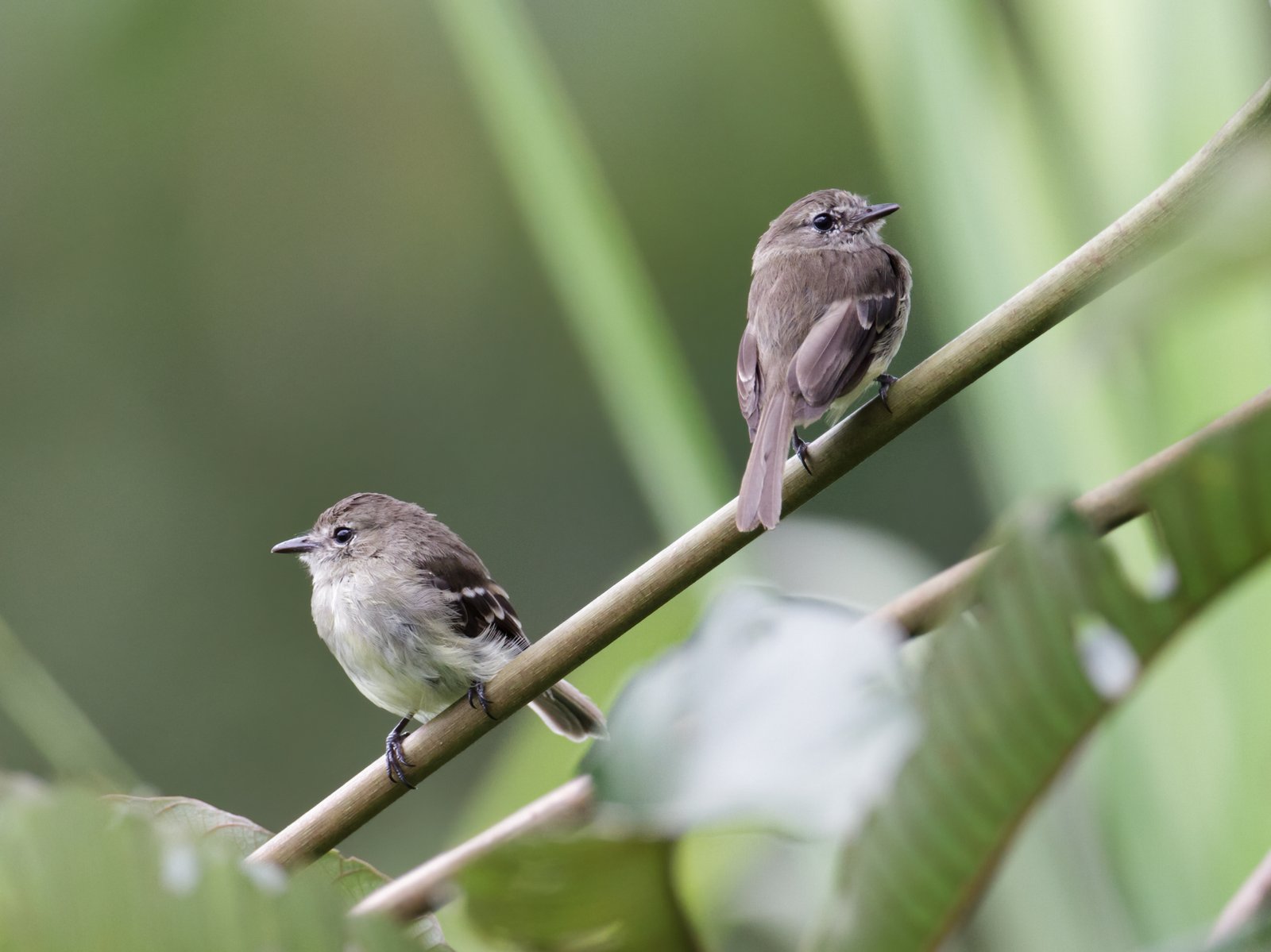
The Olive-chested Flycatcher is a small, brownish-olive tyrant flycatcher of forest edges and clearings at the foot of the eastern slope of the Andes. It keeps low in shrubbery and is mainly detected by its dry, rattling call. The scientific name cryptoxanthus means 'hidden yellow' and refers to the yellow crown patch that is usually concealed.
Voice
A dry, rapid rattle, often introduced by a few short notes, roughly pit-pit-trrrrrr, which can be heard throughout the year.
Recording: Jerome Fischer — CC BY-NC-SA 4.0 · xeno-canto
Identification
12 cm, with a short, flat bill whose lower mandible is pale. The upperparts are olive-brown, with a concealed yellow crown patch and a narrow, pale eye-ring. The wings have two ochre wing bars. The throat is whitish, the breast olive-brown with faint, blurry streaks, the belly pale yellow. The sexes are almost alike; young birds lack the crown patch.
Confusion species
Bran-colored Flycatcher Myiophobus fasciatus is warmer rufous-brown above and has a more clearly streaked, brownish breast on a white ground. Flavescent Flycatcher Myiophobus flavicans has yellow underparts and yellow spectacles and lives higher, in cloud forest. Euler's Flycatcher Lathrotriccus euleri has a greyer, unstreaked breast and lives inside forest.
Habitat
Shrubbery, clearings, roadsides, young secondary growth and the edges of humid foothill forest, roughly between 400 and 1500 m, locally somewhat higher. It lives alone or in pairs low in dense vegetation and catches insects with short sallies. The nest is a small cup in a shrub.
Where the bird is most at home, classified by the vegetation units of the Andes and the west coast.


Range and movements
Colombia: only in the far south, at the foot of the eastern slope. Ecuador: along the eastern slope of the Andes. Peru: along the eastern slope south to the centre of the country. Absent from Bolivia and the Galápagos. Does not occur outside the guide area.
- Resident
- dark = core range, pale = thinly spread
How and when to look
Search along roads through the foothills of eastern Ecuador and northern Peru, where shrubbery alternates with forest edge; the rattling call gives the bird away.
Conservation status
Least Concern. The species tolerates open, man-made landscapes and locally benefits from clearings that grow back.
Scientific name
Myiophobus cryptoxanthus | (Sclater, 1861)
Sclater described the species in 1861 as Myiobius cryptoxanthus; because it was later moved to another genus, the author and year stand in brackets. The genus Myiophobus was introduced in 1850 by Reichenbach. The genus name comes from Greek muia, 'fly', and phobos, 'terror, fear'. The species name comes from Greek kruptos, 'hidden', and xanthos, 'yellow', after the concealed yellow crown patch. The specimen the first description was based on came from Zamora, Zamora-Chinchipe, Ecuador.