All species › Passerines › Tyrant flycatchers and allies › Roraiman Flycatcher
Roraiman Flycatcher | Myiophobus roraimae
Roraimatiran | Mosquerito de Roraima | Filipe-de-roraima
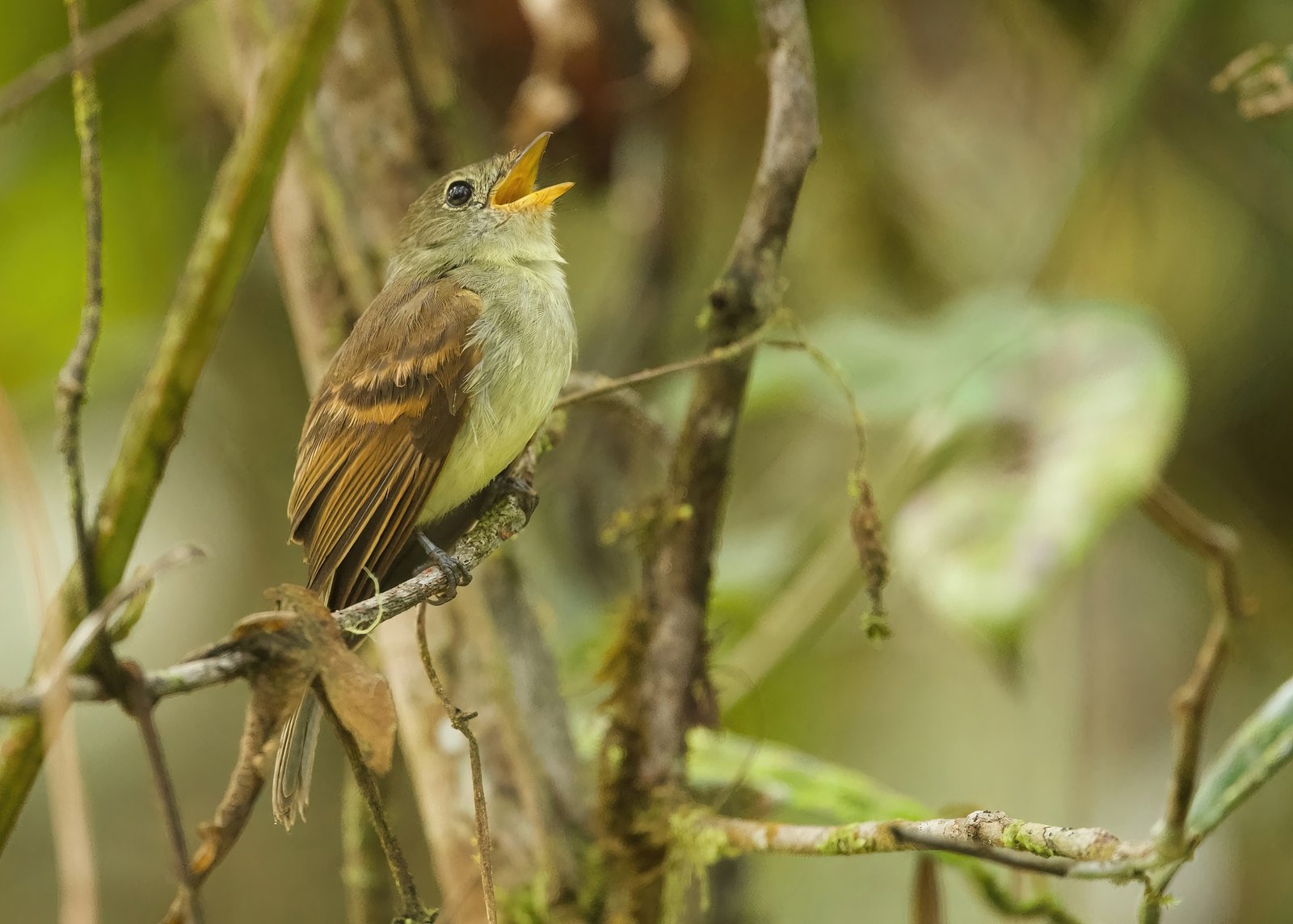
The Roraiman Flycatcher is named after Mount Roraima in the Guiana Highlands, but also occurs locally on the eastern slope of the Andes. In the guide area it is scattered and scarce in foothill and lower montane forest. It can be recognised by its rufous wing bars.
Voice
A short, dry series tsi-tsi-tsrr and high tsip calls.
Recording: Fabrice Schmitt — CC BY-NC-SA 4.0 · xeno-canto
Identification
13 cm, with a short, flat bill with a pale lower mandible. The upperparts are brownish olive, with a narrow, pale eye-ring. The wings have two broad, rufous to cinnamon wing bars and rufous edges to the flight feathers. The underparts are pale yellow, with a brownish-olive washed breast. The male has a concealed orange-red crown patch.
Confusion species
Flavescent Flycatcher Myiophobus flavicans is greener and yellower, with ochre-yellow wing bars and yellow spectacles. Orange-crested Flycatcher Myiophobus phoenicomitra is smaller and greener, with faint ochre wing bars. Cinnamon Flycatcher Pyrrhomyias cinnamomeus has cinnamon underparts and a cinnamon wing band.
Habitat
Humid foothill and lower montane forest, mainly in the understorey and in dense vegetation along forest edges, sometimes in bamboo, roughly between 1000 and 2000 m. It catches insects with short sallies from a branch. Little is known about the nest in the guide area.
Where the bird is most at home, classified by the vegetation units of the Andes and the west coast.


Range and movements
Colombia: very locally on the eastern slope of the Andes in the south. Ecuador: locally on the eastern slope of the Andes. Peru: locally on the eastern slope, south to the south-east. Bolivia: at most a single record. Absent from the Galápagos. Outside the guide area in the Guiana Highlands of Venezuela, Guyana and northern Brazil.
- Resident
- dark = core range, pale = thinly spread
How and when to look
Search dense undergrowth along forest edges on the eastern slope at middle elevations; the birds sit low and often give themselves away by their dry call.
Conservation status
Least Concern. In the Andes the species is scarce and local, and depends on forest on the eastern slope.
Scientific name
Myiophobus roraimae | (Salvin & Godman, 1883)
Salvin & Godman described the species in 1883 as Myiobius roraimae; because it was later moved to another genus, the author and year stand in brackets. The genus Myiophobus was introduced in 1850 by Reichenbach. The genus name comes from Greek muia, 'fly', and phobos, 'terror, fear'. The species name refers to the tepui Mount Roraima, not necessarily the type locality. The specimen the first description was based on came from Roraima, Venezuela.