All species › Passerines › Tyrant flycatchers and allies › Ochre-lored Flatbill
Ochre-lored Flatbill | Tolmomyias flaviventris
Geelbuikbreedbektiran | Picoplano pechiamarillo | Bico-chato-amarelo
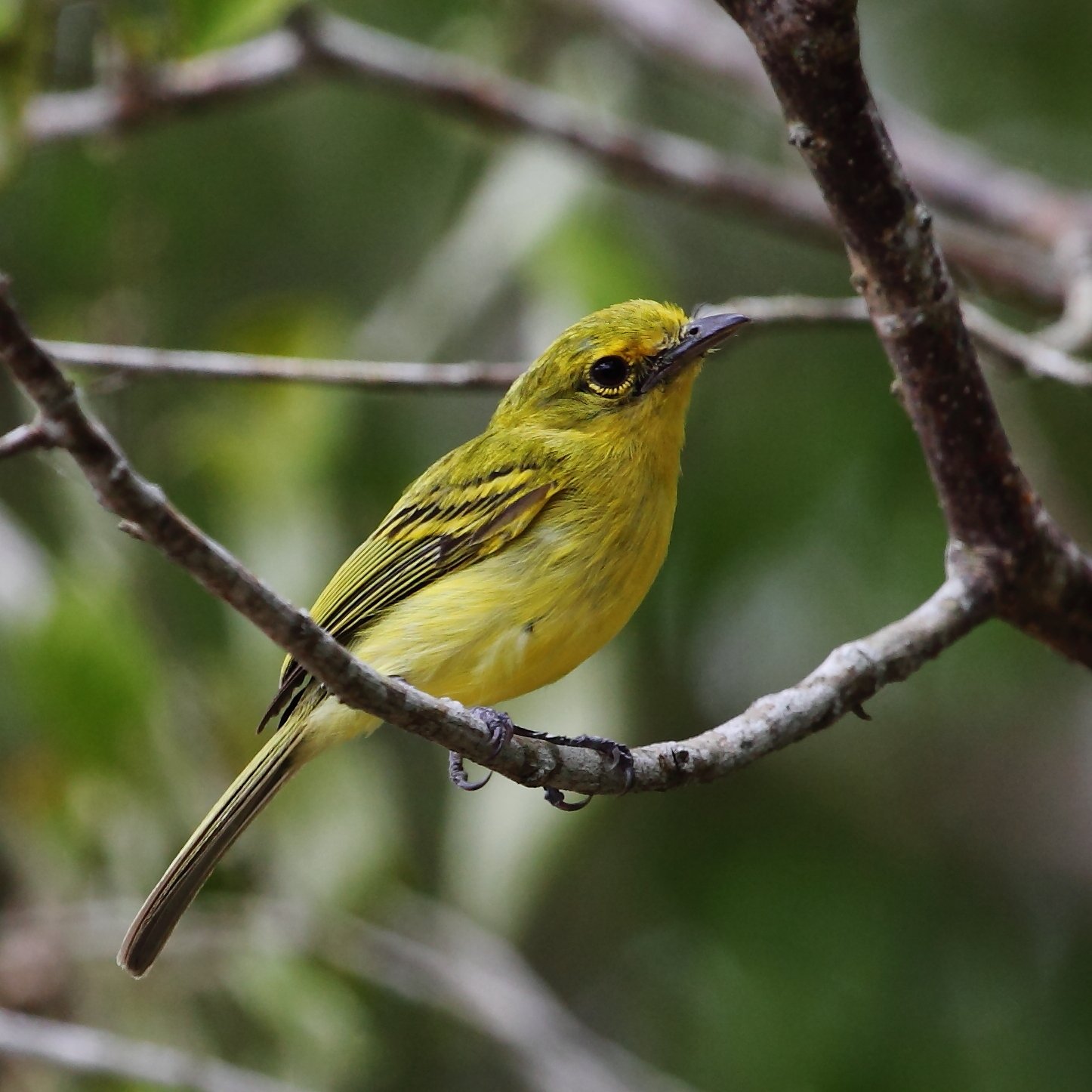
The Ochre-lored Flatbill is a yellow and olive-green flatbill of forest edge, gallery forest and semi-open country in the lowlands. In northern Colombia it has an ochre-yellow face; the forms of western Amazonia are greener on the head. The nest is a hanging pouch, often on a branch over water or a clearing.
Voice
A loud, shrill, rising shreeep, often repeated in a short series, and high, sharp calls.
Recording: JAYRSON ARAUJO DE OLIVEIRA — CC BY-NC-SA 4.0 · xeno-canto
Identification
12–13 cm, with a broad, flat bill with a pale lower mandible. The upperparts are olive-green, without a grey crown. In the northern forms the lores, eye-ring and cheeks are ochre-yellow; in the forms of western Amazonia the face is olive-green with little ochre. The iris is dark. The wings are dark, with two distinct yellow wing bars and yellow edges to the flight feathers. The underparts are bright yellow, the breast tinged olive-yellow. The sexes are alike.
Confusion species
Orange-eyed Flatbill Tolmomyias traylori has an ochre face and an orangey iris and lives mainly in riverine forest in north-eastern Peru and eastern Ecuador. Yellow-olive Flatbill Tolmomyias sulphurescens has a grey crown, a pale iris and a greyish throat. Grey-crowned Flatbill Tolmomyias poliocephalus has a grey crown and is smaller.
Habitat
Forest edge, gallery forest, várzea, riverine forest, secondary forest and semi-open country with trees in the lowlands, mostly below 800 m. It takes insects from leaves with short sallies in the middle and upper storeys, alone or with mixed flocks. The nest is a hanging pouch with an entrance tube at the bottom.
Where the bird is most at home, classified by the vegetation units of the Andes and the west coast.


Range and movements
Colombia: in the Caribbean lowlands, the Llanos and the Amazonian lowlands. Ecuador: in the eastern lowlands. Peru: in the Amazonian lowlands. Bolivia: in the northern and eastern lowlands. Absent from the Galápagos. Outside the guide area in Venezuela, the Guianas and much of Brazil.
- Resident
- dark = core range, pale = thinly spread
How and when to look
Walk along forest edges and riverbanks in the lowlands and listen for the shrill, rising call; the bird often perches at the outer edge of the foliage.
Conservation status
Least Concern. The species is widespread and tolerates forest edge and secondary forest. The green-headed forms of western Amazonia are sometimes treated as a separate species.
Scientific name
Tolmomyias flaviventris | (Wied-Neuwied, 1831)
Wied-Neuwied described the species in 1831 as Muscipeta flaviventris; because it was later moved to another genus, the author and year stand in brackets. The genus Tolmomyias was introduced in 1927 by Hellmayr. The genus name combines Greek tolma, 'courage, boldness', with New Latin myias, 'flycatcher'. The species name comes from Latin flavus, 'yellow', and venter, 'belly', after the yellow belly. The specimen the first description was based on came from Mucuri and Alcobaça, Bahia, Brazil.