All species › Passerines › Tyrant flycatchers and allies › Rusty-margined Flycatcher
Rusty-margined Flycatcher | Myiozetetes cayanensis
Roestvleugeltiran | Bienteveo alicastaño | Bentevizinho-de-asa-ferrugínea
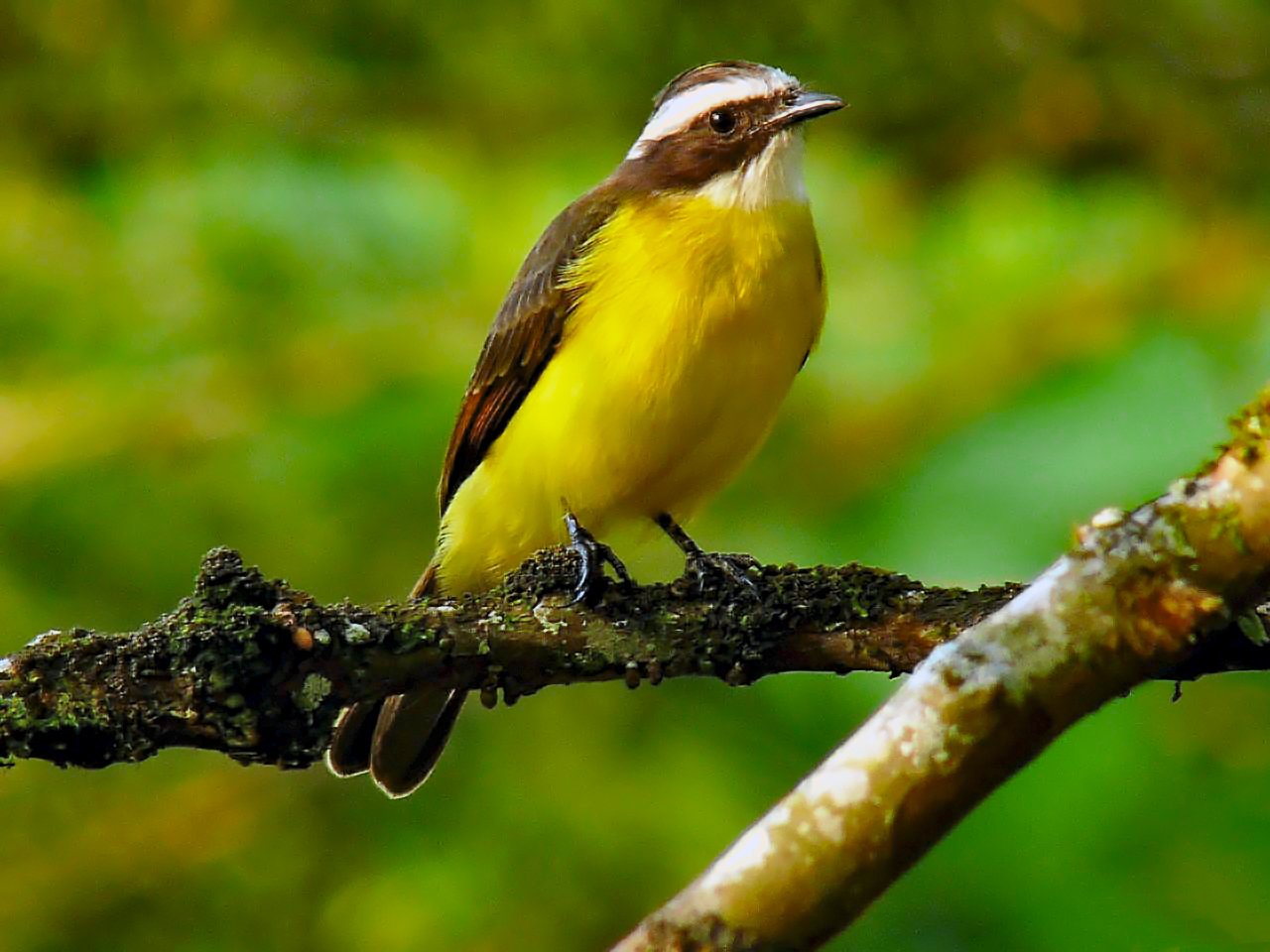
The Rusty-margined Flycatcher is one of the short-billed kiskadee-like flycatchers with a black-and-white striped head. It closely resembles Social Flycatcher, but has rufous edges to the flight feathers and is more tied to water. It lives in pairs or family groups along shores and in semi-open country.
Voice
A long, plaintive, falling whistle wheeeeeu, and loud chattering kree-kree-kree from pairs and groups.
Recording: JAYRSON ARAUJO DE OLIVEIRA — CC BY-NC-SA 4.0 · xeno-canto
Identification
16–17 cm, with a short, black bill. The crown is blackish with a concealed yellow-orange crown patch, bordered by a broad white supercilium; a dark mask runs through the eye. The upperparts are brownish olive, darker than in Social Flycatcher; the flight feathers have rufous edges. The throat is white, the underparts bright yellow. The sexes are alike; juveniles lack the crown patch and have broader rufous edges.
Confusion species
Social Flycatcher Myiozetetes similis has a paler, greener back, pale rather than rufous edges to the wing feathers and an orange-red crown patch; its voice differs. Grey-capped Flycatcher Myiozetetes granadensis has a grey crown and only a short white stripe above the eye. Lesser Kiskadee Philohydor lictor has a long, thin bill. Three-striped Flycatcher Conopias trivirgatus lacks the rufous edges and lives higher in forest.
Habitat
Shores of rivers, lakes and marshes, forest edge, semi-open country with trees and pasture near water, in the lowlands, in Colombia locally to about 1500 m. It catches insects in short sallies and also eats many berries and small fruits. The nest is an untidy domed ball of grass with a side entrance, often over water.
Where the bird is most at home, classified by the vegetation units of the Andes and the west coast.


Range and movements
Colombia: widespread in the lowlands of the Caribbean region, the Magdalena Valley, the Pacific lowlands and the east. Ecuador: in the western lowlands and locally in the eastern lowlands. Peru: locally in the lowlands east of the Andes, scarcer than Social Flycatcher. Bolivia: in the lowlands of the north and east. Absent from the Galápagos. Outside the guide area in Panama, Venezuela, the Guianas and much of Brazil.
- Resident
- dark = core range, pale = thinly spread
How and when to look
Along lake shores, listen for the long, plaintive whistle and compare the wings and crown patch of the short-billed flycatchers sitting together in the same tree.
Conservation status
Least Concern. The species is widespread and tolerates open and disturbed country.
Scientific name
Myiozetetes cayanensis | (Linnaeus, 1766)
Linnaeus described the species in 1766 as [Muscicapa] cayanensis; because it was later moved to another genus, the author and year stand in brackets. The genus Myiozetetes was introduced in 1859 by Sclater. The genus name combines Greek muias, 'fly', and zētētēs, 'searcher'. Refers to Cayenne in French Guiana. The specimen the first description was based on came from Cayenne, French Guiana.