All species › Passerines › Tyrant flycatchers and allies › Ochre-naped Ground Tyrant
Ochre-naped Ground Tyrant | Muscisaxicola flavinucha
Geelnekgrondtiran | Dormilona fraile | Dormilona-de-nuca-ocre
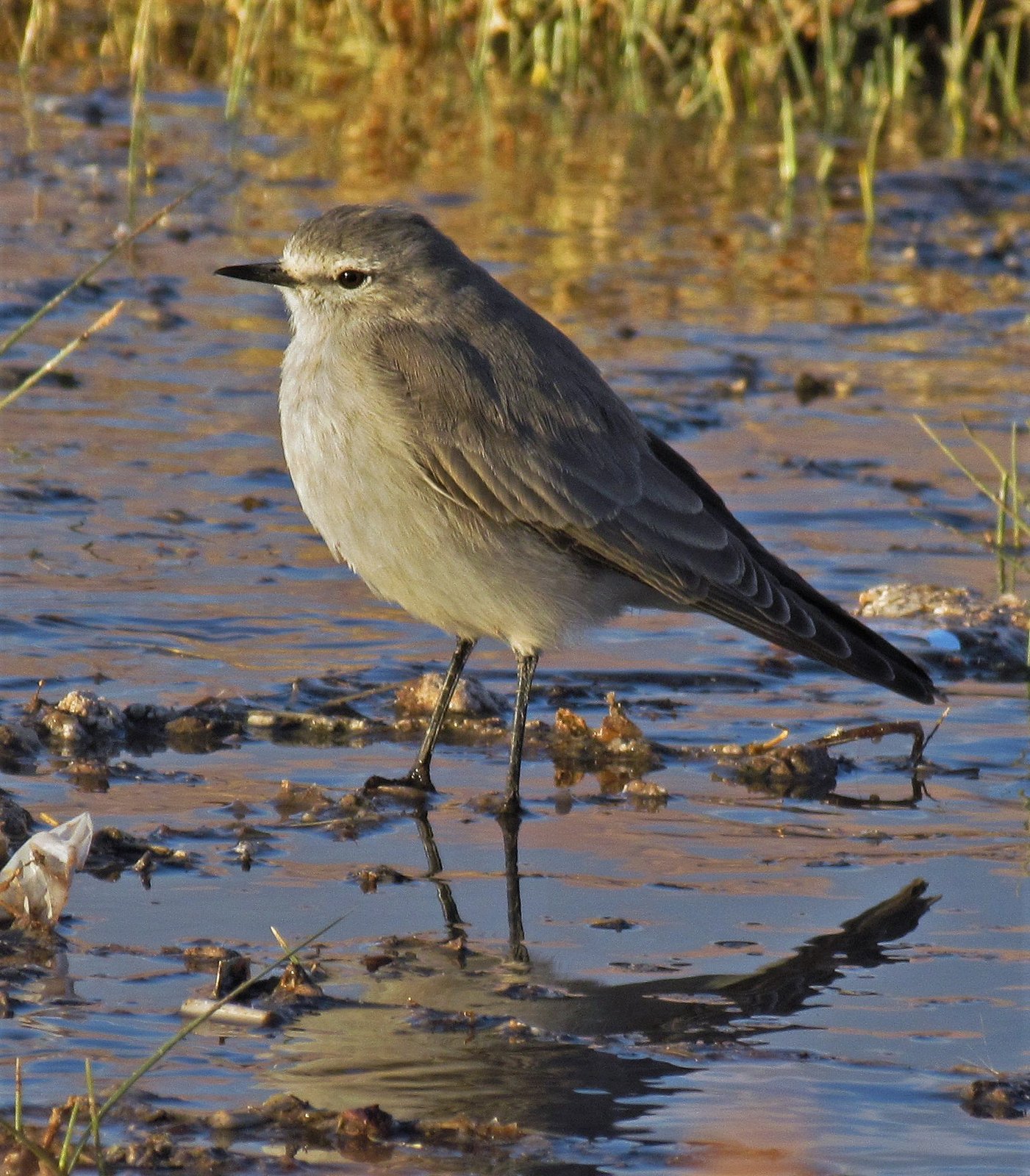
Ochre-naped Ground Tyrant is a large ground tyrant with a white forehead and an ochre-yellow patch on the nape. It breeds in the high Andes of the south and moves north in the austral winter to the puna of Peru and Bolivia. There it often mixes with other ground tyrants.
Voice
Usually silent. Gives a soft tsit; in the breeding season a short series of high notes.
Recording: Bernabe Lopez-Lanus — CC BY-NC-SA 3.0 · xeno-canto
Identification
19–20 cm, with long legs and an upright posture. The forehead and lores are white, and there is a narrow white eye-ring. The crown and back are greyish brown; on the nape is an ochre-yellow to yellowish-brown patch, clearest in fresh plumage. The underparts are greyish white. The wings are brown with pale edges; the tail is black with white outer edges. The sexes are alike; juveniles have a fainter nape patch.
Confusion species
White-fronted Ground Tyrant Muscisaxicola albifrons is larger, with pale wing panels and no yellow nape patch. Rufous-naped Ground Tyrant Muscisaxicola rufivertex is smaller, with a rufous nape patch and no white forehead. Black-fronted Ground Tyrant Muscisaxicola frontalis has a black forehead and a black crown stripe. Puna Ground Tyrant Muscisaxicola juninensis is smaller, with a cinnamon-brown crown patch.
Habitat
Open puna with short grass and stones, bofedales and rocky slopes, mostly between 3500 and 5000 m. It runs over the ground and catches insects. The nest is in a cavity among stones or in a rock face.
Where the bird is most at home, classified by the vegetation units of the Andes and the west coast.


Range and movements
Bolivia: breeds in the highlands of the south-west; in the austral winter widespread in the Andes of the west. Peru: winter visitor in the Andes of the south and centre, north to about Junín. Absent from Colombia, Ecuador and the Galápagos. Outside the guide area the species breeds in Chile and Argentina, south to Tierra del Fuego.
- Resident
- Summer visitor (c. Apr–Sep)
- Winter visitor (c. Oct–Mar)
- Passage (Mar–Apr, Oct–Nov)
- dark = core range, pale = thinly spread
How and when to look
Search from May to September on short-grazed puna and along bofedales above 4000 m, for example at Abra Málaga in Cusco or around Lake Titicaca.
Conservation status
Least Concern. The species has a large range in the high Andes.
Scientific name
Muscisaxicola flavinucha | de Lafresnaye, 1855
De Lafresnaye described the species in 1855 and placed it straight away in the genus where it still stands. The genus Muscisaxicola was introduced in 1837 by D'Orbigny, ACVMD & de Lafresnaye. The genus name is a blend of the genera Muscicapa (flycatchers) and Saxicola (stonechats and whinchats). The species name comes from Latin flavus, 'yellow', and nucha, 'nape'. The specimen the first description was based on came from Chile.