All species › Passerines › Tyrant flycatchers and allies › White-fronted Ground Tyrant
White-fronted Ground Tyrant | Muscisaxicola albifrons
Klifgrondtiran | Dormilona gigante | Dormilona-de-testa-branca
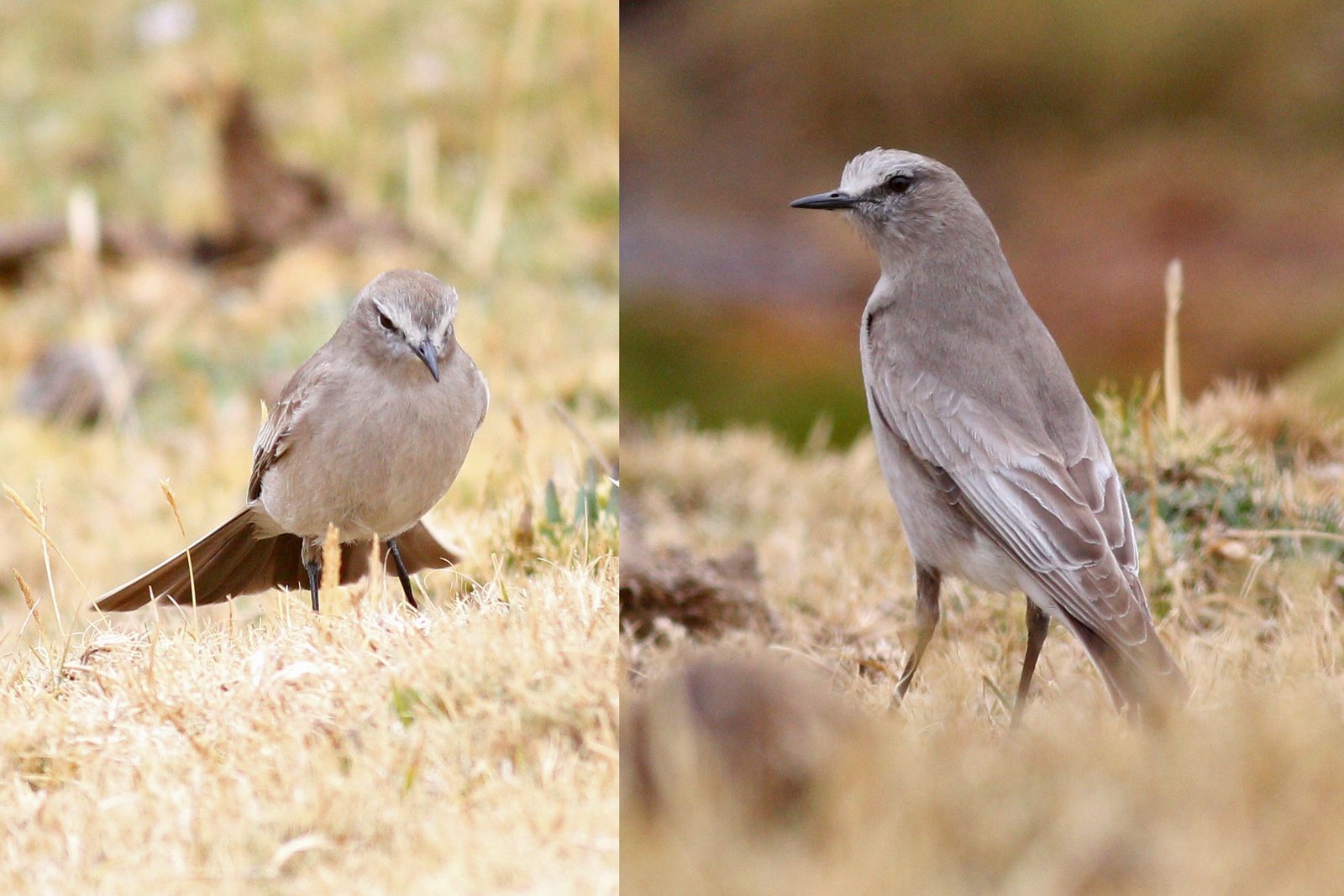
White-fronted Ground Tyrant is the largest ground tyrant and lives higher than most other Andean birds, up to just below the snowline. It is tall and slender, with a white forehead and pale wing panels. It is found mainly at bogs and bofedales in the high puna.
Voice
Usually silent. Gives a soft tsik; the song is a short series of high notes, sometimes in flight.
Recording: GABRIEL LEITE — CC BY-NC-SA 4.0 · xeno-canto
Identification
21–23 cm, large and long-legged, with a fairly long bill. The forehead and lores are white; the crown and nape are brownish, the back greyish brown. The inner secondaries and tertials have broad white edges, forming a pale panel on the closed wing. The underparts are greyish white. The tail is black with white outer edges. The sexes are alike.
Confusion species
Ochre-naped Ground Tyrant Muscisaxicola flavinucha also has a white forehead, but is smaller, with an ochre-yellow nape patch and without the pale wing panel. Taczanowski's Ground Tyrant Muscisaxicola griseus is smaller, with a greyish-brown forehead. Grey-bellied Shrike-Tyrant Agriornis micropterus is larger and heavier, with a thick, hooked bill and a streaked throat.
Habitat
Bofedales, wet flats, the banks of mountain streams and stony slopes in the high puna, mostly between 4200 and 5500 m, sometimes higher. It walks with long strides over boggy ground and rocks and catches insects. The nest is in a cavity in a rock face or among stones.
Where the bird is most at home, classified by the vegetation units of the Andes and the west coast.


Range and movements
Peru: in the highlands from Áncash (Cordillera Blanca) and Junín south to Puno and Tacna. Bolivia: in the high Andes in the west. Absent from Colombia, Ecuador and the Galápagos. Outside the guide area in the far north of Chile and in north-western Argentina.
- Resident
- dark = core range, pale = thinly spread
How and when to look
Search along bofedales and high streams above 4500 m, for example at the Ticlio pass or in the Cordillera Blanca.
Conservation status
Least Concern. Its habitat lies largely beyond the reach of intensive land use; mining and the drying out of bogs may have local effects.
Scientific name
Muscisaxicola albifrons | (Tschudi, 1844)
Tschudi described the species in 1844 as Pt[yonura] albifrons; because it was later moved to another genus, the author and year stand in brackets. The genus Muscisaxicola was introduced in 1837 by D'Orbigny, ACVMD & de Lafresnaye. The genus name is a blend of the genera Muscicapa (flycatchers) and Saxicola (stonechats and whinchats). The species name comes from Latin albus, 'white', and frons, 'forehead'. The specimen the first description was based on came from Junín, Peru.