All species › Passerines › Tyrant flycatchers and allies › Cinereous Ground Tyrant
Cinereous Ground Tyrant | Muscisaxicola cinereus
Grijze grondtiran | Dormilona cenicienta | Dormilona-cinzenta
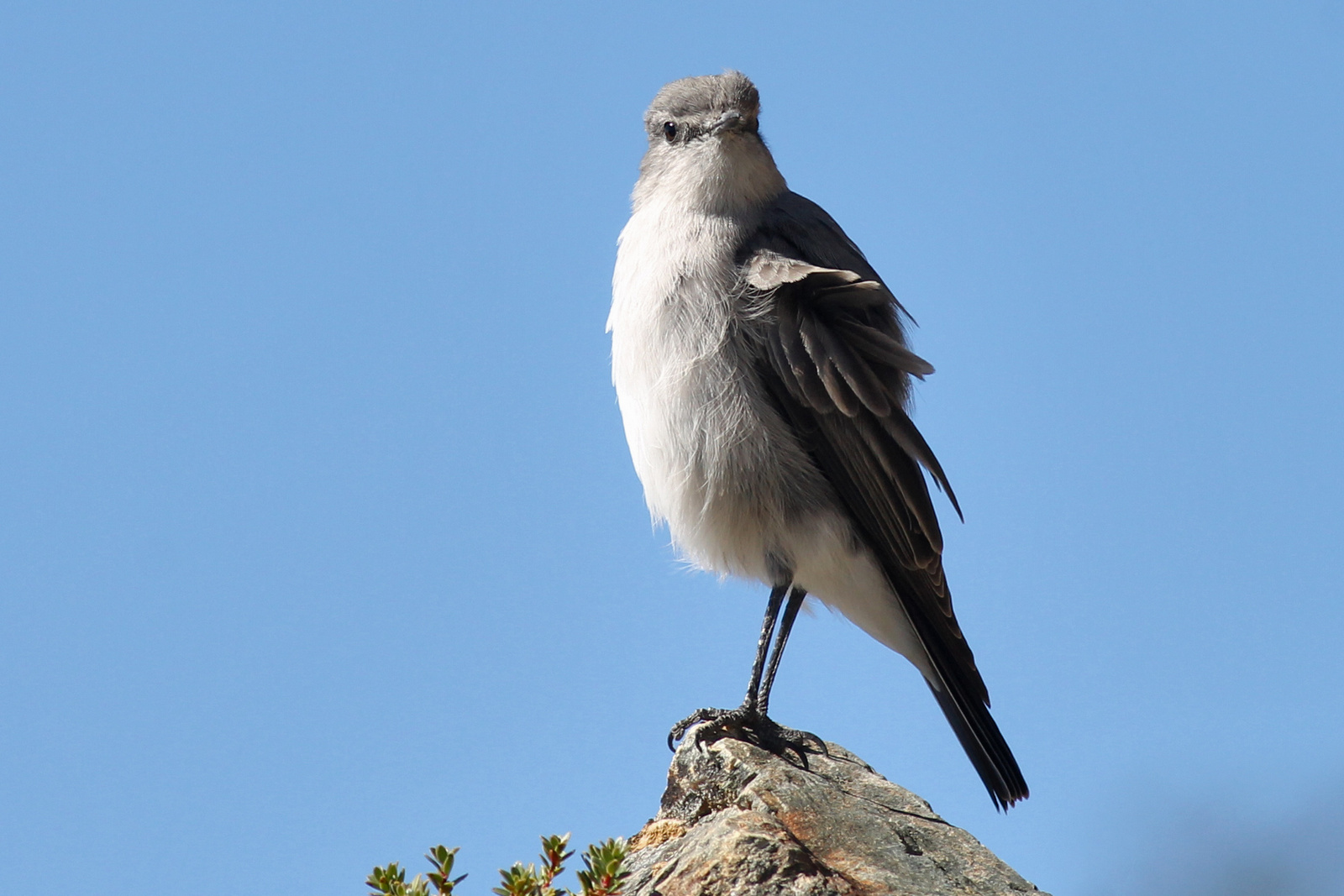
Cinereous Ground Tyrant is the palest and most uniformly grey ground tyrant of the high Andes. Birds from the south of the range move north in the austral winter and then add to the numbers in Peru and Bolivia. It lacks any coloured patch on the head or nape.
Voice
Usually silent. Gives a soft, short tsit.
No recording with a suitable Creative Commons licence is available for this species yet.
Identification
16–17 cm, upright, with long black legs and a small, thin bill. The upperparts are pale ash grey, with at most a brownish tinge on the crown. A narrow white stripe runs from the bill to the eye. The underparts are greyish white. The wings are greyish brown with pale edges; the tail is black with white outer edges. The sexes are alike.
Confusion species
Taczanowski's Ground Tyrant Muscisaxicola griseus is larger and browner grey, with a more obvious white stripe above the eye. Puna Ground Tyrant Muscisaxicola juninensis has a cinnamon-brown patch on the hindcrown. Rufous-naped Ground Tyrant Muscisaxicola rufivertex has a rufous nape patch. Black-fronted Ground Tyrant Muscisaxicola frontalis has a black forehead and a black crown stripe.
Habitat
Stony, sparsely vegetated slopes, scree and flats with cushion plants in the high Andes, in the breeding season mostly between 3500 and 5000 m; in the austral winter also lower, locally down to about 2500 m. It runs over the ground and catches insects. The nest is in a cavity among stones.
Where the bird is most at home, classified by the vegetation units of the Andes and the west coast.


Range and movements
Peru: in the Andes of the south and centre of the country, most numerous from Ayacucho and Cusco to Arequipa, Puno and Tacna; farther north in the austral winter. Bolivia: in the Andes in the west. Absent from Colombia, Ecuador and the Galápagos. Outside the guide area in Chile and western Argentina.
- Resident
- dark = core range, pale = thinly spread
How and when to look
Search bare, stony slopes and gravel flats above 4000 m in southern Peru and western Bolivia; in the austral winter also in lower puna.
Conservation status
Least Concern. Its high-Andean habitat is under little pressure.
Scientific name
Muscisaxicola cinereus | Philippi & Landbeck, 1864
Philippi & Landbeck described the species in 1864 and placed it straight away in the genus where it still stands. The genus Muscisaxicola was introduced in 1837 by D'Orbigny, ACVMD & de Lafresnaye. The genus name is a blend of the genera Muscicapa (flycatchers) and Saxicola (stonechats and whinchats). The species name comes from Latin cinereus, 'ash-grey'. The specimen the first description was based on came from Cordillera near Santiago, Chile.