All species › Passerines › Tyrant flycatchers and allies › Puna Ground Tyrant
Puna Ground Tyrant | Muscisaxicola juninensis
Punagrondtiran | Dormilona puneña | Dormilona-da-puna
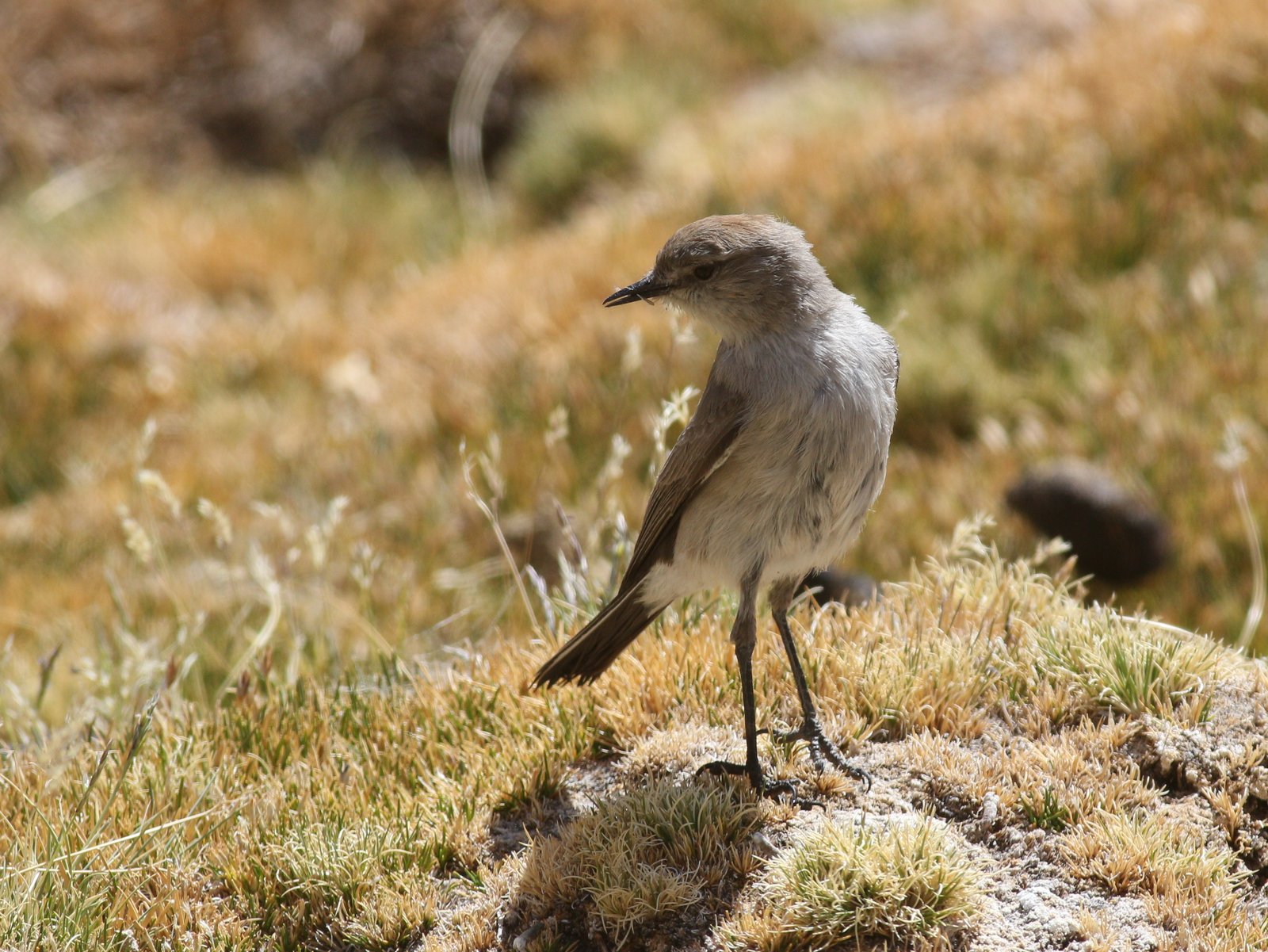
Puna Ground Tyrant is a small ground tyrant of dry and humid puna in Peru, Bolivia and neighbouring countries. It is identified by a diffuse cinnamon-brown patch on the hindcrown. The scientific name refers to Junín in central Peru.
Voice
Usually silent. Gives a soft, high tseet; in the breeding season sometimes a short series of thin notes in a display flight.
Recording: Dan Lane — CC BY-NC-SA 3.0 · xeno-canto
Identification
16–17 cm, upright, with long black legs and a thin black bill. The upperparts are greyish brown, slightly warmer brown than in most relatives. On the hindcrown there is a diffuse cinnamon-brown patch that blends gradually into the colour of the back. A short white stripe runs from the bill to above the eye. The underparts are pale grey with a faint brownish wash on the breast. The tail is black with white outer edges. The sexes are alike.
Confusion species
Rufous-naped Ground Tyrant Muscisaxicola rufivertex is greyer on the back and has a sharply defined, bright rufous patch on the crown and nape. Taczanowski's Ground Tyrant Muscisaxicola griseus is larger and lacks a brown crown patch. White-browed Ground Tyrant Muscisaxicola albilora has a long white supercilium extending well behind the eye. Ochre-naped Ground Tyrant Muscisaxicola flavinucha is larger, with a white forehead and an ochre-yellow nape patch.
Habitat
Open puna with short grass, bare ground, stones and cushion plants, often near bogs and bofedales, mostly between 4000 and 5000 m. It runs over the ground and catches insects, often together with other ground tyrants and miners. The nest is in a cavity among stones or in a bank.
Where the bird is most at home, classified by the vegetation units of the Andes and the west coast.


Range and movements
Peru: in the highlands of central Peru (Áncash and Junín) south to Puno, Arequipa and Tacna. Bolivia: in the west, from La Paz to Oruro and Potosí. Absent from Colombia, Ecuador and the Galápagos. Outside the guide area in northern Chile and north-western Argentina.
- Resident
- dark = core range, pale = thinly spread
How and when to look
Search along bofedales and on bare, stony flats above 4000 m, for example around the Ticlio pass or on the altiplano near Lake Titicaca.
Conservation status
Least Concern. Its habitat in the high puna is largely intact.
Scientific name
Muscisaxicola juninensis | Taczanowski, 1884
Taczanowski described the species in 1884 and placed it straight away in the genus where it still stands. The genus Muscisaxicola was introduced in 1837 by D'Orbigny, ACVMD & de Lafresnaye. The genus name is a blend of the genera Muscicapa (flycatchers) and Saxicola (stonechats and whinchats). The species name refers to Junín in Peru. The specimen the first description was based on came from Junín, Peru.