All species › Passerines › Tanagers and allies › Oleaginous Hemispingus
Oleaginous Hemispingus | Sphenopsis frontalis
Olijfrugsfenops | Hemispingo oleaginoso | Sanhaço-oleaginoso
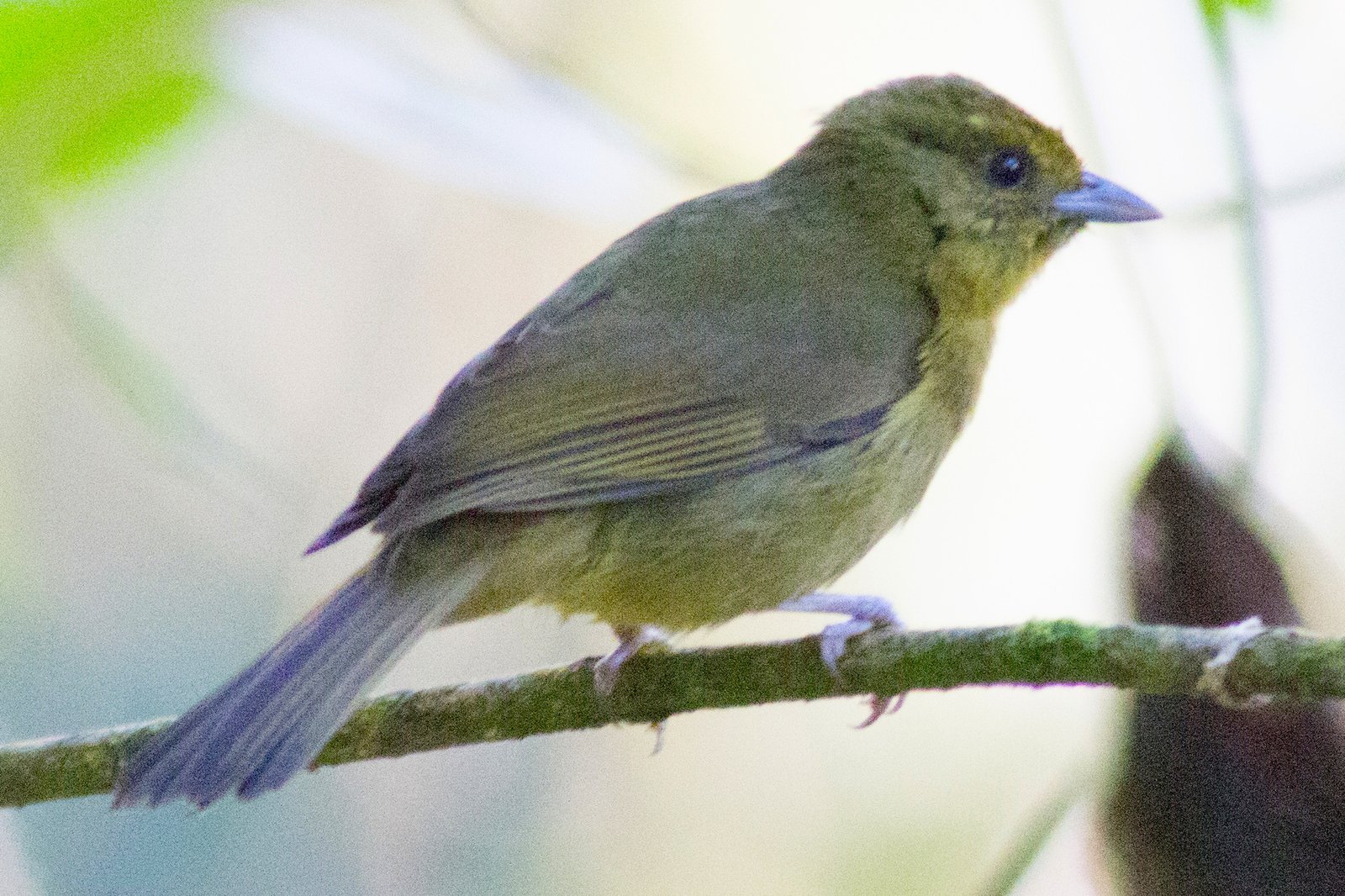
The Oleaginous Hemispingus is a small, uniformly olive tanager of montane forest in the Andes, from Colombia to Peru. Its plumage shows little pattern; the narrow, faint ochre supercilium is its most visible feature. Pairs forage low in the forest, often in mixed flocks.
Voice
The song is a fast, rattling twitter, often given as a duet by a pair. The call is a thin tsit.
Recording: Carlos Delgado JUMABITA — CC BY-NC-SA 4.0 · xeno-canto
Identification
14 cm, with a thin, pointed, dark bill. Upperparts, wings and tail uniform olive-green. A narrow, faint, ochre-yellow supercilium, most obvious above and in front of the eye; sides of the head darker olive. Underparts dull ochraceous olive to olive-yellow, the throat slightly paler. Sexes alike. Young birds are even duller, without a clear supercilium.
Confusion species
Black-eared Hemispingus Sphenopsis melanotis has a grey crown, a black ear patch and a cinnamon throat and breast. Citrine Warbler Myiothlypis luteoviridis has a bright yellow supercilium and yellower underparts, and moves like a warbler with a slimmer bill. Dusky Chlorospingus Chlorospingus semifuscus of the western slope has a grey head and a grey breast. Superciliaried Hemispingus Thlypopsis superciliaris has a clear supercilium and bright yellow underparts.
Habitat
Humid montane forest and cloud forest, especially the understory and forest edges, also with bamboo, roughly between 1500 and 2800 m. It forages in pairs in the lower and middle levels for insects, usually in mixed flocks. Little is known about the nest.
Where the bird is most at home, classified by the vegetation units of the Andes and the west coast.


Range and movements
In Colombia in the Andes. In Ecuador mainly on the eastern slope of the Andes. In Peru on the eastern slope, from the north to Cusco. Absent from Bolivia and the Galápagos. Outside the guide area in Venezuela.
- Resident
- dark = core range, pale = thinly spread
How and when to look
In mixed flocks in the understory of cloud forest, look for an inconspicuous olive bird moving low through the foliage; the rattling duet often draws attention to it first.
Conservation status
Least Concern. The species is fairly common in most of its range. Clearing of montane forest locally reduces its habitat.
Scientific name
Sphenopsis frontalis | (Tschudi, 1844)
Tschudi described the species in 1844 as H[ylophilus] frontalis; because it was later moved to another genus, the author and year stand in brackets. The genus Sphenopsis was introduced in 1862 by Sclater. The genus name combines Greek sphēn, 'wedge', and opsis, 'appearance'. The species name comes from Latin frons, 'voorhoofd', for the forehead. The specimen the first description was based on came from east slope of the Andes, Peru.