All species › Passerines › Shrike-babblers, Erpornis and vireos › Olivaceous Greenlet
Olivaceous Greenlet | Hylophilus olivaceus
Olijfvireo | Verdillo oliváceo | Verdinho-oliváceo
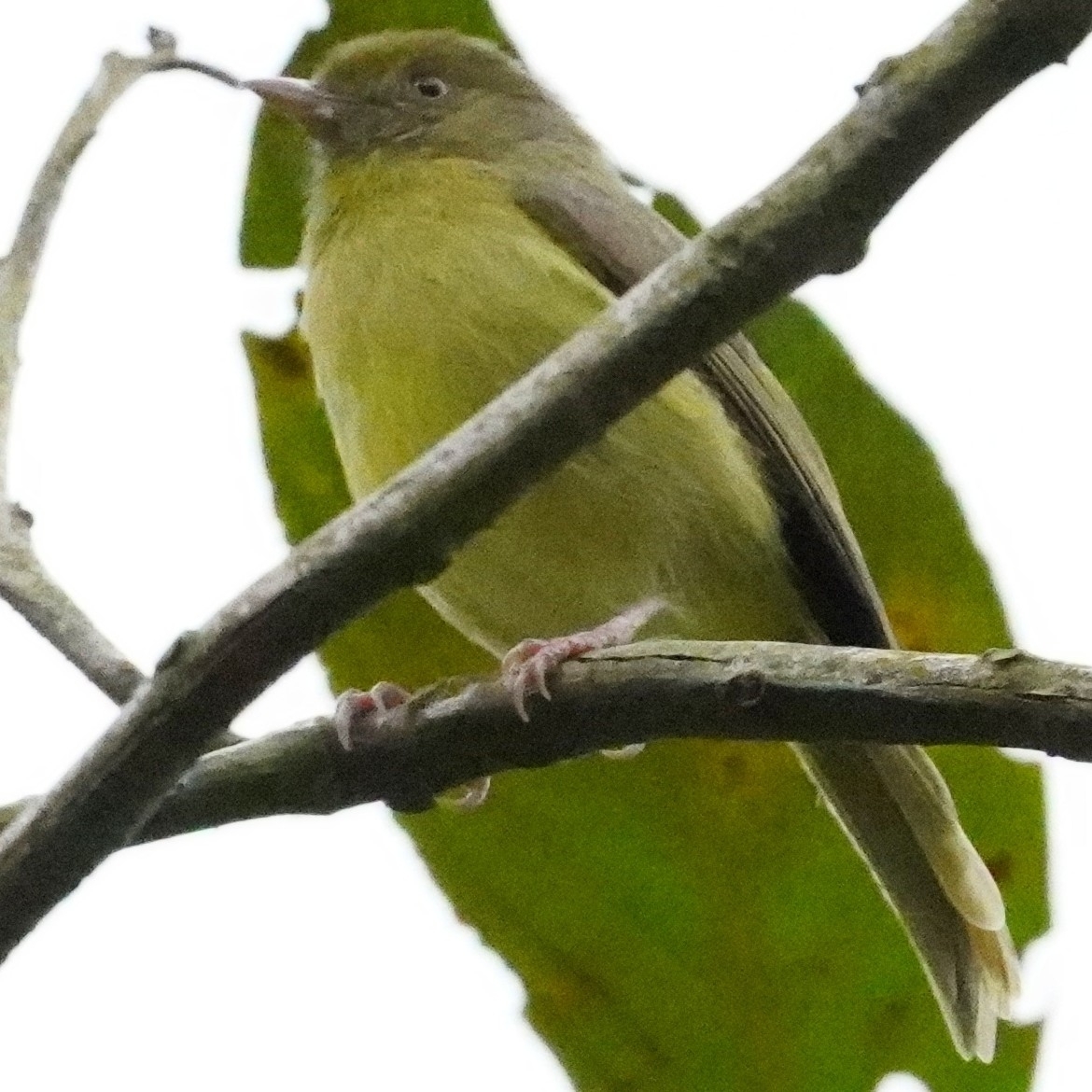
The Olivaceous Greenlet is a plain olive-green greenlet of the lower montane forests on the eastern slope of the Andes in Ecuador and Peru. It has a pale eye and a pale bill and otherwise lacks distinct markings. The species occurs only in the guide area.
Voice
A fast, repeated series of clear, even notes, recalling the songs of other Hylophilus species. Calls with short, somewhat nasal notes.
Recording: Juan Freile — CC BY-NC-SA 4.0 · xeno-canto
Identification
12 cm, with a fairly long, pointed, pale bill. The upperparts are plain olive-green; the underparts are olive-yellow, slightly paler on the throat and belly. The eye is pale grey to whitish, the legs pale pink. No wing bars and no obvious head markings. The sexes are alike.
Confusion species
Lemon-chested Greenlet Hylophilus thoracicus has a grey nape, a white belly and a bright yellow breast, and lives lower. Dusky-capped Greenlet Pachysylvia hypoxantha has a dark eye, a brownish cap and a shorter bill and lives in the lowlands. Ochre-crowned Greenlet Tunchiornis ochraceiceps has an ochre-brown crown and lives in the forest interior. Red-eyed Vireo Vireo olivaceus is larger, with a grey crown and a white supercilium.
Habitat
Forest edges, secondary forest, scrubby clearings and roadsides in lower montane and foothill forest, roughly between 900 and 2000 m. It searches low and mid-level shrubs and trees for insects in pairs or with mixed flocks. Little is known about the nest.
Where the bird is most at home, classified by the vegetation units of the Andes and the west coast.


Range and movements
Ecuador: on the eastern slope of the Andes along the whole length of the country. Peru: on the eastern slope of the Andes, south to Junín. Colombia: absent, or at most in the far south on the border with Ecuador. Absent from Bolivia and the Galápagos. Does not occur outside the guide area.
- Resident
- dark = core range, pale = thinly spread
How and when to look
Search along roads with scrub and young forest on the eastern slope, for example around Wildsumaco in Ecuador or along the road to Satipo in Peru. In mixed flocks, look for a plain green greenlet with a pale eye.
Conservation status
Least Concern. The species tolerates forest edges and secondary growth, but its range is limited to a narrow strip along the Andes.
Scientific name
Hylophilus olivaceus | Tschudi, 1844
Tschudi described the species in 1844 and placed it straight away in the genus where it still stands. The genus Hylophilus was introduced in 1822 by Temminck. The genus name comes from Greek hulē, 'woodland, forest', and philos, 'loving': 'forest-lover'. The species name comes from New Latin olivaceus, 'olive-green', from Latin oliva, 'olive'. The specimen the first description was based on came from Junín, Peru.