All species › Passerines › Shrike-babblers, Erpornis and vireos › Rufous-crowned Greenlet
Rufous-crowned Greenlet | Hylophilus poicilotis
Roestkruinvireo | Verdillo coronado | Verdinho-coroado
The Rufous-crowned Greenlet is a small greenlet with a chestnut crown from south-eastern Brazil, Paraguay and north-eastern Argentina. There are a few reports from Bolivia, but these are unconfirmed. The species was long lumped with Grey-eyed Greenlet; Bolivian birds of this group may belong to Hylophilus moxensis, described in 2026.
Voice
A fast, high series of notes, with much variation between regions. Groups keep contact with short calls like chek or chi-chek.
Recording: Augusto Matheus dos Santos — CC BY-NC-SA 4.0 · xeno-canto
Identification
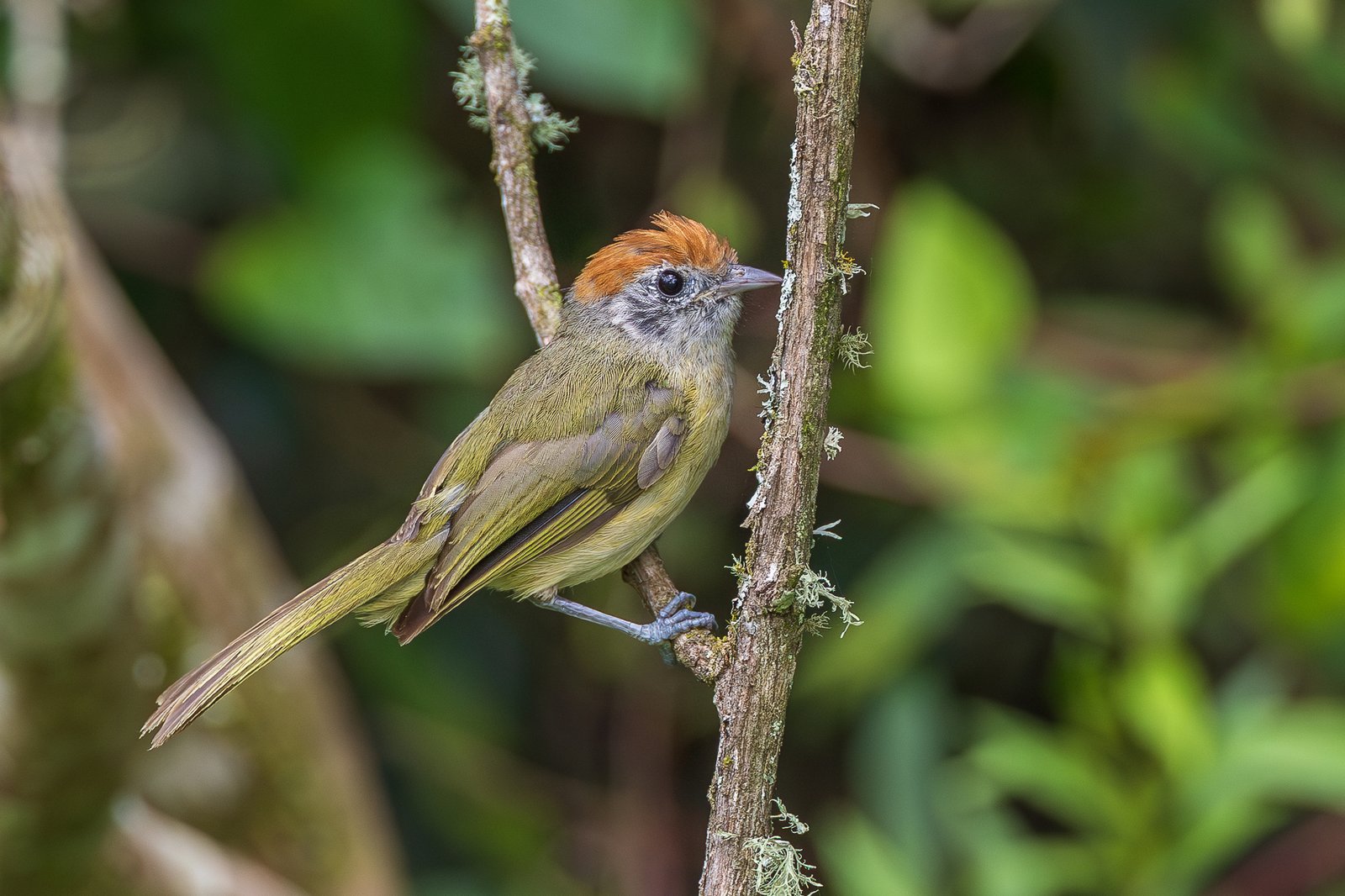
12–13 cm, with a pointed bill. The forehead and crown are chestnut, the ear-coverts mottled grey-black. The nape, upper back and shoulders are olive-green, the lower back and rump brighter green. The wings are grey-black with green edges, the tail greyish green. The underparts grade from pale grey on the throat to yellowish on the breast and brighter yellow on the flanks and belly. The eye is dark reddish brown, the lower mandible grey to pink. The sexes are alike; young birds are more olive on the back and yellower below.
Confusion species
Grey-eyed Greenlet Hylophilus amaurocephalus has a grey eye, grey-brown upperparts and brownish-grey underparts. Hylophilus moxensis of the Beni has plain pale grey ear-coverts without a black patch. Ashy-headed Greenlet Hylophilus pectoralis has a grey head without rufous and a yellow breast band.
Habitat
Humid forest, forest edges, open woodland, scrub and old secondary forest, from sea level to about 1800 m. It forages in the middle and upper levels, often with mixed flocks, gleaning insects from leaves. The nest is a hanging cup in a fork.
Where the bird is most at home, classified by the vegetation units of the Andes and the west coast.


Range and movements
Bolivia: only unconfirmed reports; the species has not been recorded there with certainty. Absent from Colombia, Ecuador, Peru and the Galápagos. Outside the guide area in south-eastern Brazil, eastern Paraguay and Misiones in Argentina.
- Resident
- dark = core range, pale = thinly spread
How and when to look
The species has not been recorded with certainty in the guide area. Document any chestnut-crowned greenlet in eastern Bolivia with photographs and sound recordings, and note the eye colour and ear-coverts.
Conservation status
Least Concern. The species has a large range and also occurs in secondary forest.
Scientific name
Hylophilus poicilotis | Temminck, 1822
Temminck described the species in 1822 and placed it straight away in the genus where it still stands. He introduced the genus Hylophilus in that same work. The genus name comes from Greek hulē, 'woodland, forest', and philos, 'loving': 'forest-lover'. The species name comes from Greek poikilos, 'variegated, spotted', and ous, ōtos, 'ear': for the mottled ear-coverts. The specimen the first description was based on came from Ipanema, São Paulo, Brazil.