All species › Passerines › Cotingas › Olivaceous Piha
Olivaceous Piha | Snowornis cryptolophus
Geelbuikpiha | Guardabosques oliváceo | Cricrió-oliváceo
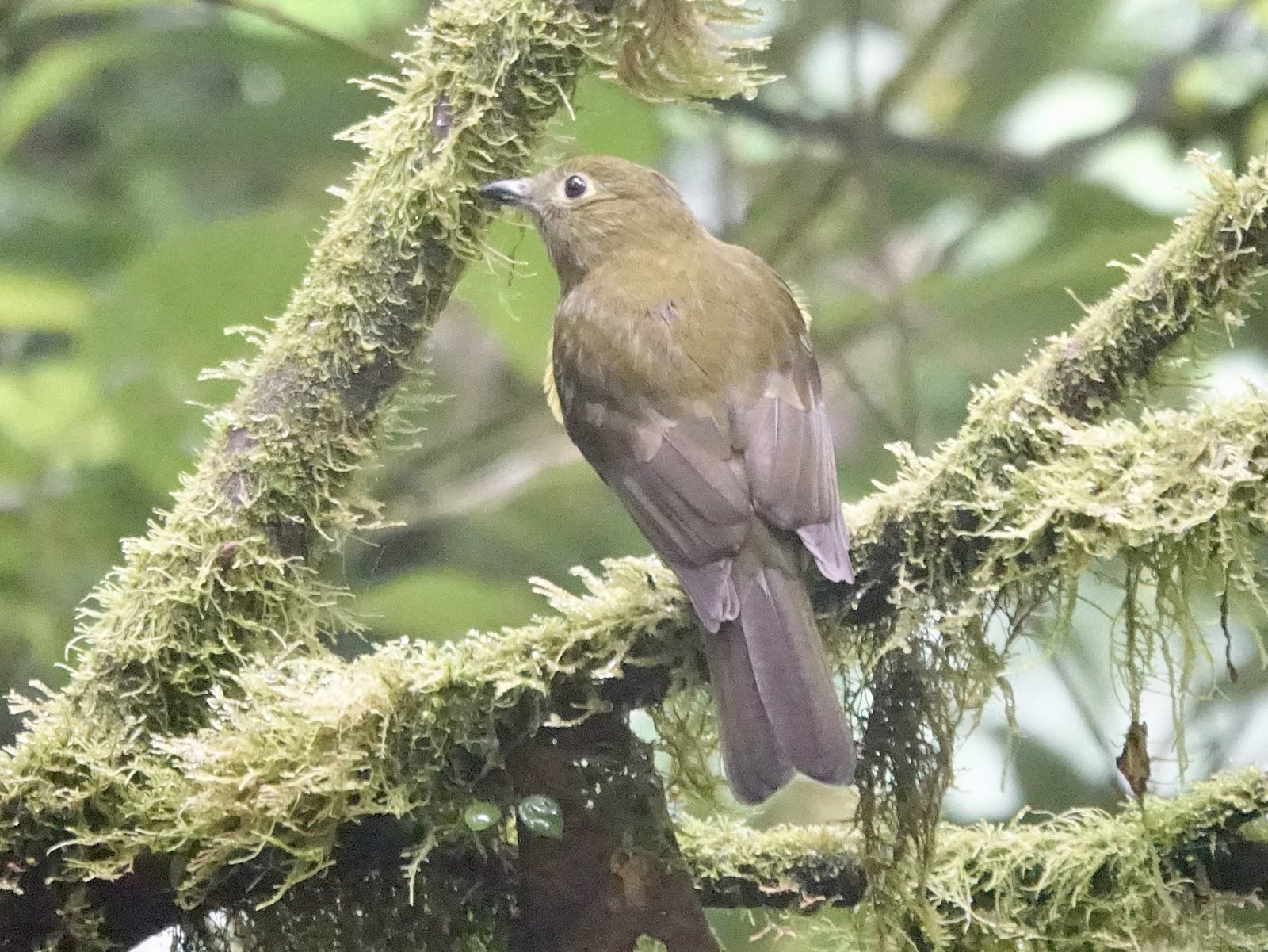
The Olivaceous Piha is an olive-green cotinga of humid montane forest in the northern Andes. It usually lives alone in the understorey and middle storey, sometimes joins mixed flocks and is seldom heard. There are two subspecies: one on the west slope in Colombia and north-western Ecuador and one on the east slope.
Voice
Poorly known. A short rattle has been attributed to the species. Usually silent.
Recording: Jonas Nilsson — CC BY-NC-SA 4.0 · xeno-canto
Identification
23–24 cm, a slender bird with a fairly long tail and a dark bill with a paler base. The male is mostly olive-green, with brighter olive ear coverts and rump and a partly concealed black crest in the centre of the crown. The wings are brown with narrow olive edges. The underparts are olive with thin white streaks from the lower throat to the belly; the undertail coverts are lemon-yellow. The female is browner, with little or no crest. The subspecies mindoensis on the west slope is smaller, with concealed creamy-white bases to the crest feathers.
Confusion species
Grey-tailed Piha Snowornis subalaris has an ash-grey tail and a grey belly, and lives lower. Dusky Piha Lipaugus fuscocinereus is larger and entirely grey. Some olive flycatchers and female tityras have a different head and wing pattern and different behaviour.
Habitat
Humid lower montane forest and cloud forest in the subtropical zone, from the understorey to the middle storey, roughly between 1000 and 2300 m. It feeds on fruit and large arthropods, picked from a perch, taken in a brief hover or caught in the air. Little is known about the nest.
Where the bird is most at home, classified by the vegetation units of the Andes and the west coast.


Range and movements
In Colombia on the west slope of the Western Andes from Antioquia southwards (mindoensis) and in the upper Magdalena valley in the far south. In Ecuador on the east slope and in the north-west, in Pichincha (mindoensis). In Peru in the far north and again from central Amazonas south to Huánuco. Absent from Bolivia and the Galápagos. Does not occur outside the guide area.
- Resident
- dark = core range, pale = thinly spread
How and when to look
Search cloud forest along mountain roads, for example around Mindo in Ecuador or on the east slope in Ecuador and northern Peru. The bird often sits still for long periods and calls little; look for a large, uniformly olive bird in a mixed flock.
Conservation status
Least Concern. The species is locally scarce and threatened by clearance of montane forest.
Scientific name
Snowornis cryptolophus | (Sclater & Salvin, 1877)
Sclater & Salvin described the species in 1877 as Lathria cryptolopha; because it was later moved to another genus, the author and year stand in brackets. The genus Snowornis was introduced in 2001 by Prum. The genus name honours the British ornithologist David W. Snow (1924–2009), combined with Greek ornis, 'bird'. The species name comes from Greek kryptos, 'hidden', and lophos, 'crest': 'with a hidden crest'. The specimen the first description was based on came from Monji, Ecuador.