All species › Passerines › Manakins › Orange-collared Manakin
Orange-collared Manakin | Manacus aurantiacus
Oranjekraagmanakin | Saltarín cuellinaranja | Rendeira-de-colar-laranja
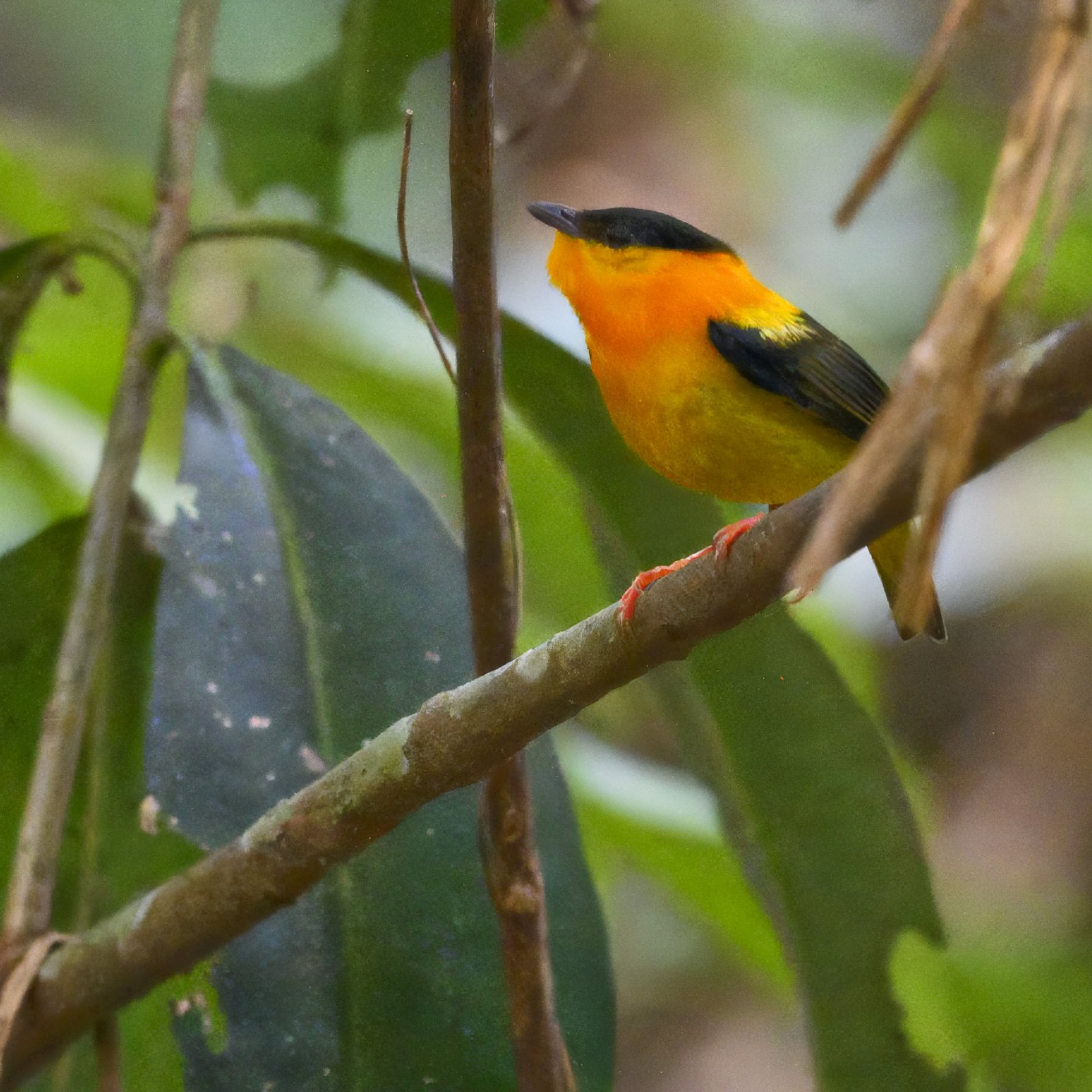
The Orange-collared Manakin is a manakin of the Pacific lowlands of Costa Rica and western Panama. It does not occur in the guide area; it is included here as the closest relative of the Golden-collared Manakin. Males display in groups on the forest floor, producing loud, snapping sounds with their wings.
Voice
During display loud, snapping click and snap sounds made by the wings and a whirring sound in flight; also a high cheep.
Recording: Asociación Ambiental Finca Cántaros — CC BY-NC-SA 4.0 · xeno-canto
Identification
10 cm, compact, with a short tail and orange legs. The male has a black crown, black wings and a black band across the back; the throat, collar and upper back are bright orange, the lower back and belly olive-green. The female is plain olive-green, with a paler, yellowish belly and orange legs.
Confusion species
Golden-collared Manakin Manacus vitellinus has a golden-yellow rather than orange collar in the male and lives farther east, in Panama and Colombia. White-collared Manakin Manacus candei has a white collar and a yellow belly and lives on the Caribbean side of Central America. The females of these species are very similar.
Habitat
Humid lowland forest, secondary forest, forest edges and thickets, also in plantations, up to about 1000 m. It eats mainly small fruits, as well as insects. Males display on small, cleared patches of the forest floor.
Where the bird is most at home, classified by the vegetation units of the Andes and the west coast.


Range and movements
Does not occur in the guide area; there are no known records from Colombia, Ecuador, Peru or Bolivia. Its range lies on the Pacific side of Costa Rica and western Panama.
- Resident
- dark = core range, pale = thinly spread
How and when to look
Found only outside the guide area, for example in lowland forest in south-western Costa Rica. The snapping of displaying males is often the first clue.
Conservation status
Least Concern. The species tolerates secondary forest and edges, but depends on forest remnants in a heavily cleared landscape.
Scientific name
Manacus aurantiacus | (Salvin, 1870)
Salvin described the species in 1870 as Chiromachaeris aurantiaca; because it was later moved to another genus, the author and year stand in brackets. The genus Manacus was introduced in 1760 by Brisson. The genus name comes from Dutch manneken, 'pretty little thing', which is also the source of the word 'manakin'. The specific name is New Latin aurantiacus, 'orange', after the orange collar of the male. The specimen the first description was based on came from Chiriquí, Panama.