All species › Parrots › African and New World parrots › Painted Parakeet
Painted Parakeet | Pyrrhura picta
Bonte parkiet | Cotorra pintada | Tiriba-de-testa-azul
In the classification followed here, the Painted Parakeet is a species with many forms, which differ strongly in the colour of the forehead, crown and face. In the guide area it is mainly represented by forms with a red or maroon forehead from western Amazonia, which are sometimes treated elsewhere as separate species. Groups fly fast and low through the forest, calling constantly.
Voice
Shrill, grating calls, in flight rapidly repeated by the whole group, such as kreet-kreet, and soft chattering from groups in the canopy.
Recording: Felipe Arantes — CC BY-NC-SA 4.0 · xeno-canto
Identification
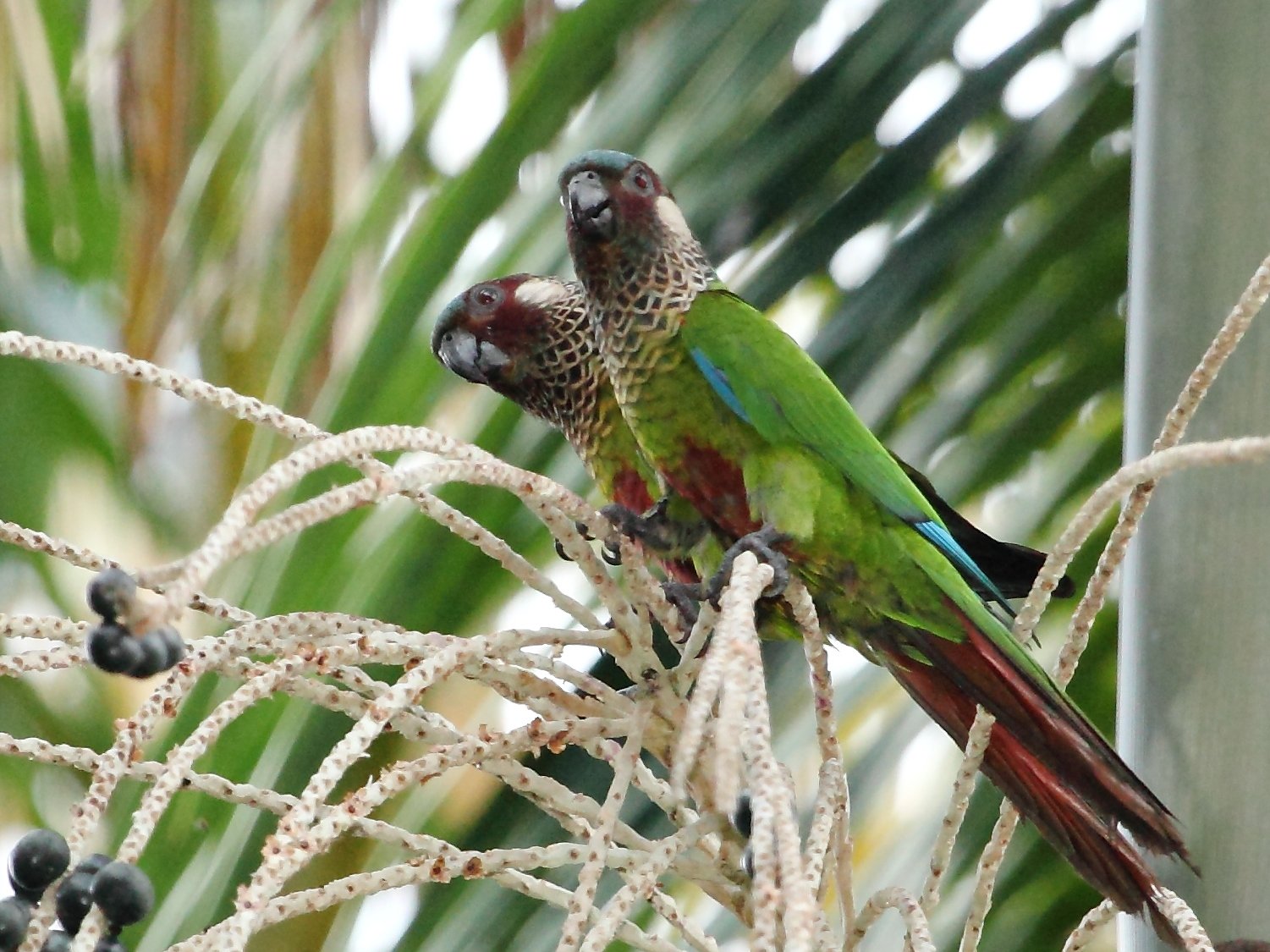
22 cm, slim, with a long, graduated tail. The plumage is largely green. The throat and breast are dark, with pale, creamy edges giving a wavy or scaly pattern, and there is a pale ear patch. There is a reddish-brown patch in the centre of the belly. The primaries are blue, the tail reddish brown above. Depending on the form, the forehead, crown and face are red, maroon with a blue forecrown, or dark brown with a narrow red band. The sexes are alike; juveniles have less red on the head.
Confusion species
Maroon-tailed Parakeet Pyrrhura melanura has a green belly without a red patch, red primary coverts and a more narrowly scaled breast; it lives mainly north of the Marañón and the Amazon. Santarem Parakeet Pyrrhura amazonum is very similar and replaces the Painted Parakeet in parts of northern Bolivia and Brazil. Crimson-bellied Parakeet Pyrrhura perlata has blue cheeks and a large bright red belly.
Habitat
Humid lowland terra firme and várzea forest, foothill forest and their edges, also secondary forest, from the lowlands up to about 1650 m. It eats fruit, seeds and flowers in the canopy. It lives in groups of ten to twenty birds. The nest is in a tree cavity.
Where the bird is most at home, classified by the vegetation units of the Andes and the west coast.


Range and movements
In Peru widespread in the eastern lowlands and foothills, from Loreto, Amazonas and San Martín to Cusco, Madre de Dios and the Apurímac valley. In Ecuador only locally in the south-east, in Morona-Santiago. In Bolivia in the north, in Pando and adjacent Beni and La Paz. In Colombia at most locally; the assignment of Colombian birds to this species is uncertain. Absent from the Galápagos. Outside the guide area in western Brazilian Amazonia and, with other forms, in Venezuela, the Guianas and northern Brazil.
- Resident
- dark = core range, pale = thinly spread
How and when to look
Search along forest edges, rivers and from canopy towers in eastern Peru, for example in Madre de Dios and San Martín; groups give themselves away by their shrill calls as they fly over the forest.
Conservation status
Least Concern. Some forms have a small range and suffer locally from deforestation; the population of the individual forms is poorly known.
Scientific name
Pyrrhura picta | (Müller, 1776)
Müller described the species in 1776 as Psittacus pictus; because it was later moved to another genus, the author and year stand in brackets. The genus Pyrrhura was introduced in 1856 by Bonaparte. The genus name comes from Greek purrhos, 'flame-coloured', and oura, 'tail'. Latin pictus, 'painted'. The specimen the first description was based on came from Cayenne, French Guiana.