All species › Parrots › African and New World parrots › Santarem Parakeet
Santarem Parakeet | Pyrrhura amazonum
Hellmayrs parkiet | Cotorra de Santarém | Tiriba-de-hellmayr
The Santarem Parakeet is a small Pyrrhura of the Brazilian Amazon south of the Amazon River. The guide area touches only the south-western edge of its range, in northern Bolivia, where the species is known from just a few sites. The Bolivian birds belong to the form of the Madeira basin, which is sometimes treated as a separate species.
Voice
A shrill, harsh kreek or kee-kee-kee, mainly in flight; flocks in a tree make soft, babbling sounds.
Recording: JAYRSON ARAUJO DE OLIVEIRA — CC BY-NC-SA 4.0 · xeno-canto
Identification
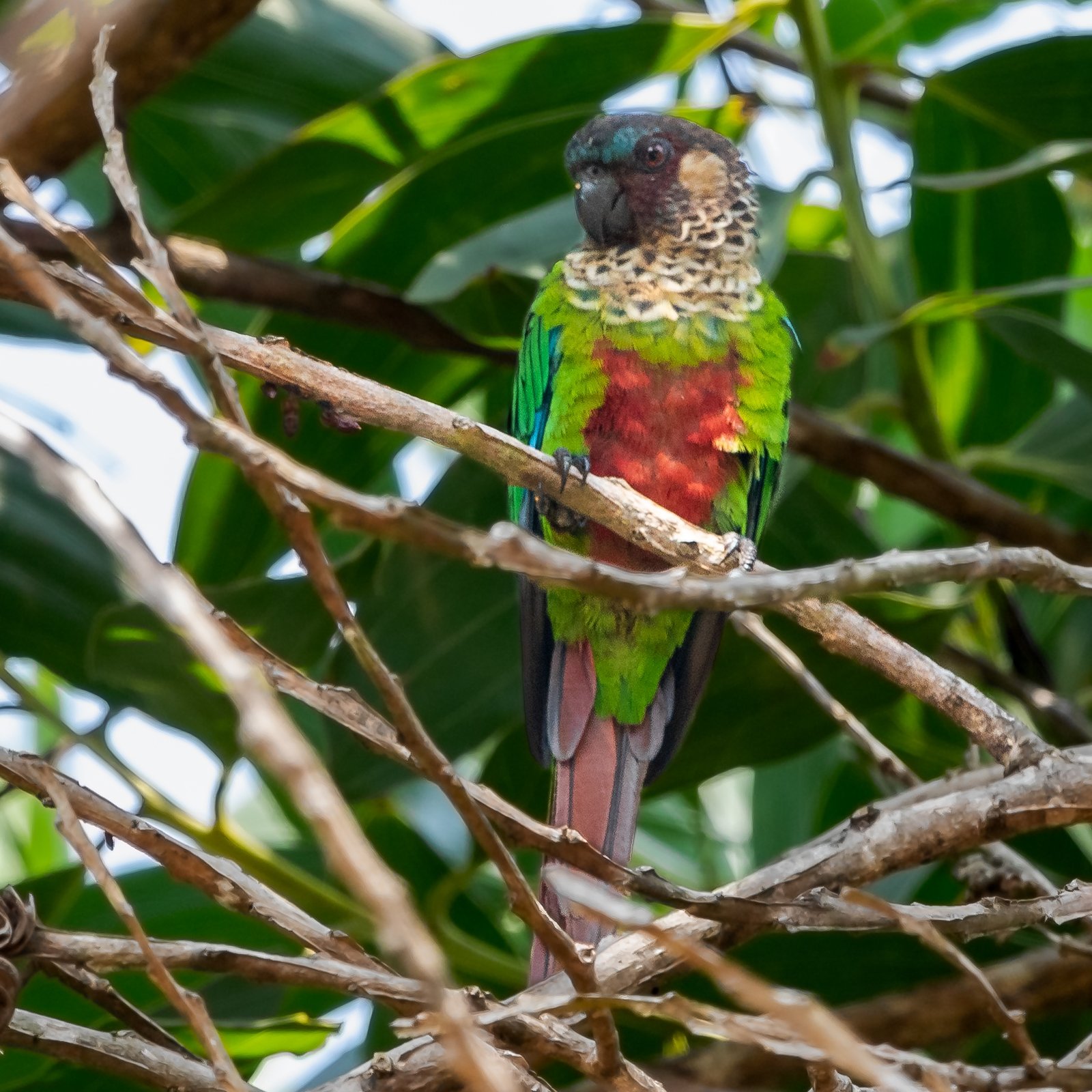
22 cm, with a long, pointed tail and a dark grey bill. The plumage is mainly green, with dark maroon cheeks and a whitish to buff ear patch. The breast is pale with narrow, dark, pointed spots or scales; the Madeira form has little or no blue on the forehead. The belly and rump are dark red. The flight feathers are bluish. The tail is green above with a red tip and dark red below. The eye-ring is usually dark grey. The sexes are alike.
Confusion species
Black-capped Parakeet Pyrrhura rupicola has a blackish-brown cap, a dark breast with broad white edges, a green tail and no red belly. Crimson-bellied Parakeet Pyrrhura perlata has a crimson belly and blue cheeks and neck sides. Painted Parakeet Pyrrhura picta has a blue forehead and red or blue on the face.
Habitat
Humid lowland forest on terra firme, flooded forest along rivers and forest edges, below 500 m. It feeds on fruit, seeds and flowers in the canopy. It nests in tree cavities.
Where the bird is most at home, classified by the vegetation units of the Andes and the west coast.


Range and movements
In Bolivia only in the north, in the Madeira basin in Pando and northern Beni, where the species has rarely been recorded. Absent from Colombia, Ecuador, Peru and the Galápagos. Outside the guide area in the Brazilian Amazon south of the Amazon River, from the Madeira east to the Tocantins, with a small extension north of the river.
- Resident
- dark = core range, pale = thinly spread
How and when to look
In the guide area only in the forests of northern Pando and Beni, where flocks forage in the treetops along rivers. Watch for chattering flocks with a dark red belly and tail.
Conservation status
Near Threatened. Most of the range lies in the southern Amazon, where deforestation for cattle ranching, agriculture and roads is advancing rapidly; the species is therefore expected to decline.
Scientific name
Pyrrhura amazonum | Hellmayr, 1906
Hellmayr described the species in 1906 and placed it straight away in the genus where it still stands. The genus Pyrrhura was introduced in 1856 by Bonaparte. The genus name comes from Greek purrhos, 'flame-coloured', and oura, 'tail'. Latin amazonum, 'of the Amazons', referring to the Amazon region; not necessarily the type locality. The specimen the first description was based on came from Óbidos, Pará, Brazil.