All species › Parrots › African and New World parrots › Santa Marta Parakeet
Santa Marta Parakeet | Pyrrhura viridicata
Santamartaparkiet | Periquito de Santa Marta | Tiriba-de-santa-marta
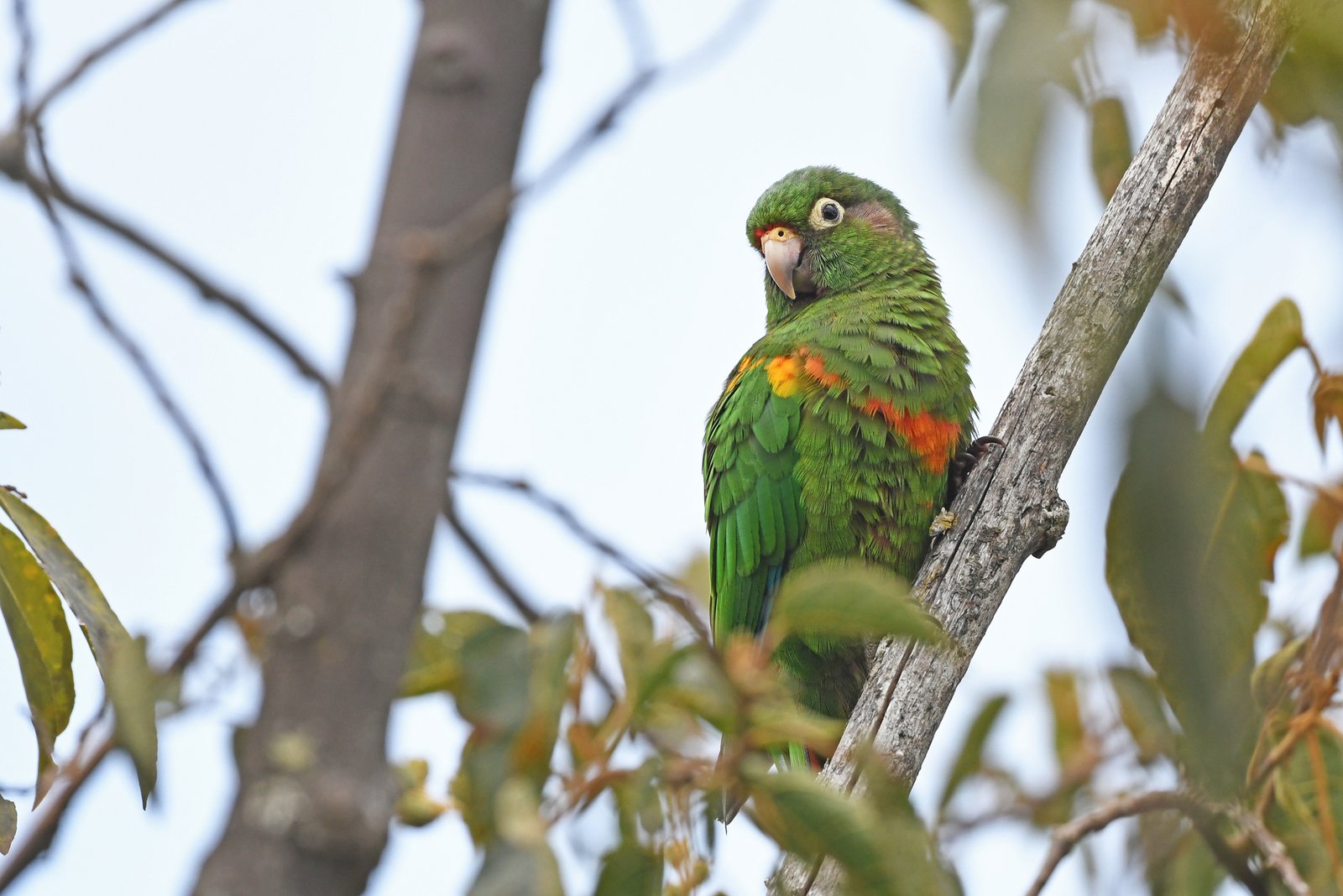
The Santa Marta Parakeet is a medium-sized, long-tailed parakeet found only in the Sierra Nevada de Santa Marta in northern Colombia. It lives in flocks in montane forest and forest edges at middle elevations. With a small range and a small population it is one of the threatened endemic birds of this isolated mountain range.
Voice
Shrill, harsh chattering, mainly in flight, such as a repeated kreek-kreek; flocks in a tree make soft, scratchy and babbling sounds.
Recording: GABRIEL LEITE — CC BY-NC-SA 4.0 · xeno-canto
Identification
25 cm, with a long, pointed tail and a pale, horn-coloured bill. The plumage is mainly green, with a narrow red forehead band and a dark reddish-brown ear patch. The belly has an orange-red patch of variable size. The bend of the wing and the underwing coverts are red and yellow, visible mainly in flight. The tail is green above with a reddish-brown tip and dull reddish-brown below. A bare, pale ring surrounds the eye. The sexes are alike; juveniles show less red on belly and wing.
Confusion species
Scarlet-fronted Parakeet Psittacara wagleri occurs in the same mountains but is larger, with a red forehead and a plain green tail, and lacks the red belly patch and the red and yellow in the wing. No other Pyrrhura occurs in the Sierra Nevada de Santa Marta; Perija Parakeet Pyrrhura caeruleiceps lives in the nearby Serranía de Perijá and has a blue crown.
Habitat
Humid montane forest, cloud forest and their edges, and semi-open country with scattered trees, mostly between 1800 and 2800 m, locally lower or higher. It feeds on fruit, flowers and seeds in the canopy. It nests in cavities in trees and dead palms; nest boxes are also used in the area.
Where the bird is most at home, classified by the vegetation units of the Andes and the west coast.


Range and movements
Only in Colombia, in the Sierra Nevada de Santa Marta, in the departments of Magdalena, La Guajira and Cesar. Absent from Ecuador, Peru, Bolivia and the Galápagos. Endemic to the guide area.
- Resident
- dark = core range, pale = thinly spread
How and when to look
On the San Lorenzo ridge above Minca, including the El Dorado reserve, where flocks forage at the forest edge and in the tops of fruiting trees. In the early morning, watch for chattering flocks flying low overhead.
Conservation status
Endangered. The species has a small range and a small population; montane forest in the Sierra Nevada de Santa Marta has been widely converted to pasture, coffee and other crops, and the remaining forest is fragmented. Forest protection and the installation of nest boxes help the population locally.
Scientific name
Pyrrhura viridicata | Todd, 1913
Todd described the species in 1913 and placed it straight away in the genus where it still stands. The genus Pyrrhura was introduced in 1856 by Bonaparte. The genus name comes from Greek purrhos, 'flame-coloured', and oura, 'tail'. Latin viridicatus, 'made green, greenish'. The specimen the first description was based on came from San Lorenzo, Sierra Nevada de Santa Marta, Colombia.