All species › Passerines › Tyrant flycatchers and allies › Pale-bellied Mourner
Pale-bellied Mourner | Rhytipterna immunda
Vaalbuiktreurtiran | Plañidera pálida | Vissiá-cantor
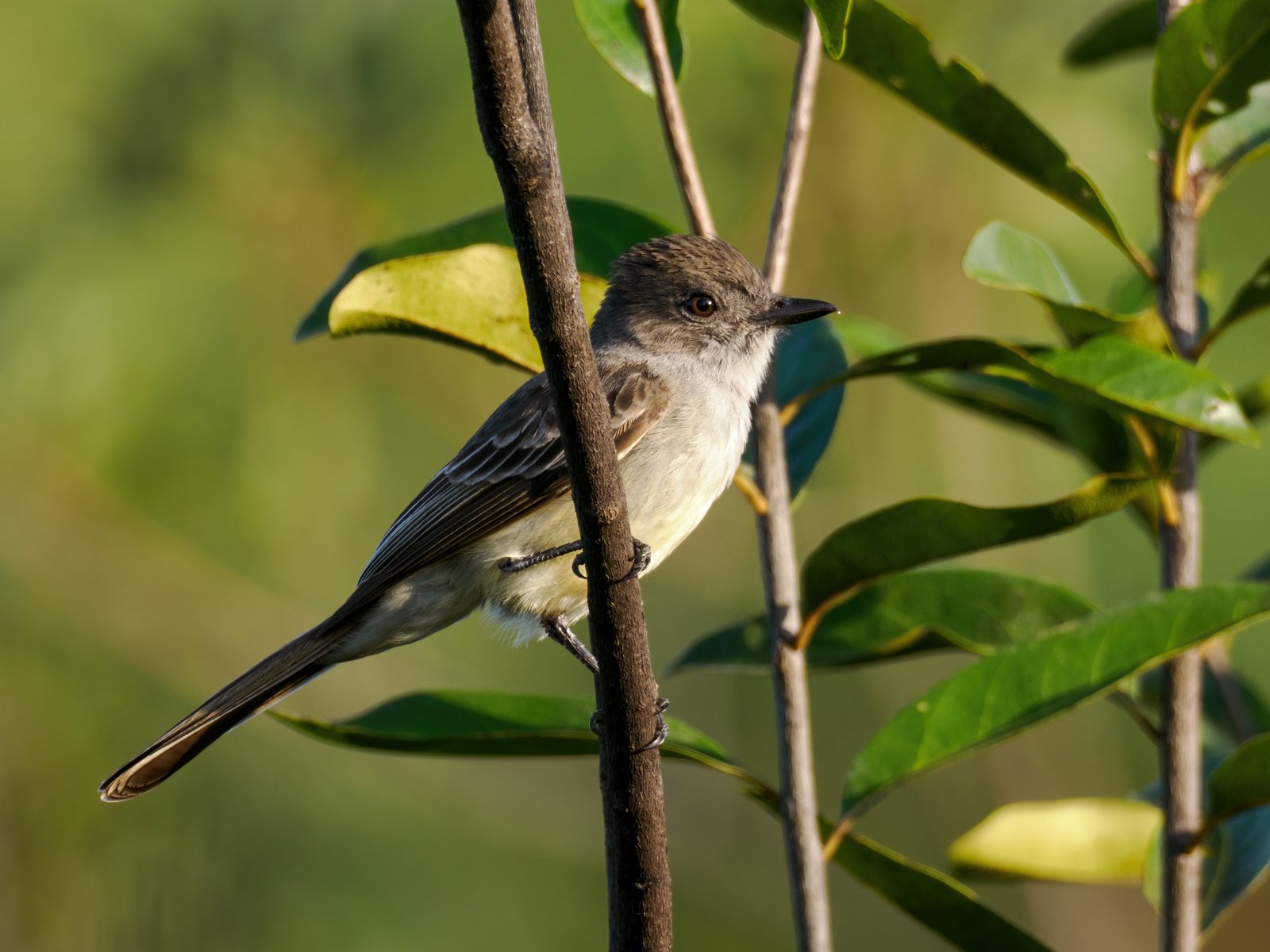
The Pale-bellied Mourner is a brownish-grey flycatcher with a pale yellow belly which, unlike its relatives, lives in fairly open, low woodland, especially on white-sand soils. In the guide area it reaches only the outermost edges of its large range, in eastern Colombia and northern Bolivia. It closely resembles a flycatcher of the genus Myiarchus.
Voice
The song consists of two well-separated reet-je notes. The most frequent call is a distinctive pur-treeep, cheeeuu or puu-puu-trreeep, cheeeuu.
Recording: Iván Lau — CC BY-NC-SA 4.0 · xeno-canto
Identification
18.5–19 cm, with a slightly hooked blackish bill and prominent rictal bristles. The head and upperparts are dull greyish olive-brown. The wings have two faint wing bars and rufous edges to the primaries. The throat and breast are greyish, the belly dull pale yellow, the flanks with a rusty tinge. The eye is dark brown. The sexes are alike.
Confusion species
Flycatchers of the genus Myiarchus, such as Short-crested Flycatcher Myiarchus ferox and Brown-crested Flycatcher Myiarchus tyrannulus, have a more distinct crest, a brighter yellow belly and often rufous edges to the tail; the call is the best distinction. Greyish Mourner Rhytipterna simplex is uniformly grey, without a yellow belly, and lives in tall humid forest.
Habitat
Fairly open wooded landscapes: savanna woodland, especially on sandy soils, scrubby low várzea woodland and campina; in Colombia below 250 m. It sits in the middle storey and catches insects with a short sally; it also eats fruit. Little is known about the nest.
Where the bird is most at home, classified by the vegetation units of the Andes and the west coast.


Range and movements
Colombia: locally in the extreme east, on white-sand soils along the borders with Venezuela and Brazil. Ecuador and Peru: not known. Bolivia: in the extreme north, adjoining its occurrence in Rondônia (Brazil); few records. Absent from the Galápagos. Outside the guide area in Brazil, southern Venezuela, Guyana and Suriname.
- Resident
- dark = core range, pale = thinly spread
How and when to look
Search low woodland and scrub on white sand in Guainía or Vaupés and listen for the distinctive call; without it the bird often goes unnoticed among the Myiarchus flycatchers.
Conservation status
Least Concern. Widespread in Amazonia; in the guide area local and scarce at the edge of its range.
Scientific name
Rhytipterna immunda | (Sclater & Salvin, 1873)
Sclater & Salvin described the species in 1873 as Lipaugus immundus; because it was later moved to another genus, the author and year stand in brackets. The genus Rhytipterna was introduced in 1850 by Reichenbach. The genus name comes from Greek rhutis, 'wrinkle', and pterna, 'heel', after the corrugations on the rear of the tarsus shown by Reichenbach (1850). The species name comes from Latin immundus, 'dirty, unclean', probably after the drab, dingy plumage. The specimen the first description was based on came from Oyapock, French Guiana.