All species › Passerines › Tyrant flycatchers and allies › Greyish Mourner
Greyish Mourner | Rhytipterna simplex
Grijze treurtiran | Plañidera gris | Vissiá
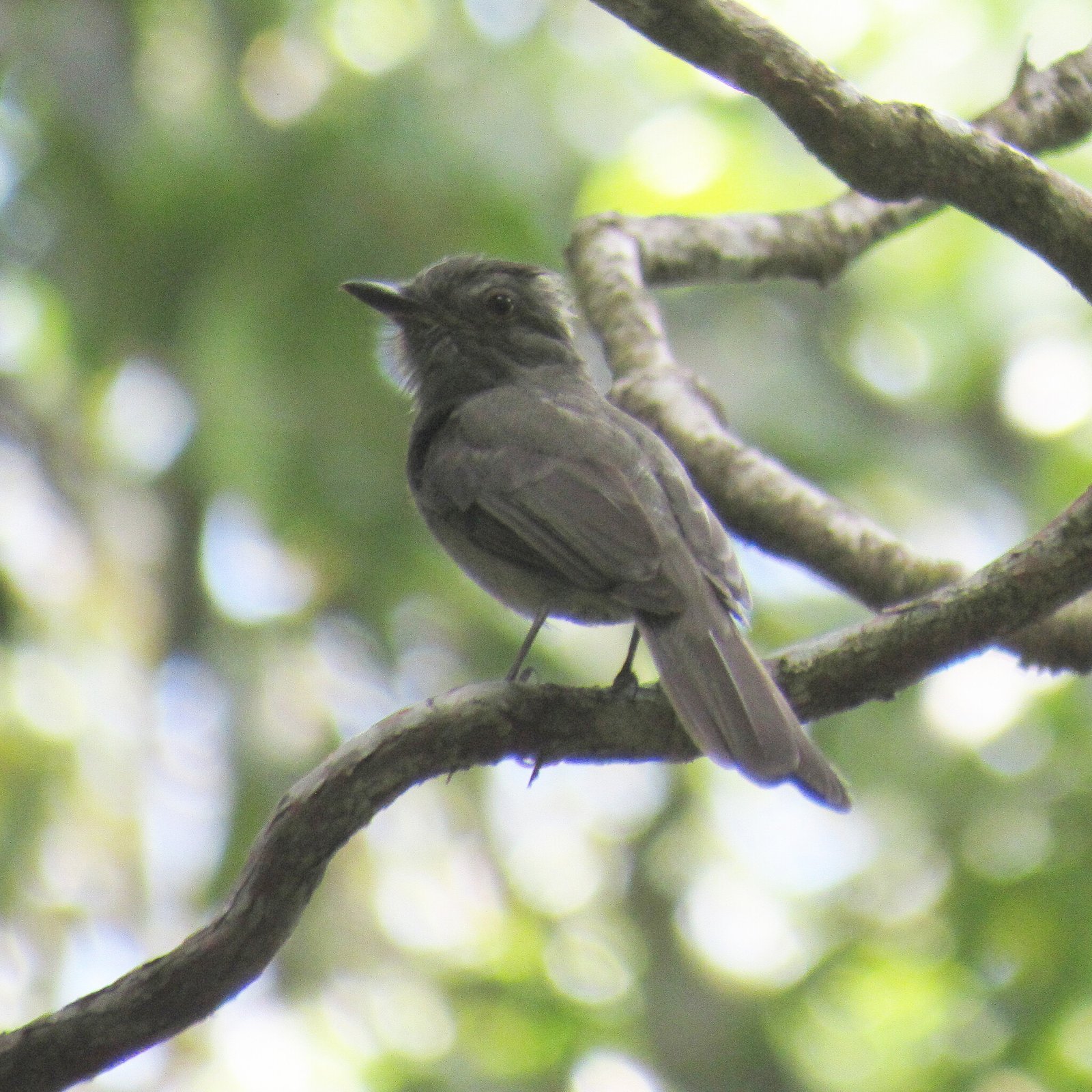
The Greyish Mourner is a uniformly grey, rather inconspicuous flycatcher of the Amazonian lowlands. It sits still in the middle and upper storeys of tall forest and often joins mixed flocks. Its song, a rising series of sharp notes with an explosive ending, is the best feature.
Voice
The song varies in tempo; usually a rising series of sharp ih notes ending in some loud, explosive itch notes. Also a slowly rising series of clear, whistled whew notes.
Recording: JAYRSON ARAUJO DE OLIVEIRA — CC BY-NC-SA 4.0 · xeno-canto
Identification
19.5–20.5 cm, with a fairly large head with a slight crest at the rear of the crown and a slightly hooked black bill, often with a pink base. The head and upperparts are grey, the wings and tail with a brownish tinge. The throat is pale grey, the underparts slightly darker grey with a faint yellowish-green tinge on the belly. The eye is dark red to reddish brown. Females have fulvous edges to the wing and tail feathers. Birds in the guide area are darker than those of eastern Brazil.
Confusion species
Cinereous Mourner Laniocera hypopyrra has rows of cinnamon spots on the wing coverts and an orange tuft on the side of the breast. Screaming Piha Lipaugus vociferans is larger (about 25 cm), with a longer tail and a very loud call. Flycatchers of the genus Myiarchus, such as Short-crested Flycatcher Myiarchus ferox, have a yellow belly and pale wing edges. Pale-bellied Mourner Rhytipterna immunda is browner, with a pale yellow belly, and lives in open woodland on sandy soils.
Habitat
Humid terra firme lowland forest, mainly in the middle and upper storeys, sometimes in transitions to other forest types; in Colombia and Ecuador up to about 700 m, in Peru up to about 1400 m. It catches large insects with a sally to the foliage and also eats fruit; it often travels with mixed flocks. Little is known about the nest; in Peru it breeds from August to November.
Where the bird is most at home, classified by the vegetation units of the Andes and the west coast.


Range and movements
Colombia: in the southeast, in the Amazonian lowlands. Ecuador: in the eastern lowlands. Peru: throughout the Amazonian lowlands east of the Andes, locally into the foothills. Bolivia: in the northwest and north. Absent from the Galápagos. Outside the guide area in Venezuela, the Guianas and Brazil, with a separate population in the Atlantic Forest.
- Resident
- dark = core range, pale = thinly spread
How and when to look
Listen in tall lowland forest for the rising series with an explosive ending, then search the middle storey for a quiet grey bird, often in a mixed flock.
Conservation status
Least Concern. Widespread in Amazonia, but dependent on large, unbroken forest.
Scientific name
Rhytipterna simplex | (Lichtenstein, 1823)
Lichtenstein described the species in 1823 as M[uscicapa] simplex; because it was later moved to another genus, the author and year stand in brackets. The genus Rhytipterna was introduced in 1850 by Reichenbach. The genus name comes from Greek rhutis, 'wrinkle', and pterna, 'heel', after the corrugations on the rear of the tarsus shown by Reichenbach (1850). The species name comes from Latin simplex, 'simple, plain', after the unmarked plumage. The specimen the first description was based on came from Bahia, Brazil.