All species › Passerines › Tyrant flycatchers and allies › Rufous Mourner
Rufous Mourner | Rhytipterna holerythra
Rosse treurtiran | Plañidera alazán | Vissiá-ruivo
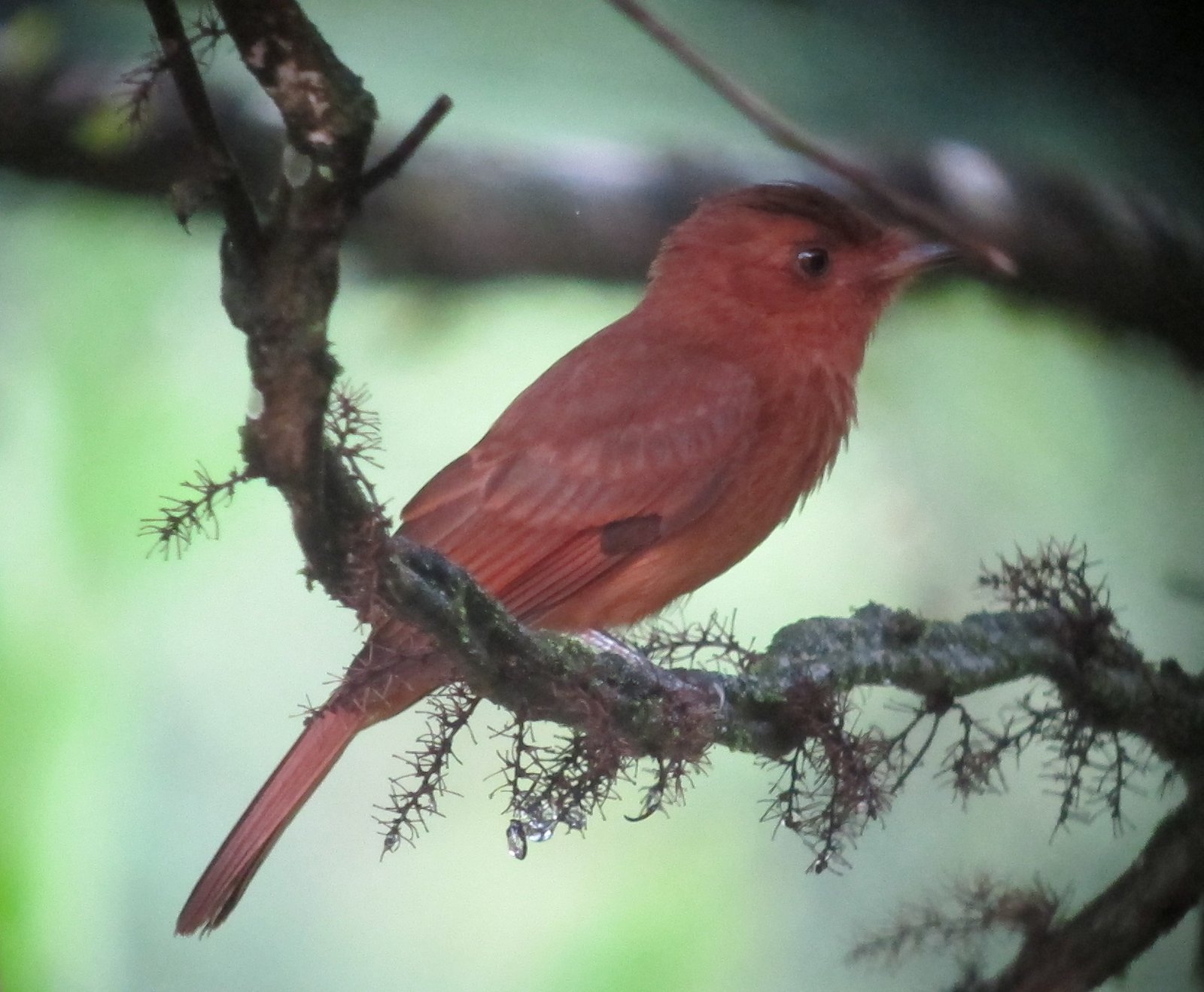
The Rufous Mourner is a uniformly rufous flycatcher of humid forest in the Chocó region and northern Colombia. It sits motionless for long periods in the middle storey and is mainly noticed by its plaintive whistle, which rises and falls. It closely resembles Rufous Piha, a clear case of similarity between unrelated species.
Voice
The song is a steady, rich, somewhat plaintive series wheeo-wheeo-wheeo-wheeo-wheee. The call is a long, mournful whistle that first rises and then falls, like a wolf-whistle.
Recording: Niels Krabbe — CC BY-NC-SA 4.0 · xeno-canto
Identification
19.5–21 cm, with a fairly round head and a black bill. The head and upperparts are cinnamon-brown to russet, the crown slightly darker rufous. The wings are darker brown with rufous edges. The underparts are bright cinnamon to tawny, the throat hardly paler. Birds on the Pacific side are more deeply coloured. The sexes are alike; juveniles are more rufous above and paler below.
Confusion species
Rufous Piha Lipaugus unirufus is larger (about 24 cm), with a paler throat, a slightly broader bill and a loud, explosive call. Speckled Mourner Laniocera rufescens has rows of dark spots on the wing coverts and a yellow tuft on the side of the breast. Cinnamon Becard Pachyramphus cinnamomeus is smaller, with a shorter tail, dark lores and a pale spot above the lores.
Habitat
Humid evergreen forest and mature secondary forest in the lowlands and lower foothills, in Colombia up to about 1400 m, in Ecuador up to about 700 m. It sits still in the middle storey, often in mixed flocks, and eats large insects and fruit. It mostly nests in tree cavities such as old woodpecker holes; in Colombia from February to May.
Where the bird is most at home, classified by the vegetation units of the Andes and the west coast.


Range and movements
Colombia: in the north and centre of the country and on the Pacific side from southern Chocó. Ecuador: on the Pacific side south to Pichincha, with scattered records further south. Peru and Bolivia: absent. Absent from the Galápagos. Outside the guide area from southern Mexico through Central America to Panama.
- Resident
- dark = core range, pale = thinly spread
How and when to look
Listen in humid lowland forest on the Pacific side, for example in Esmeraldas or southern Chocó, for the rising and falling whistle; the bird often sits long on one branch in the middle storey.
Conservation status
Least Concern. Dependent on humid forest, which has declined strongly in western Colombia and Ecuador.
Scientific name
Rhytipterna holerythra | (Sclater & Salvin, 1860)
Sclater & Salvin described the species in 1860 as Lipaugus holerythrus; because it was later moved to another genus, the author and year stand in brackets. The genus Rhytipterna was introduced in 1850 by Reichenbach. The genus name comes from Greek rhutis, 'wrinkle', and pterna, 'heel', after the corrugations on the rear of the tarsus shown by Reichenbach (1850). The species name comes from Greek holos, 'entire', and eruthros, 'red': 'wholly red(dish)'. The specimen the first description was based on came from Choctum, Alta Verapaz, Guatemala.