All species › Passerines › Tyrant flycatchers and allies › Brownish Twistwing
Brownish Twistwing | Cnipodectes subbrunneus
Schroefvleugeltiran | Alitorcido pardo | Flautim-pardo
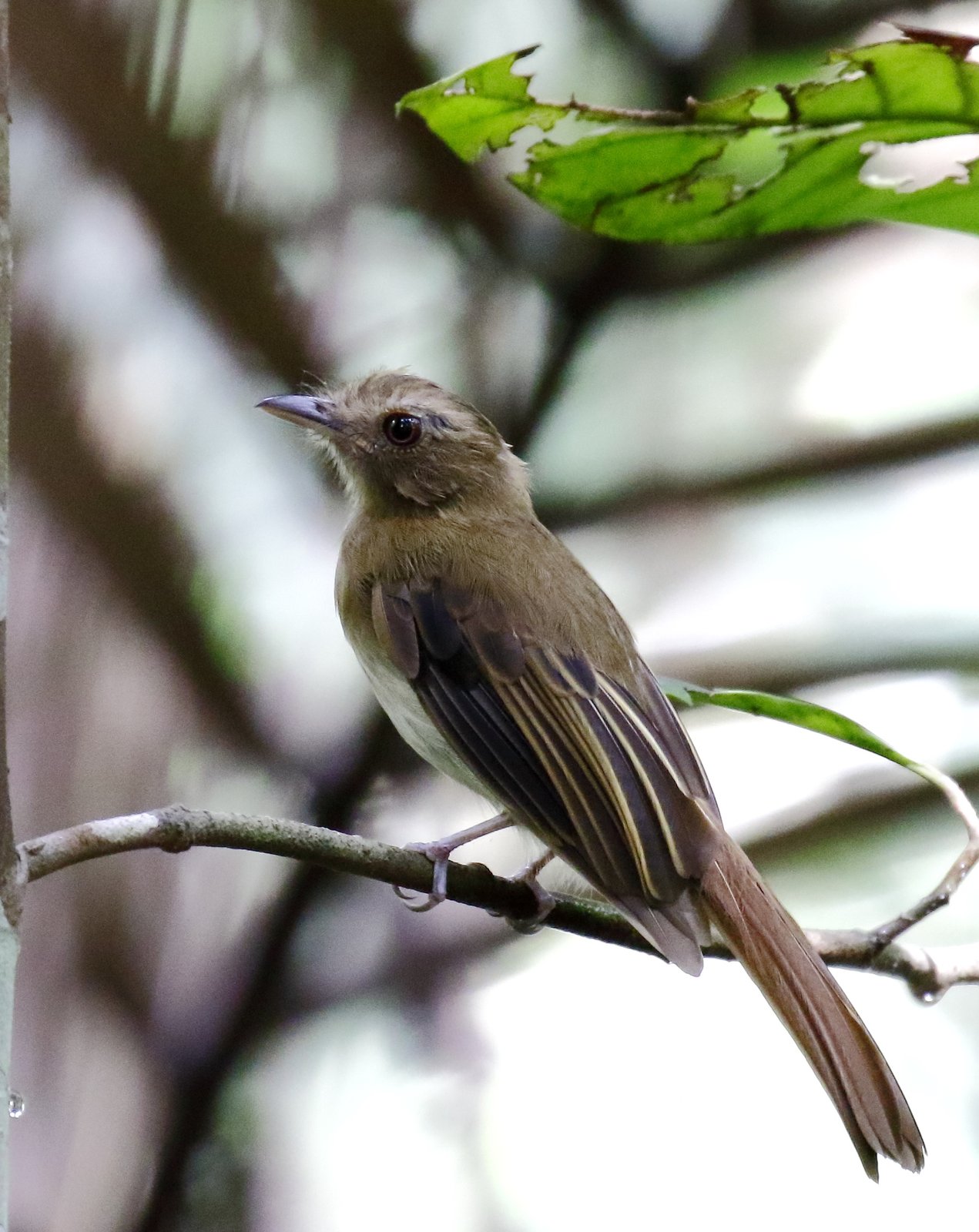
The Brownish Twistwing is a brown flycatcher of the understorey of humid lowland forest. Its name refers to the male's twisted, stiff outer primaries, which make a whirring sound when it flutters. It often lifts one wing at a time over its back.
Voice
A sharp, sneezing kee-WEET or chuh-weet, often repeated several times; when fluttering a whirring wing sound.
Recording: Juan Freile — CC BY-NC-SA 4.0 · xeno-canto
Identification
16–18 cm, with a broad, flat bill with a pale lower mandible. The upperparts are olive-brown, the rump and tail rufous-brown. The wings are dark, with faint rufous edges to the coverts and flight feathers. The throat and breast are brownish buff, the belly paler, buffy yellow. The male is clearly larger than the female and has twisted outer primaries. The iris is pale brown to orange-brown.
Confusion species
Ochre-bellied Flycatcher Mionectes oleagineus also lifts its wings, but is smaller, with a narrow bill, an olive-green back and an ochre-yellow belly. Ruddy-tailed Flycatcher Terenotriccus erythrurus is much smaller, with a grey head. Brown-winged Schiffornis Schiffornis turdina is uniform olive-brown, with a large dark eye and a narrow bill, and does not lift its wings. West of the Andes, Rufous Mourner Rhytipterna holerythra is similar but uniformly rufous-brown and lives higher in the trees.
Habitat
The understorey and lower storey of humid lowland forest, várzea, old secondary forest and dense forest edge, up to roughly 1000 m. It sits fairly upright in the understorey and catches insects with short sallies to the leaves. The nest is a hanging, pear-shaped pouch with an entrance at the bottom.
Where the bird is most at home, classified by the vegetation units of the Andes and the west coast.


Range and movements
Colombia: in the Pacific lowlands, the Caribbean lowlands, the Magdalena valley and the Amazonian lowlands. Ecuador: in the western and eastern lowlands. Peru: in the Amazonian lowlands and locally in the far north-west. Bolivia: locally in the north, in Pando. Absent from the Galápagos. Outside the guide area in Panama and in western Brazilian Amazonia.
- Resident
- dark = core range, pale = thinly spread
How and when to look
Listen in the understorey of lowland forest for the sharp, sneezing call and watch for a brown bird that lifts one wing after the other.
Conservation status
Least Concern. The species tolerates old secondary forest, but is tied to forest and disappears where lowland forest is cleared.
Scientific name
Cnipodectes subbrunneus | (Sclater, 1860)
Sclater described the species in 1860 as Cyclorhynchus subbrunneus; because it was later moved to another genus, the author and year stand in brackets. The genus Cnipodectes was introduced in 1873 by Sclater & Salvin. The genus name probably comes from Greek knips, 'insect, gnat', and dēktēs, 'biter'. Latin sub, 'somewhat', and brunneus, 'brown': brownish. The specimen the first description was based on came from Babahoyo, Los Ríos, Ecuador.