All species › Passerines › Tyrant flycatchers and allies › Rufous Twistwing
Rufous Twistwing | Cnipodectes superrufus
Rosse schroefvleugeltiran | Alitorcido rufo | Flautim-rufo
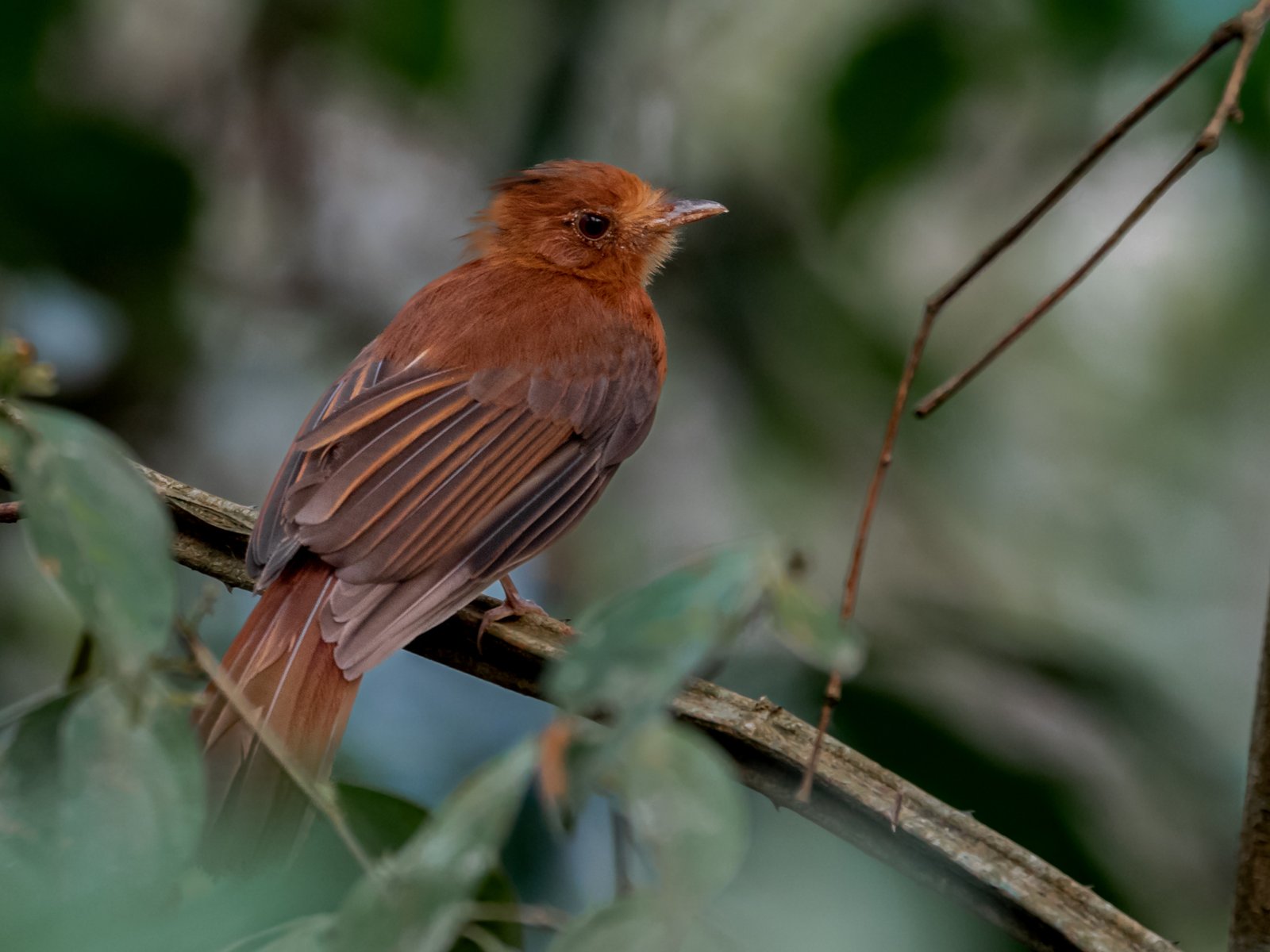
The Rufous Twistwing was described only in 2007 and is a bright rufous flycatcher of bamboo forest in south-western Amazonia. It lives hidden in dense Guadua bamboo. As in the Brownish Twistwing, males have twisted outer primaries that make a sound in flight.
Voice
Loud, nasal and clear calls, often a two-part kee-ew, repeated at intervals. When fluttering, males make a rattling sound with the wings.
Recording: Jacob Wijpkema — CC BY-NC-SA 4.0 · xeno-canto
Identification
18–19 cm, with a broad, fairly long bill and a long tail. The whole plumage is bright cinnamon-rufous to rusty, the belly slightly paler, the wings darker with rufous edges. The lower mandible is pale. The male is larger than the female and has twisted, stiff outer primaries. It often lifts one wing at a time over its back.
Confusion species
Brownish Twistwing Cnipodectes subbrunneus is smaller and brown, with only the rump and tail rufous. Rufous Casiornis Casiornis rufus is smaller, with a paler, buffy belly and a narrower bill, and lives in drier forest. Cinnamon Attila Attila cinnamomeus has a dark bill hooked at the tip and blackish wings, and lives in várzea and swamp forest.
Habitat
Dense stands of Guadua bamboo in humid lowland and foothill forest, roughly between 200 and 1000 m. It forages in the understorey and middle storey, catching insects in the bamboo with short sallies. Little is known of its breeding biology.
Where the bird is most at home, classified by the vegetation units of the Andes and the west coast.


Range and movements
Peru: in the south-east, in Madre de Dios, Cusco and southern Ucayali. Bolivia: locally in Pando. Absent from Colombia, Ecuador and the Galápagos. Outside the guide area in eastern Acre in Brazil.
- Resident
- dark = core range, pale = thinly spread
How and when to look
In south-eastern Peru, look for large bamboo stands along rivers and in the foothills; the species mainly gives itself away by its loud call from within the bamboo.
Conservation status
Vulnerable. The species has a small range and is tied to bamboo forest, which is affected by deforestation, road building and gold mining in south-eastern Peru.
Scientific name
Cnipodectes superrufus | Lane, Servat, Valqui H & Lambert, 2007
Lane, Servat, Valqui H & Lambert described the species in 2007 and placed it straight away in the genus where it still stands. The genus Cnipodectes was introduced in 1873 by Sclater & Salvin. The genus name probably comes from Greek knips, 'insect, gnat', and dēktēs, 'biter'. Latin super, 'above, very', and rufus, 'rufous': very rufous, after the rufous plumage. The specimen the first description was based on came from Pakitza, Manu National Park, Peru.