All species › Passerines › Tyrant flycatchers and allies › Ticking Doradito
Ticking Doradito | Pseudocolopteryx citreola
Tikkerdoradito | Doradito limón | Doradito-limão
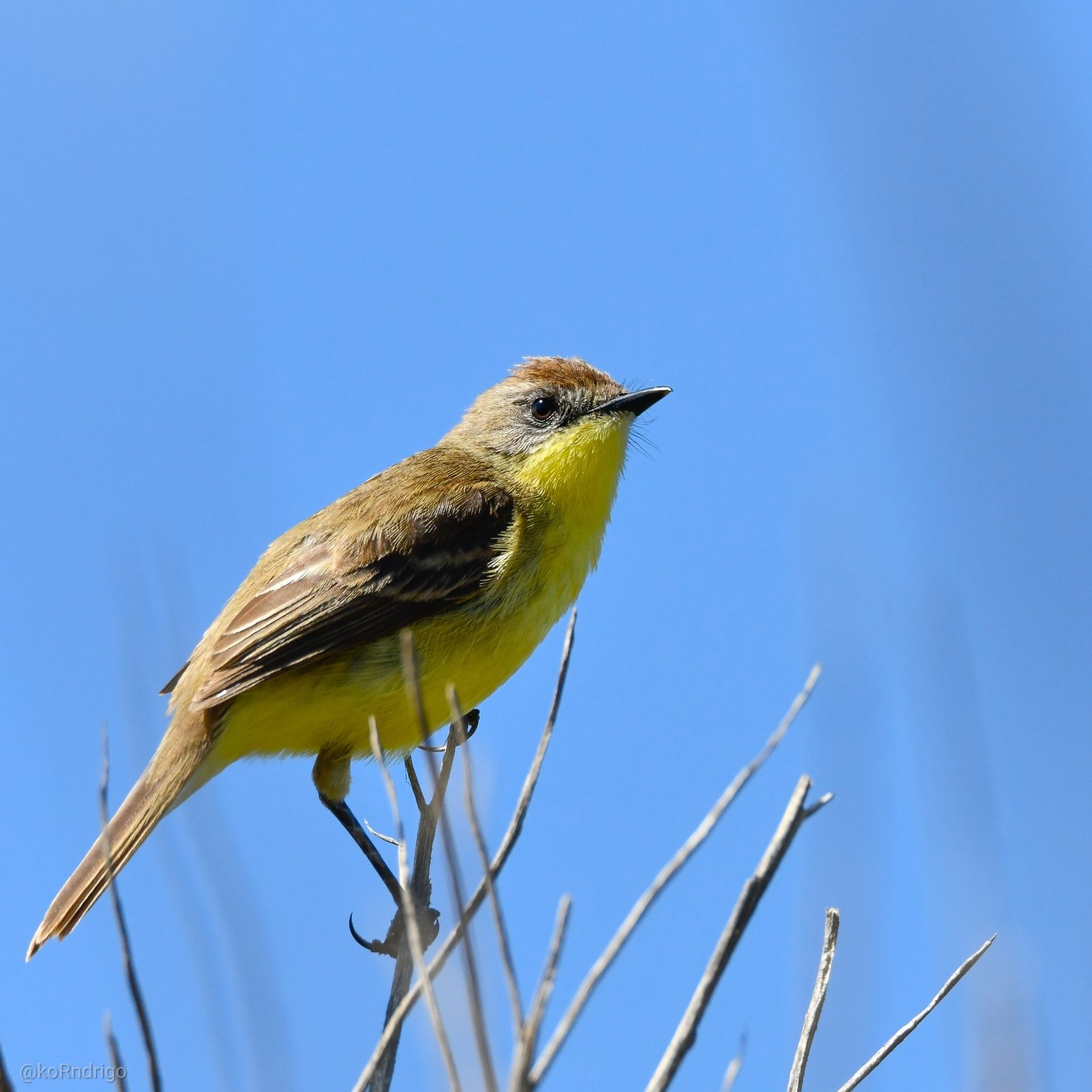
The Ticking Doradito is a small, olive-brown and lemon-yellow tyrant of reed beds and scrub near water. It was split fairly recently as a separate species from Warbling Doradito Pseudocolopteryx flaviventris of eastern Argentina. Its name refers to the ticking notes that open its song.
Voice
The song begins with low ticking notes, first slow and then faster, and ends abruptly. The call is a dry tek.
Recording: Cristian Pinto — CC BY-NC-SA 4.0 · xeno-canto
Identification
11–12 cm, with a thin bill and a medium-length tail. The head and upperparts are dull olive-brown, the crown with a rufous tinge; the lores and cheeks are darker. The wings are olive-brown, with cinnamon edges to the flight feathers and two narrow wing bars. The throat and underparts are lemon yellow. The sexes are similar; the male has an all-black bill, the female a pale pinkish base to the bill.
Confusion species
Subtropical Doradito Pseudocolopteryx acutipennis is greener on the back, without a rufous crown, and lives mainly in Andean marshes. Dinelli's Doradito Pseudocolopteryx dinelliana is smaller and more yellowish olive on the back. Crested Doradito Pseudocolopteryx sclateri has a dark, streaked crest.
Habitat
Dense scrub, often with Baccharis or tamarisk, thickets along watercourses and reed beds, mainly in dry valleys and in the lowlands. It searches for insects low in the vegetation. The nest is a small cup among the stems.
Where the bird is most at home, classified by the vegetation units of the Andes and the west coast.


Range and movements
In Bolivia mainly as a visitor in the austral winter, in the dry valleys and lowlands of the south and centre; breeding in southern Bolivia has been reported. There are no confirmed records from Peru. Absent from Colombia, Ecuador and the Galápagos. Outside the guide area it breeds in central Chile and western Argentina.
How and when to look
In the austral winter, listen in scrub and reed edges in the dry valleys of southern Bolivia for the series of ticking notes.
Conservation status
Least Concern. The range is large; the population is poorly known and probably declining.
Scientific name
Pseudocolopteryx citreola | (Landbeck, 1864)
Landbeck described the species in 1864 as Arundinicola citreola; because it was later moved to another genus, the author and year stand in brackets. The genus Pseudocolopteryx was introduced in 1905 by Lillo. The genus name comes from Greek pseudos, 'false', and the genus Colopteryx, from Greek kolos, 'stunted', and pterux, 'wing'. The species name is a diminutive of Latin citreus, 'lemon-yellow', for the yellow plumage. The specimen the first description was based on came from Mapocho valley near Santiago, Chile.