All species › Passerines › Tyrant flycatchers and allies › Dinelli's Doradito
Dinelli's Doradito | Pseudocolopteryx dinelliana
Driebanddoradito | Doradito tucumano | Doradito-de-dinelli
Dinelli's Doradito is a small, yellow tyrant of marshes and wet grassland in northern Argentina. After breeding it moves north in the austral winter and then just reaches southern Bolivia. It has a small breeding range and depends on wetlands in the Chaco.
Voice
A soft but somewhat twangy song of rhythmically repeated notes, and short, dry calls.
Recording: Bernabe Lopez-Lanus — CC BY-NC-SA 3.0 · xeno-canto
Identification
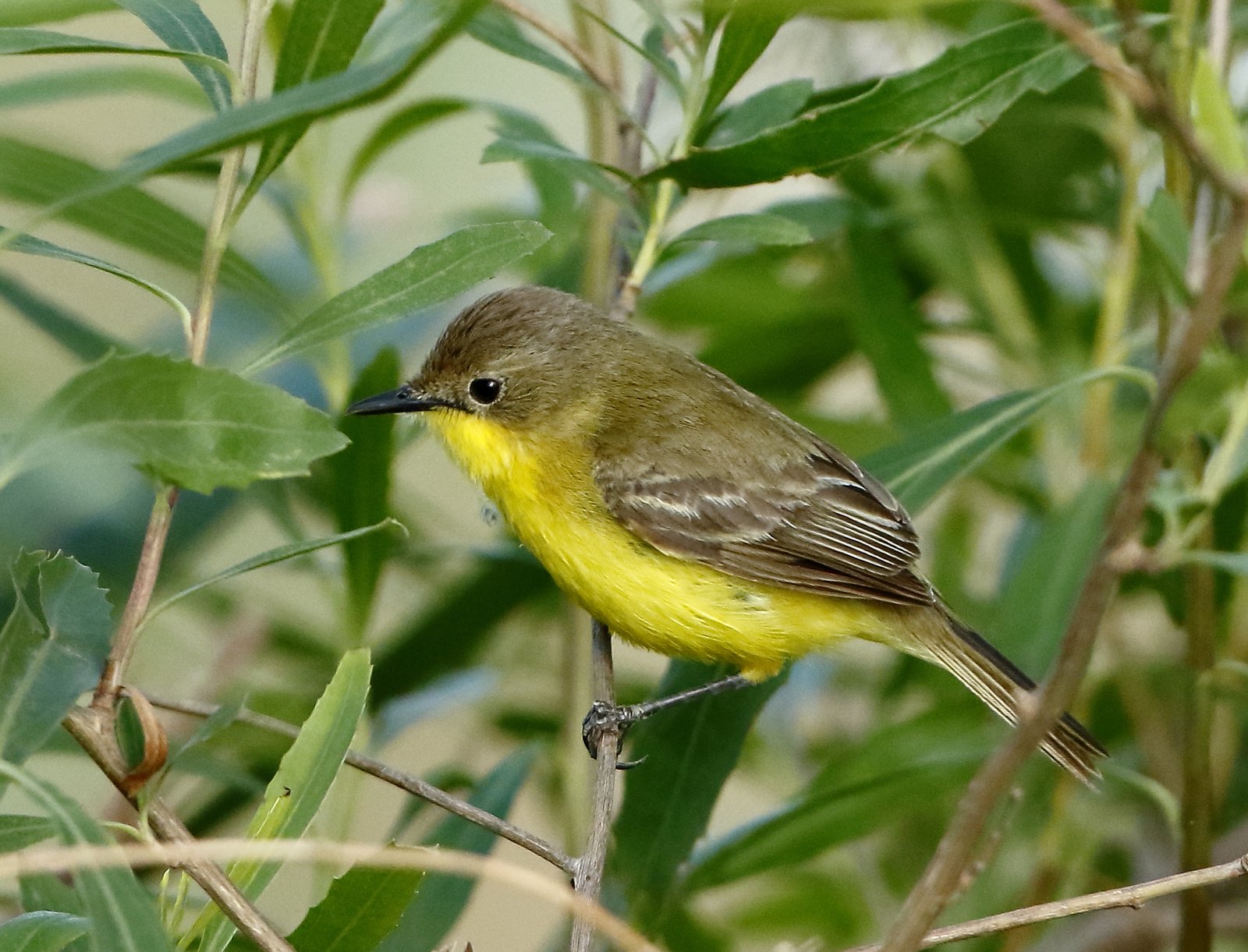
11 cm, with a thin black bill and a fairly short tail. The head and upperparts are yellowish olive-green, with a rufous tinge on the crown, lores and cheeks. The wings are greyish olive, with thin buffy edges and two faint wing bars. The throat and underparts are bright yellow. The sexes are similar; the female is slightly duller yellow.
Confusion species
Subtropical Doradito Pseudocolopteryx acutipennis lacks the rufous tinge on the head and lives mainly higher in the Andes. Ticking Doradito Pseudocolopteryx citreola is slightly larger, with a browner back and a ticking call. Crested Doradito Pseudocolopteryx sclateri has a dark, streaked crest and a streaked back.
Habitat
Reed beds, marshes with tall grass and scrub near water in the lowlands, up to about 500 m. It searches for insects and spiders low in dense marsh vegetation. The nest is a small cup among the stems.
Where the bird is most at home, classified by the vegetation units of the Andes and the west coast.


Range and movements
In Bolivia only in the south and south-east, as a visitor in the austral winter. Absent from Colombia, Ecuador, Peru and the Galápagos. Outside the guide area it breeds in northern Argentina; in winter also in western Paraguay.
- Summer visitor (c. Apr–Sep)
- dark = core range, pale = thinly spread
How and when to look
Search reed beds and wet grassland in the Chaco of southern Bolivia from May to September and watch for small yellow birds perching briefly at the top of the stems.
Conservation status
Near Threatened. The population is small and declining; its habitat is lost through canalisation and drainage of wetlands and conversion of scrub to pasture and fields.
Scientific name
Pseudocolopteryx dinelliana | Lillo, 1905
Lillo described the species in 1905 and placed it straight away in the genus where it still stands. He introduced the genus Pseudocolopteryx in that same work. The genus name comes from Greek pseudos, 'false', and the genus Colopteryx, from Greek kolos, 'stunted', and pterux, 'wing'. The species name honours the Argentine biologist Luis Dinelli. The specimen the first description was based on came from Environs of Tucumán, Argentina.