All species › Passerines › Tyrant flycatchers and allies › Subtropical Doradito
Subtropical Doradito | Pseudocolopteryx acutipennis
Smalvleugeldoradito | Doradito subtropical | Doradito-subtropical
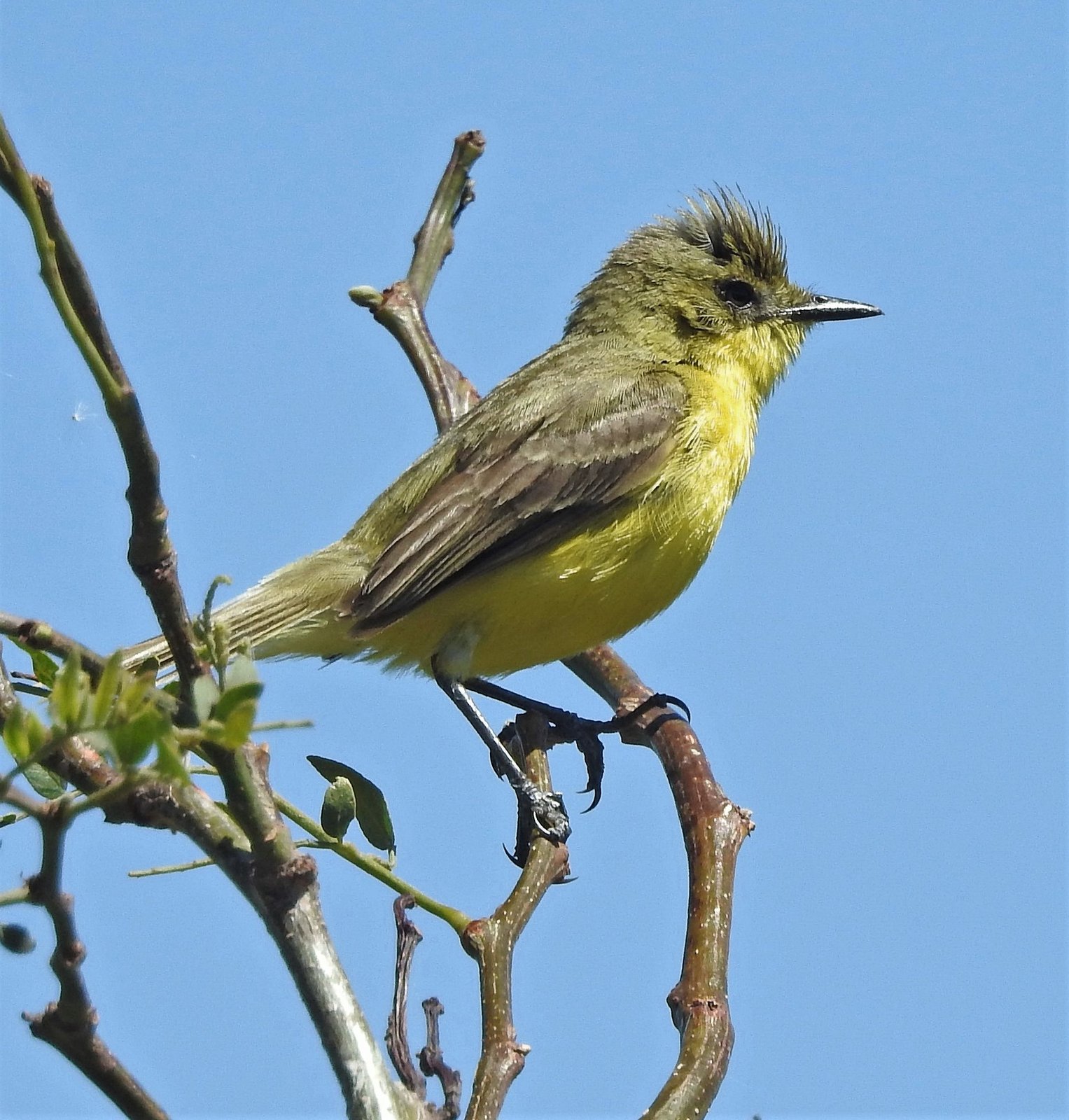
The Subtropical Doradito is a small olive and yellow tyrant of marshes and wet grasslands in the Andes. It lives hidden in reeds, rushes and tall grass and, because of its plain plumage and secretive habits, is little known. The male has narrow, pointed outer primaries that make a soft sound in flight.
Voice
Soft, high calls, tsip, and a short, soft song of dry notes. The male makes a soft whirring wing sound in flight.
Recording: Juan Freile — CC BY-NC-SA 4.0 · xeno-canto
Identification
11 cm, with a small, pointed bill and a fairly short tail. The upperparts are plain olive-green, the crown slightly browner. The wings are dark olive-brown, without distinct wing bars or with only faint, pale edges. The underparts are bright yellow, washed slightly olive on the breast. The male has attenuated, pointed outer primaries; the female is slightly duller.
Confusion species
Ticking Doradito Pseudocolopteryx citreola is very similar, but has a browner crown and a different, ticking call; in the guide area it occurs only as a winter visitor in Bolivia. Crested Doradito Pseudocolopteryx sclateri has a dark, streaked crest and a streaked back. Many-colored Rush Tyrant Tachuris rubrigastra has a black head, a yellow supercilium and a white wing bar.
Habitat
Marshes, reedbeds, rush beds, wet grasslands and rank growth along lakes and streams in the Andes, roughly between 1500 and 3800 m; in the austral winter also in lowland marshes. It searches for small insects low in the vegetation. The nest is a cup attached to stems in the marsh vegetation.
Where the bird is most at home, classified by the vegetation units of the Andes and the west coast.


Range and movements
In Colombia very locally in the Andes. In Ecuador locally in marshes in the inter-Andean valleys. In Peru scattered in the Andes, mainly in the centre and south, with a few records in the lowlands. In Bolivia in the Andean valleys and in the austral winter also in the lowlands of Beni and Santa Cruz. Absent from the Galápagos. Outside the guide area in north-western Argentina, from where birds move north in the austral winter.
- Resident
- dark = core range, pale = thinly spread
How and when to look
Search the edges of lakes and marshes with reeds and rushes in the Andean valleys, especially in the early morning, when birds briefly sit at the top of the stems.
Conservation status
Least Concern. The species is local everywhere and little studied; drainage and grazing of Andean marshes reduce its habitat.
Scientific name
Pseudocolopteryx acutipennis | (Sclater & Salvin, 1873)
Sclater & Salvin described the species in 1873 as Hapalocercus acutipennis; because it was later moved to another genus, the author and year stand in brackets. The genus Pseudocolopteryx was introduced in 1905 by Lillo. The genus name comes from Greek pseudos, 'false', and the genus Colopteryx, from Greek kolos, 'stunted', and pterux, 'wing'. The species name comes from Latin acutus, 'pointed', and penna, 'feather', for the pointed primaries. The specimen the first description was based on came from Bogotá, Colombia (trade skin).