All species › Passerines › Tyrant flycatchers and allies › Unstreaked Tit-Tyrant
Unstreaked Tit-Tyrant | Uromyias agraphia
Streeploze meestiran | Cachudito sin rayas | Tiranete-chapim-sem-estrias
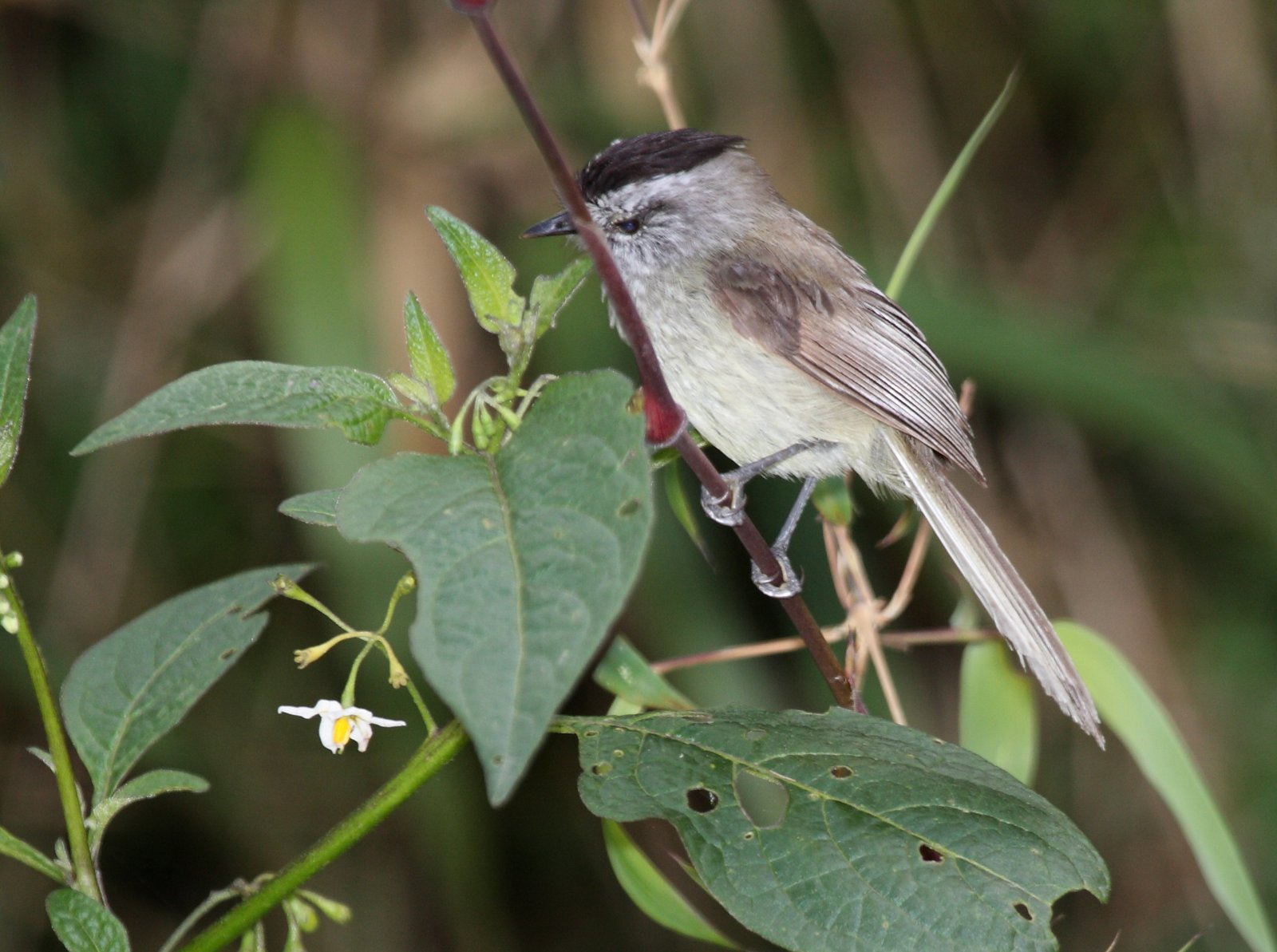
The Unstreaked Tit-Tyrant is a small, long-tailed tyrant found only in Peru, on the east slope of the Andes. It is the southern counterpart of the Agile Tit-Tyrant and differs from it mainly in its unstreaked underparts, to which the name refers. Like that species, it lives in bamboo near the treeline.
Voice
A high, sputtering trill; calls are high ti and tsee notes and a short, descending trill.
Recording: Jerome Fischer — CC BY-NC-SA 4.0 · xeno-canto
Identification
12–13 cm, with a long tail and a short dark bill. Crown black with a flat black crest; a broad grey supercilium mottled with white and a thin black eye-stripe. Upperparts olive-brown. Throat and breast white to pale grey with a grey-brown scaled pattern; flanks, belly and undertail coverts pale grey with a pale yellow wash, unmarked. Iris dark brown. Sexes alike. Juveniles have two rufous wing bars. The northern subspecies plengei is darker olive-brown above with a whiter belly; squamiger has whiter scaling on the breast.
Confusion species
Agile Tit-Tyrant Uromyias agilis has heavily streaked upperparts and yellow, streaked underparts; it lives further north, in Colombia and Ecuador. Tufted Tit-Tyrant Anairetes parulus is smaller, with a pale iris, a curled crest and a streaked throat and breast, and lives more in open scrub. White-throated Tyrannulet Mecocerculus leucophrys has a white throat, pale wing bars and no crest.
Habitat
Humid montane forest and elfin forest from about 2600 to 3450 m, most numerous near the treeline, with a strong preference for stands of Chusquea bamboo and forest openings. It actively gleans insects from leaves and twigs, often with short upward hops. It lives in pairs or small groups, often in mixed flocks. Nothing is known about its breeding.
Where the bird is most at home, classified by the vegetation units of the Andes and the west coast.


Range and movements
Peru: endemic, on the east slope of the Andes, from Amazonas through La Libertad and Huánuco to the Cordillera Vilcanota in Cusco. Colombia, Ecuador and Bolivia: absent. Absent from the Galápagos.
- Resident
- dark = core range, pale = thinly spread
How and when to look
Search bamboo along mountain roads near the treeline on the east slope and listen for high trills in mixed flocks.
Conservation status
Least Concern. The population is believed to be stable; the species is considered rare to uncommon, but known numbers may be underestimated.
Scientific name
Uromyias agraphia | (Chapman, 1919) (GBIF: Anairetes agraphia)
Chapman described the species in 1919 as Anaeretes agraphia; because it was later moved to another genus, the author and year stand in brackets. The genus Uromyias was introduced in 1927 by Hellmayr. The genus name comes from Greek oura, 'tail', and New Latin myias, 'flycatcher', from Greek muia, 'fly'. The specific name comes from Greek agraphos, 'unwritten', with the negative prefix a- and graphos, 'lines, writing'; this fits the absence of streaks. The specimen the first description was based on came from Idma near Santa Ana, Cusco, Peru.