All species › Passerines › New World warblers › Palm Warbler
Palm Warbler | Setophaga palmarum
Palmzanger | Reinita palmera | Mariquita-das-palmeiras
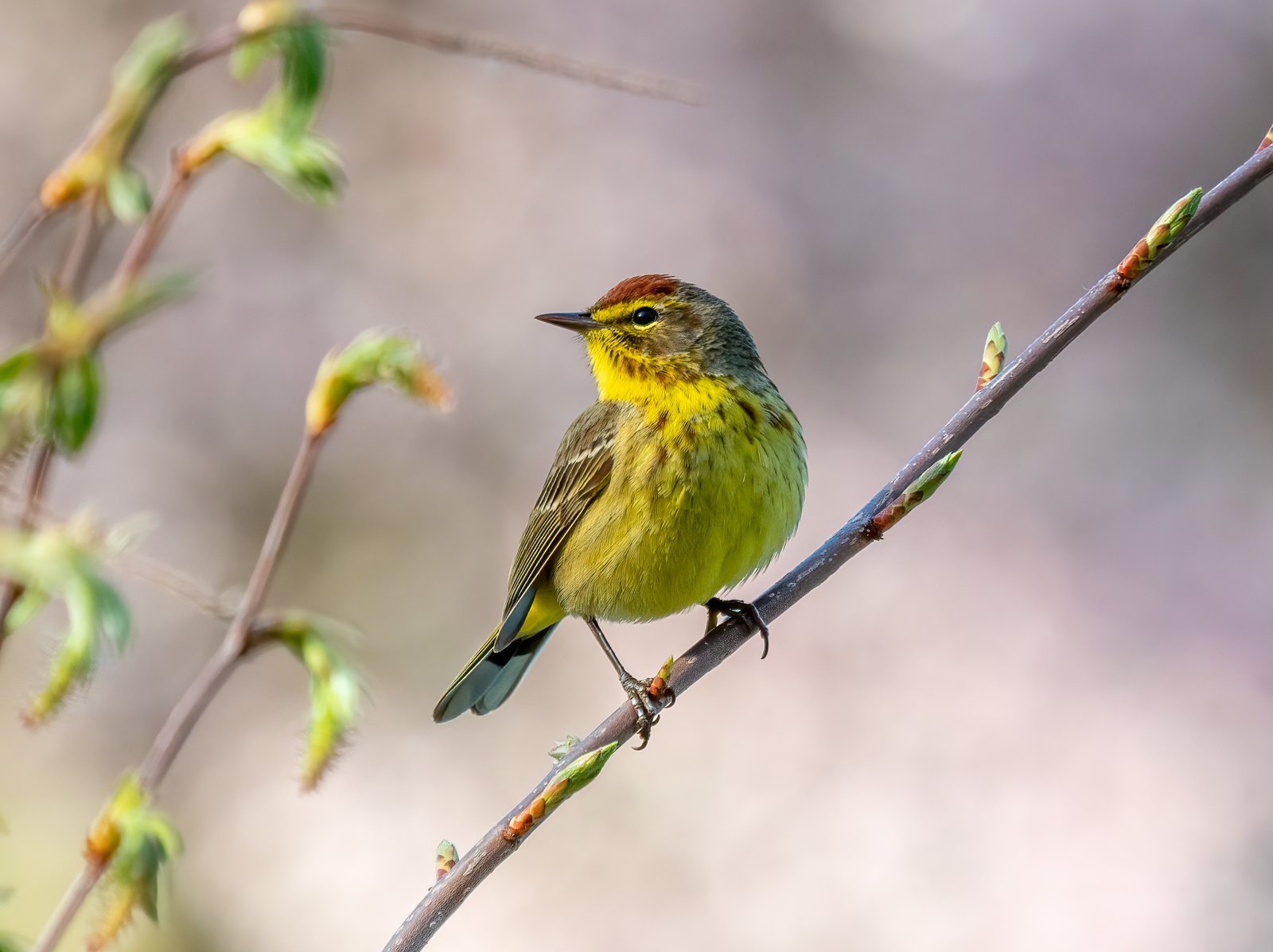
The Palm Warbler is a brownish North American warbler that often feeds on the ground, constantly pumping its tail. It winters in the south-eastern United States, the Caribbean islands and along the coast of Central America. In the guide area it has been confirmed only on San Andrés.
Voice
A sharp, somewhat metallic chik, often repeated. The song on the breeding grounds is a flat, buzzy trill.
Recording: Stanislas Wroza — CC BY-NC-SA 4.0 · xeno-canto
Identification
13–14 cm, slender, with a fairly long tail. In winter plumage brownish grey above, with a faint pale supercilium, a dark eye-line and an olive-green rump. The underparts are dull white to yellowish with fine brown streaks, and the undertail coverts are always bright yellow. In breeding plumage a rufous crown. The eastern form is yellow from throat to belly, the western form mainly white with yellow on the throat and undertail. The sexes are nearly alike.
Confusion species
Prairie Warbler Setophaga discolor also pumps its tail, but is bright yellow below, with a black stripe below the eye and black flank streaks, and has an olive-green back. Cape May Warbler Setophaga tigrina in female plumage is greyer, with white undertail coverts, and feeds in the canopy. Young Yellow-rumped Warblers Setophaga coronata have a bright yellow rump and white wing bars.
Habitat
In winter quarters open country with scattered trees and shrubs: gardens, lawns, pastures, coastal scrub and mangrove edges, in the lowlands. It walks on the ground and through low shrubs searching for insects, and also takes seeds and berries. It breeds in bogs and open coniferous forest in Canada.
Where the bird is most at home, classified by the vegetation units of the Andes and the west coast.


Range and movements
Colombia: rare winter visitor; documented on San Andrés, with a few unconfirmed reports from the Caribbean mainland. Not known from Ecuador, Peru, Bolivia or the Galápagos. Outside the guide area it breeds in Canada and the northern United States and winters from the south-eastern United States through the Greater Antilles to the Yucatán Peninsula and the Caribbean coast of Central America.
How and when to look
Between November and March on San Andrés, search lawns, roadsides and the airport area for a brownish warbler walking on the ground and pumping its tail.
Conservation status
Least Concern. The population is large and appears stable.
Scientific name
Setophaga palmarum | (Gmelin, 1789)
Gmelin described the species in 1789 as Motacilla palmarum; because it was later moved to another genus, the author and year stand in brackets. The genus Setophaga was introduced in 1827 by Swainson. The genus name comes from Greek sēs (genitive sētos), 'moth', and -phagos, '-eating', so 'moth-eater'. The species name comes from Latin palmarum, 'of the palms', for the palms where the bird is seen in winter. The specimen the first description was based on came from Hispaniola.