All species › Passerines › New World warblers › Cape May Warbler
Cape May Warbler | Setophaga tigrina
Tijgerzanger | Reinita atigrada | Mariquita-de-cape-may
The Cape May Warbler is a North American warbler that breeds in the spruce forests of Canada and winters in the Caribbean islands. The guide area lies beyond the edge of its normal winter range: in Colombia there are only a few documented records, mainly from San Andrés. Its tongue is split and tubular at the tip, which allows it to take nectar and fruit juice in winter.
Voice
In winter quarters mainly a very high, thin tseet. The song on the breeding grounds is a series of evenly spaced, very high, hissing notes.
Recording: Stanislas Wroza — CC BY-NC-SA 4.0 · xeno-canto
Identification
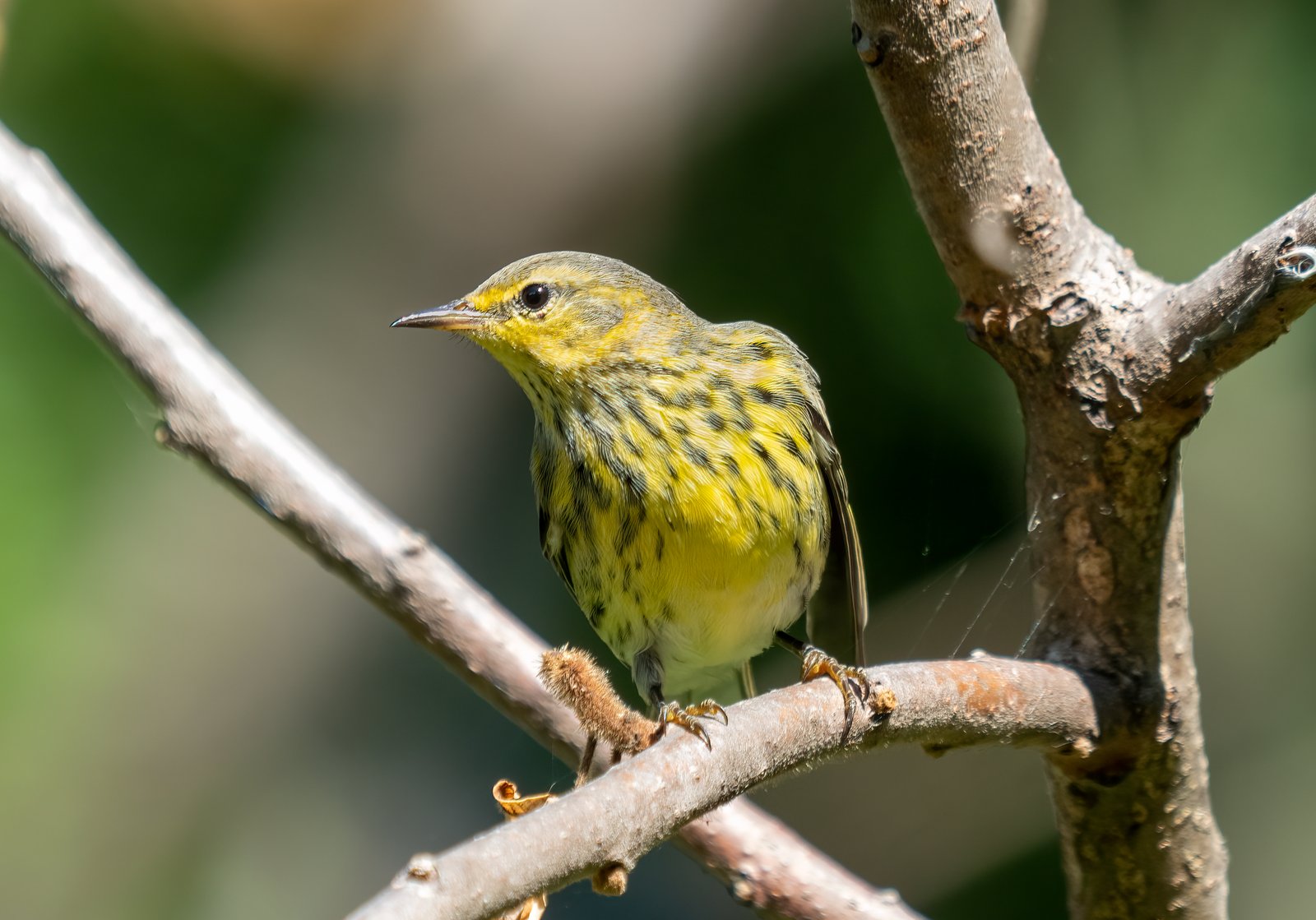
13 cm, with a short tail and a thin, pointed, slightly decurved bill. The male has a chestnut cheek patch, yellow neck sides, a yellow breast with dense black streaks, a large white wing patch and a yellow rump. The female is greyish olive, with a faint pale patch on the neck side, fine grey streaks below, a narrow white wing bar and a greenish-yellow rump. Young birds in autumn are even drabber and sometimes show almost no yellow.
Confusion species
Magnolia Warbler Setophaga magnolia has a white band across the middle of the tail, a grey crown and a white eye-ring. Yellow-rumped Warbler Setophaga coronata is browner, with a white throat, a bright yellow rump and yellow patches on the flanks. Blackpoll Warbler Setophaga striata in autumn plumage has two clear wing bars, white undertail coverts and pale legs. Palm Warbler Setophaga palmarum constantly pumps its tail and has yellow undertail coverts.
Habitat
In winter quarters gardens, parks, forest edges, coastal woodland and open country with flowering trees, mainly in the lowlands. It gleans insects from foliage and drinks nectar from flowers, sometimes defending a flowering tree against other birds. It breeds in coniferous forest in Canada and the northern United States, where numbers follow outbreaks of spruce budworm.
Where the bird is most at home, classified by the vegetation units of the Andes and the west coast.


Range and movements
Colombia: rare winter visitor; the documented records come from San Andrés, with a few unconfirmed reports from the Caribbean mainland. Not known from Ecuador, Peru, Bolivia or the Galápagos. Outside the guide area it breeds in Canada and the north-eastern United States and winters mainly in the Greater and Lesser Antilles, in smaller numbers to Central America and northern Venezuela.
How and when to look
Chances are best between November and March on San Andrés; check flowering trees in gardens and along roads, where the bird drinks nectar.
Conservation status
Least Concern. Numbers fluctuate strongly with spruce budworm outbreaks on the breeding grounds and are declining through forest management that suppresses these outbreaks.
Scientific name
Setophaga tigrina | (Gmelin, 1789)
Gmelin described the species in 1789 as Motacilla tigrina; because it was later moved to another genus, the author and year stand in brackets. The genus Setophaga was introduced in 1827 by Swainson. The genus name comes from Greek sēs (genitive sētos), 'moth', and -phagos, '-eating', so 'moth-eater'. The species name comes from Latin tigrinus, 'striped like a tiger', for the dark streaks on the yellow breast. The specimen the first description was based on came from Canada.