All species › Passerines › Antpittas › Panao Antpitta
Panao Antpitta | Grallaria oneilli
Panaomierpitta | Tororoí de O'Neill | Tovacuçu-de-panao
Panao Antpitta was described as a new species in 2020 when Rufous Antpitta was split. It is named after Panao in Huánuco; the scientific name honours John P. O'Neill, who collected the type specimen in Huánuco in 1983. It is a small, rufous ground bird of high cloud forest on the east slope in central Peru.
Voice
The long song is a series of buzzy notes that first slows slightly and then speeds up. The short song is a two-note phrase on an even pitch, lasting about 0.75 to 1.25 seconds.
Recording: Willem-Pier Vellinga — CC BY-NC-SA 3.0 · xeno-canto
Identification
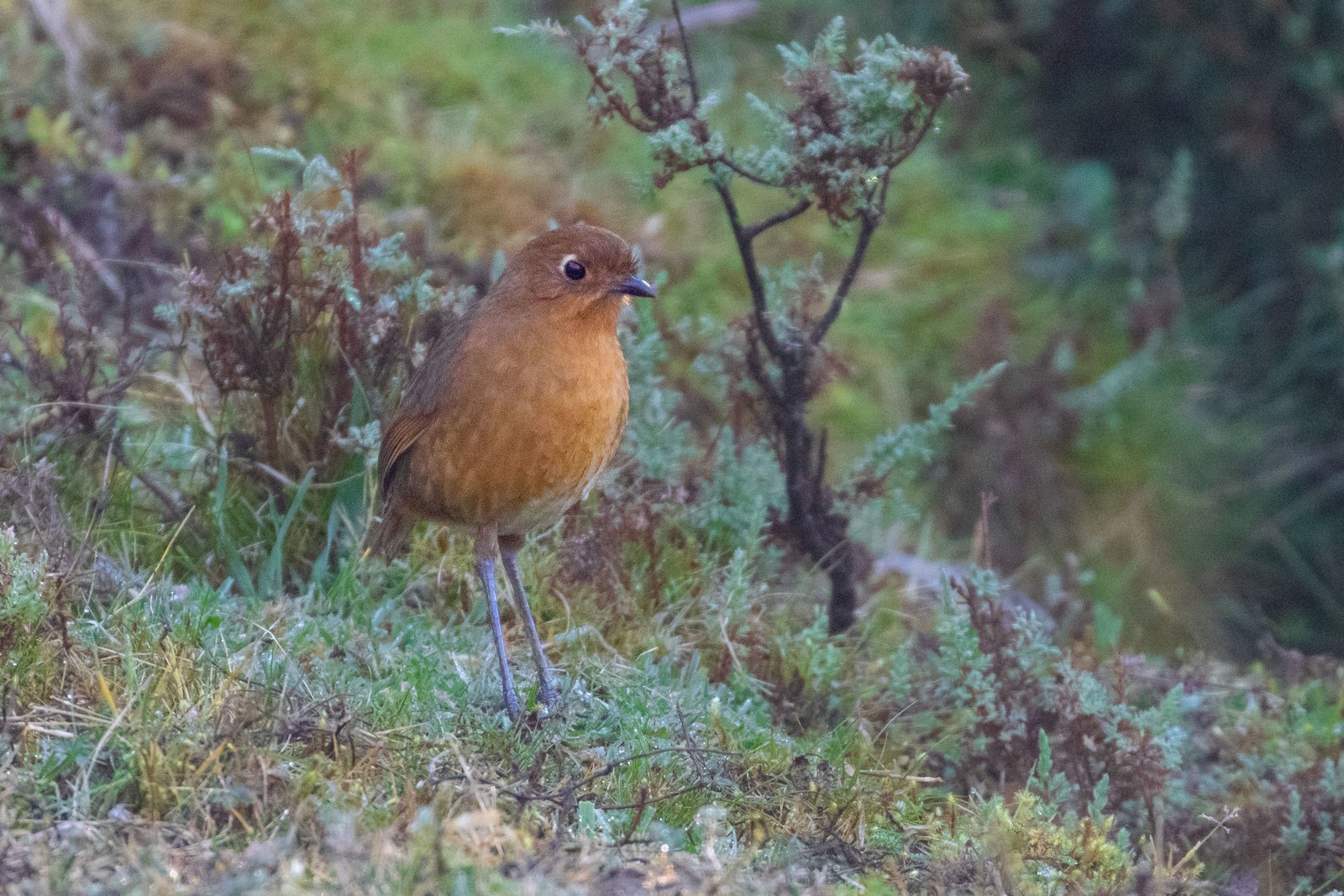
14–15 cm, small, round and almost tailless, on mid-grey legs, with a blackish bill with a pink base. The crown, upperparts, wings and tail are dark yellowish rufous-brown, the flight feathers with paler edges. A pale buff ring around the eye. The throat and breast are pale rufous-brown, fading towards the belly; the belly centre is whitish, the flanks rufous-brown. The sexes are alike.
Confusion species
Oxapampa Antpitta Grallaria centralis occurs on the same part of the east slope but lower, roughly between 2400 and 2700 m, and sings a fast, clear trill. Junin Antpitta Grallaria obscura further south is very similar and is best separated by voice and range. Bay Antpitta Grallaria capitalis is larger and uniformly dark chestnut. Chestnut Antpitta Grallaria blakei is darker and lives lower.
Habitat
Probably the floor and understorey of humid cloud forest and forest edge, with abundant moss, epiphytes and Chusquea bamboo, roughly between 2750 and 3700 m, up to the treeline. Like related species it probably searches the ground for invertebrates. Nothing is known about its breeding.
Where the bird is most at home, classified by the vegetation units of the Andes and the west coast.


Range and movements
Only in Peru, on the east slope of the Andes in Huánuco and Pasco, south of the Huallaga and north of the Perené. Absent from Colombia, Ecuador, Bolivia and the Galápagos. Does not occur outside the guide area.
- Resident
- dark = core range, pale = thinly spread
How and when to look
Listen at dawn for the buzzy song in high, bamboo-rich cloud forest near the treeline in eastern Huánuco and in Pasco. Because the species was recognised only recently, its exact range is still incompletely known.
Conservation status
Not evaluated as a separate species; the broadly defined Rufous Antpitta is listed as Least Concern. The range is small; high montane forest on the east slope is locally lost to grazing, burning and agriculture.
Scientific name
Grallaria oneilli | Chesser & Isler, 2020
Chesser & Isler described the species in 2020 and placed it straight away in the genus where it still stands. The genus Grallaria was introduced in 1816 by Vieillot. The genus name comes from New Latin grallarius, 'stilt-walker', referring to the long legs. The species name honours John P. O'Neill, American ornithologist who collected the type in Huánuco in 1983. The specimen the first description was based on came from Bosque Potrero near Panao, Huánuco, Peru.