All species › Passerines › Tanagers and allies › Paramo Seedeater
Paramo Seedeater | Catamenia homochroa
Páramocatamenia | Semillero paramero | Papa-capim-do-páramo
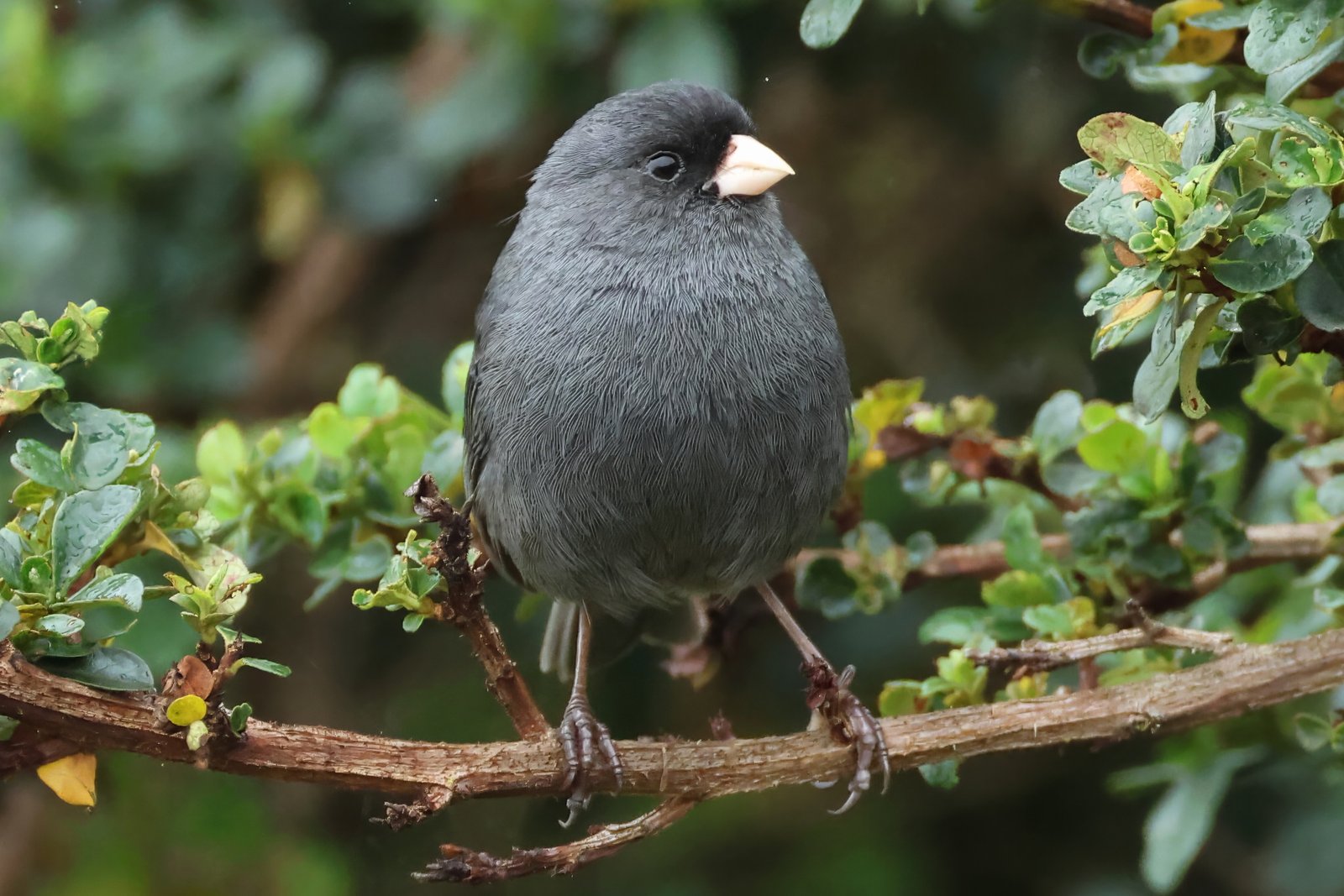
The Paramo Seedeater is a dark grey seedeater of shrubbery and elfin forest around the treeline, from Colombia to Bolivia. It is nomadic and often appears in numbers where bamboo is seeding. The male is plain slate-grey with a pink bill and a chestnut vent.
Voice
The song is a short, high, buzzy trill, sometimes preceded by a few separate notes. The call is a soft chip.
Recording: JAYRSON ARAUJO DE OLIVEIRA — CC BY-NC-SA 4.0 · xeno-canto
Identification
13 cm, with a short, thick, pink to pinkish-yellow bill. The male is plain dark slate-grey, blackish around the base of the bill, without streaks, with a chestnut vent. The female is dark olive-brown, streaked above and below, with a rusty vent. Young birds resemble the female.
Confusion species
Plain-colored Seedeater Catamenia inornata is paler grey, with streaks on the back, and lives in more open grassland. Band-tailed Seedeater Catamenia analis has a white band in the tail. Slaty Finch Haplospiza rustica has a thin, pointed, dark bill and no chestnut vent. The male Plumbeous Sierra Finch Geospizopsis unicolor is paler lead-grey, with a pointed, dark bill, and lives in open terrain.
Habitat
Shrubbery and elfin forest at the treeline, edges of upper cloud forest, shrubby páramo and stands of bamboo, roughly between 2300 and 3600 m. It eats seeds, mainly of grasses and bamboo, and wanders to places where seed is available. Little is known about the nest.
Where the bird is most at home, classified by the vegetation units of the Andes and the west coast.


Range and movements
In Colombia locally in the Andes and in the Sierra Nevada de Santa Marta. In Ecuador locally on both slopes of the Andes. In Peru along the Andes, mainly on the east slope. In Bolivia on the east slope of the Andes. Absent from the Galápagos. Outside the guide area in Venezuela, in the Andes and on the tepuis.
- Resident
- dark = core range, pale = thinly spread
How and when to look
In shrubbery at the treeline, watch for dark grey birds with a pink bill, especially where bamboo is seeding; the species can be absent from a site for years.
Conservation status
Least Concern. The range is large, but the species is nomadic and locally scarce; fires and grazing at the treeline reduce its habitat.
Scientific name
Catamenia homochroa | Sclater, 1859
Sclater described the species in 1859 and placed it straight away in the genus where it still stands. The genus Catamenia was introduced in 1850 by Bonaparte. The genus name probably comes from Greek katamēnia, 'menses', presumably referring to the rufous undertail coverts. The species name comes from Greek homokhroos, 'uniformly coloured', referring to the plain plumage. The specimen the first description was based on came from Matos near Riobamba, Chimborazo, Ecuador.