All species › Passerines › Tanagers and allies › Black-headed Hemispingus
Black-headed Hemispingus | Pseudospingus verticalis
Zwartkoppseudospingus | Hemispingo cabecinegro | Sanhaço-de-cabeça-preta
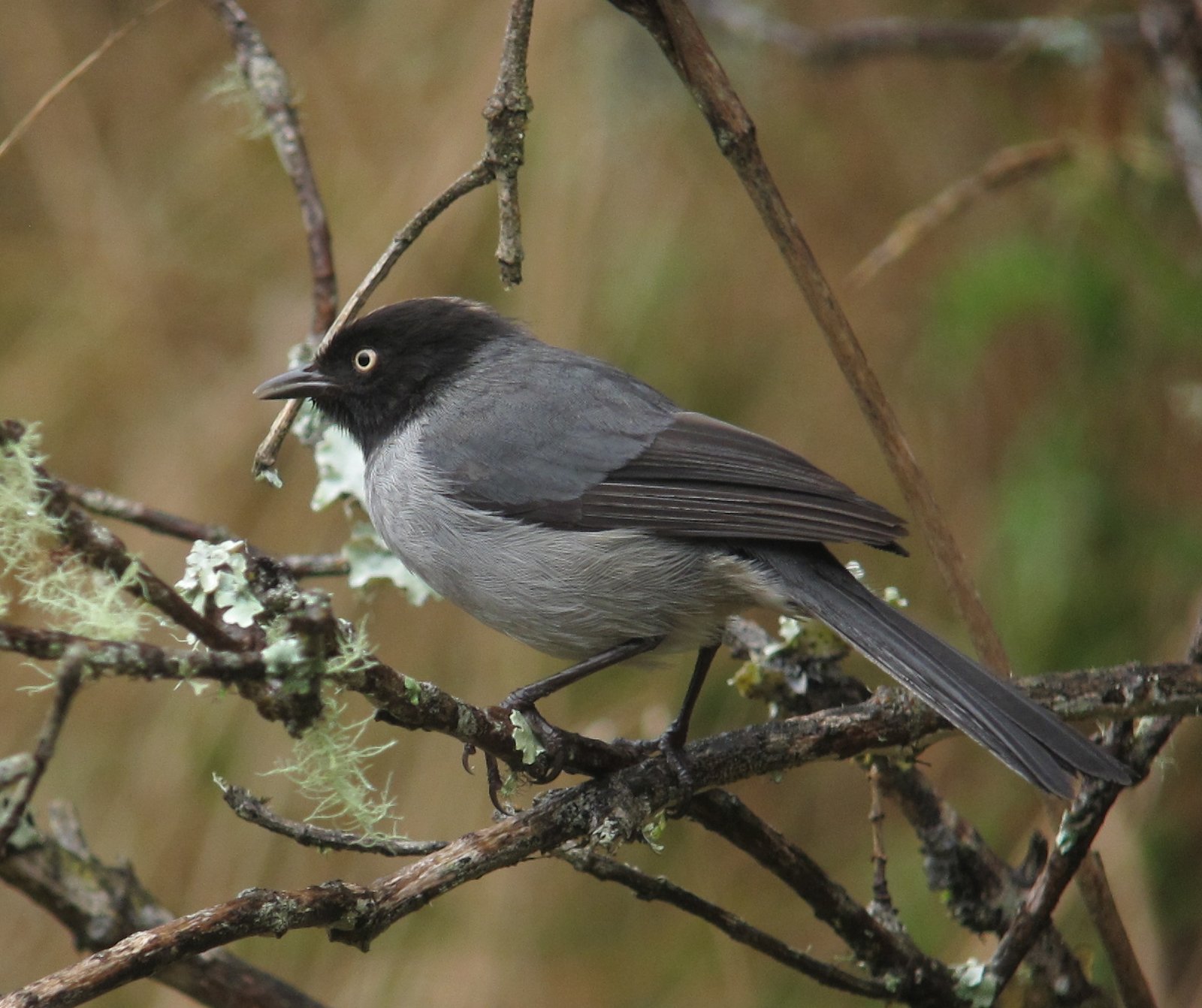
The Black-headed Hemispingus is a small grey tanager of high montane forest and the treeline in the northern Andes, with a black head and a broad pale stripe along the centre of the crown. It moves in small groups through the outer branches, often with mixed flocks. The species was formerly placed in the genus Hemispingus.
Voice
It often gives a high, thin, repeated tsit. The song is a fast, high series of twittering notes, sometimes in duet.
Recording: Jorge Enrique Avendaño — CC BY-NC-SA 4.0 · xeno-canto
Identification
14 cm, with a thin, pointed, blackish bill. The head is black, with a broad greyish-white to buffy-white median stripe from the forehead to the nape. Upperparts grey, underparts paler grey, whiter towards the belly. Sexes alike. Young birds are duller, with a less sharply defined crown stripe.
Confusion species
Drab Hemispingus Pseudospingus xanthophthalmus is uniform greyish brown, without a black head, with a pale eye, and lives south of the Marañón. Black-capped Hemispingus Kleinothraupis atropileus has a black crown with a long white eyebrow, olive-green upperparts and yellow underparts. Black-eared Hemispingus Sphenopsis melanotis is olive-grey above and buffy below, with a blackish ear patch.
Habitat
High montane forest, elfin forest and scrub at the treeline and the transition to páramo, roughly between 2500 and 3600 m. It forages in the outer branches and the canopy for insects and other small invertebrates, often in mixed flocks with conebills, tanagers and brushfinches. Little is known about the nest.
Where the bird is most at home, classified by the vegetation units of the Andes and the west coast.


Range and movements
In Colombia in the Andes, mainly in the Central and Eastern Andes, south to Nariño. In Ecuador in the Andes, mainly on the eastern slope, south to Loja and Zamora-Chinchipe. In Peru only in the far north (Piura and Cajamarca, north and west of the Marañón). Absent from Bolivia and the Galápagos. Outside the guide area in the Andes of western Venezuela.
- Resident
- dark = core range, pale = thinly spread
How and when to look
At the treeline and in high montane forest, follow mixed flocks; the groups call constantly and usually stay in the outer branches of shrubs and low trees.
Conservation status
Least Concern. The species is fairly common in much of its range. Clearing and burning at the treeline locally reduce its habitat.
Scientific name
Pseudospingus verticalis | (de Lafresnaye, 1840)
De Lafresnaye described the species in 1840 as Nemosia verticalis; because it was later moved to another genus, the author and year stand in brackets. The genus Pseudospingus was introduced in 1896 by Berlepsch & Sztolcman. The genus name combines Greek pseudos, 'false', and spingos, 'finch'. The species name comes from Latin verticalis, van vertex, 'of the crown', for the black head. The specimen the first description was based on came from Bogotá, Colombia.