All species › Passerines › Tanagers and allies › Drab Hemispingus
Drab Hemispingus | Pseudospingus xanthophthalmus
Geeloogpseudospingus | Hemispingo modesto | Sanhaço-pardo
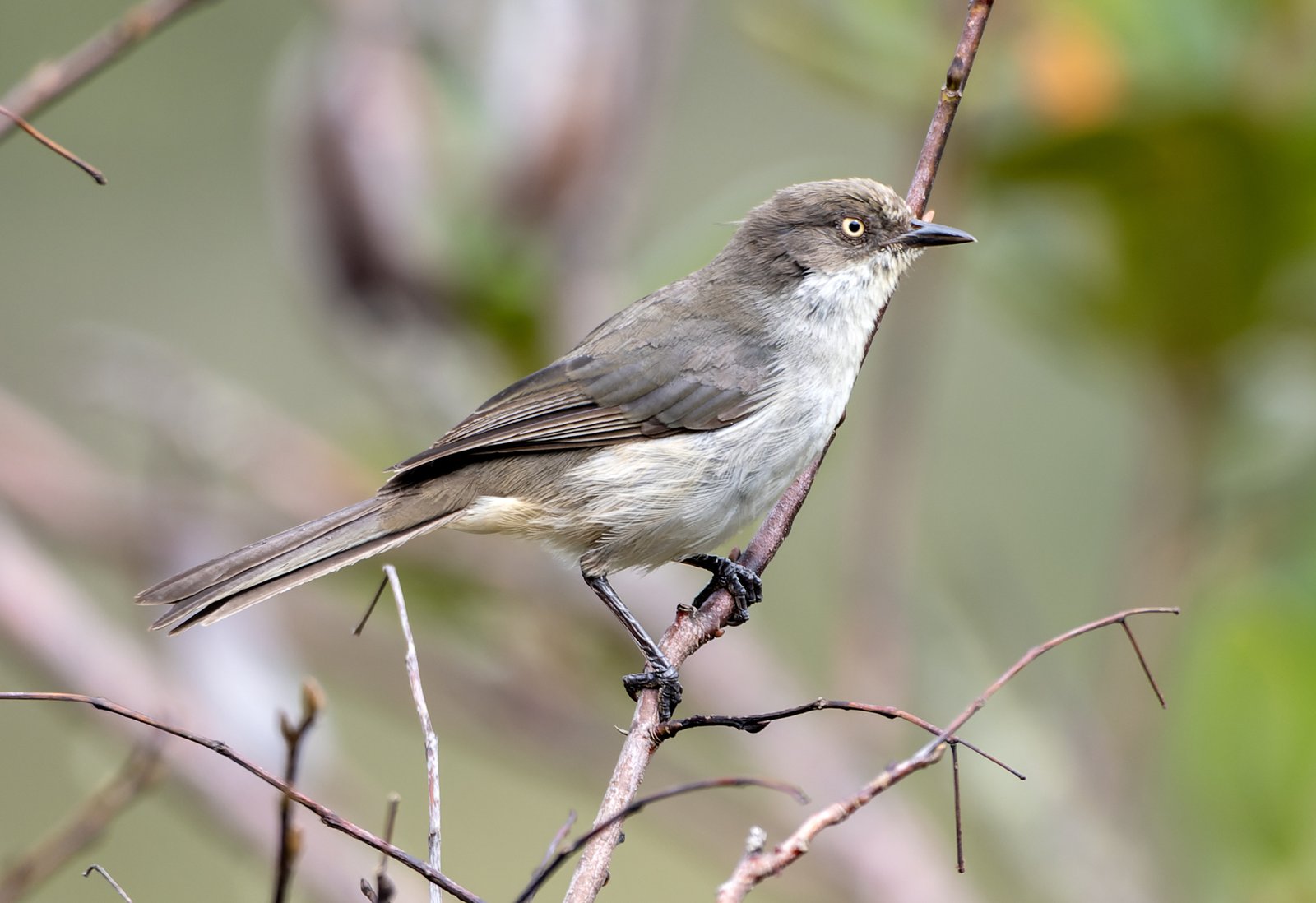
The Drab Hemispingus is a small, uniformly greyish-brown tanager of high montane forest on the eastern slope of the Andes of Peru and Bolivia. Its most distinctive feature is the pale, white to pale yellow eye in an otherwise plain plumage. It is the southern counterpart of Black-headed Hemispingus.
Voice
The song is a fast series of sharp tchip notes that accelerates into squeaky warbling. The call is a high tsit.
No recording with a suitable Creative Commons licence is available for this species yet.
Identification
13–14 cm, with a thin, pointed, blackish bill and blackish legs. Head, upperparts, wings and tail uniform brownish grey. Throat and belly whitish, breast greyish white, flanks greyer, undertail coverts tinged buff. The iris is white to pale yellow. Sexes alike. Young birds are browner, with a darker eye.
Confusion species
Black-headed Hemispingus Pseudospingus verticalis has a black head with a pale crown stripe and lives north of the Marañón. Oleaginous Hemispingus Sphenopsis frontalis is olive-green with yellowish underparts and a yellow eyebrow. Superciliaried Hemispingus Thlypopsis superciliaris has yellow underparts and a pale eyebrow. Female conebills (Conirostrum) have a more pointed bill and usually a dark eye.
Habitat
Humid montane forest, cloud forest and elfin forest up to the treeline, also scrub and bamboo at forest edges, in Peru roughly between 2200 and 3350 m, in Bolivia at about 2900–3050 m. It forages in the middle and upper levels of the forest, often in mixed flocks, for insects. Little is known about the nest.
Where the bird is most at home, classified by the vegetation units of the Andes and the west coast.


Range and movements
In Peru on the eastern slope of the Andes, from Amazonas and San Martín (south of the Marañón) through La Libertad, Huánuco, Pasco and Junín to Cusco and Puno. In Bolivia in the Andes of La Paz. Absent from Colombia, Ecuador and the Galápagos. Does not occur outside the guide area.
- Resident
- dark = core range, pale = thinly spread
How and when to look
In cloud forest and elfin forest near the treeline, follow mixed flocks, for example along the high roads on the eastern slope in Cusco and Huánuco; look for the pale eye in an otherwise plain plumage.
Conservation status
Least Concern. The species is fairly common in most of its range. Clearing and burning at the treeline locally reduce its habitat.
Scientific name
Pseudospingus xanthophthalmus | (Taczanowski, 1874)
Taczanowski described the species in 1874 as Dacnis xanthophthalma; because it was later moved to another genus, the author and year stand in brackets. The genus Pseudospingus was introduced in 1896 by Berlepsch & Sztolcman. The genus name combines Greek pseudos, 'false', and spingos, 'finch'. The species name combines Greek xanthos, 'yellow', and ophthalmos, 'eye', for the pale eye. The specimen the first description was based on came from Maraynioc, Junín, Peru.