All species › Passerines › Tanagers and allies › Mourning Sierra Finch
Mourning Sierra Finch | Rhopospina fruticeti
Rouwsierragors | Yal negro | Tico-tico-serrano-enlutado
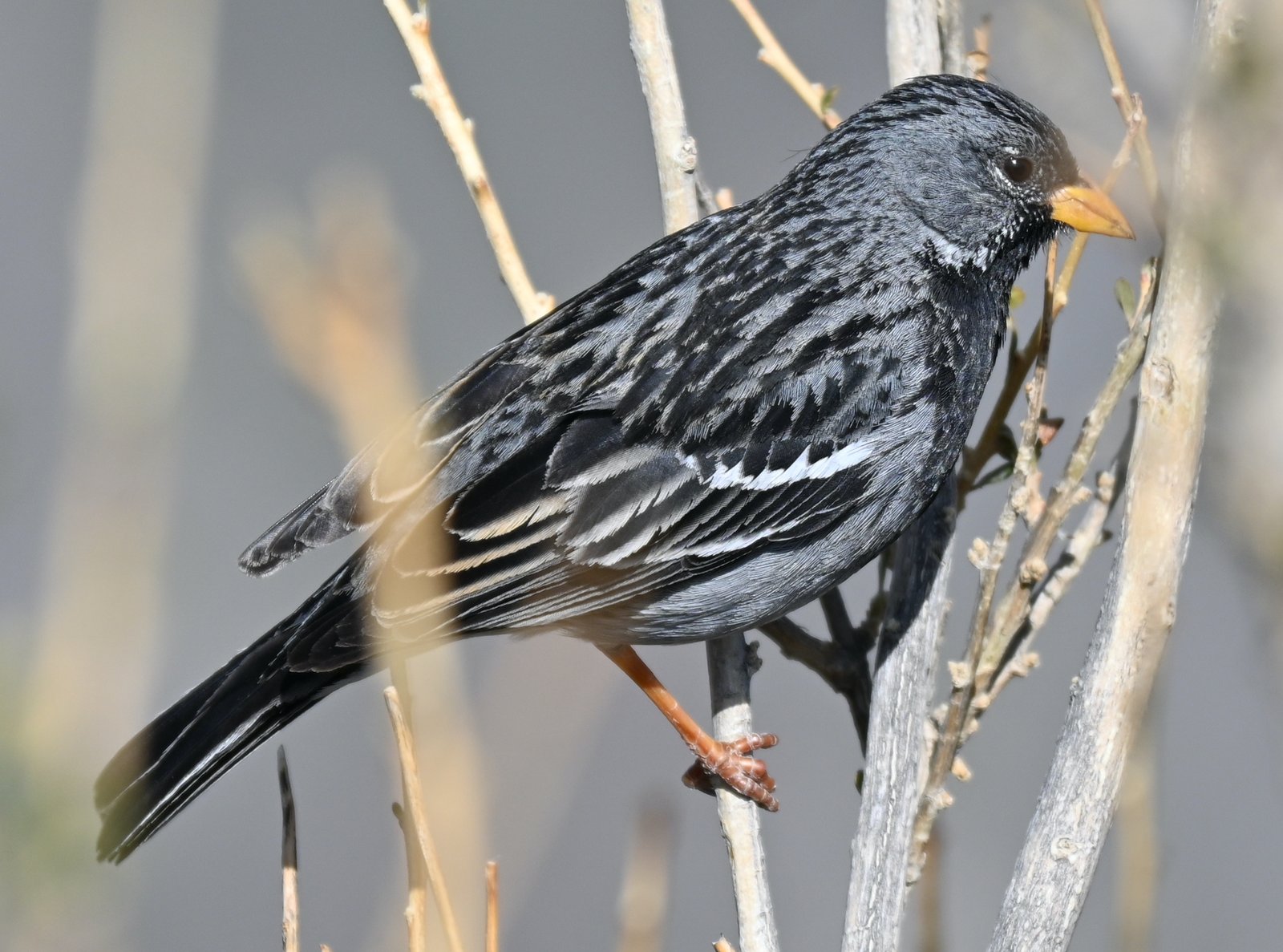
The Mourning Sierra Finch is a large, dark sierra finch of dry scrub in the Andes from Peru to Chile and Argentina. The male is grey with a black throat and breast and two white wing bars. In the breeding season the male sings in a short song flight.
Voice
The song is a series of harsh, squeaky and buzzy notes, such as chee-chee-zzzoo, often given in a short song flight upwards followed by a glide down. The call is a short, nasal chip.
Recording: Bernard BOUSQUET — CC BY-NC-SA 4.0 · xeno-canto
Identification
16 cm, with a fairly thick, yellow to orange-yellow bill and yellowish legs. The male is dark grey with a black face, a black throat and breast, a whitish belly, a faintly streaked back and two clear white wing bars. The female is brown with dark streaks on the upperparts and breast, a pale cheek patch and pale wing bars; her bill is pale yellow to horn. Young birds resemble the female but are more heavily streaked.
Confusion species
Plumbeous Sierra Finch Geospizopsis unicolor has a dark bill and lacks the white wing bars and the black breast. Band-tailed Sierra Finch Rhopospina alaudina is smaller, with a white band in the tail and a white belly without a black breast. Slender-billed Finch Xenospingus concolor has a thin, yellow bill, is plain grey and lives in scrub along streams on the west slope and in the coastal valleys.
Habitat
Dry scrub, hedgerows, field edges, Polylepis woodland, rocky slopes and shrubby puna, roughly between 2000 and 4500 m. It forages in flocks on the ground for seeds. The nest is a cup of grass and rootlets, in a shrub or among stones.
Where the bird is most at home, classified by the vegetation units of the Andes and the west coast.


Range and movements
In Peru in the Andes of the centre and south, mainly on the west slope and in dry inter-Andean valleys. In Bolivia in the west, on the altiplano and in the dry valleys. Absent from Colombia, Ecuador and the Galápagos. Outside the guide area in northern and central Chile and western Argentina.
- Resident
- dark = core range, pale = thinly spread
How and when to look
In dry scrub with hedgerows and small fields in the higher valleys, look for small flocks of dark finches with white wing bars; in the breeding season the males' song flights draw attention.
Conservation status
Least Concern. Widespread and locally common; it tolerates small-scale farming and shrubby pastures.
Scientific name
Rhopospina fruticeti | (Kittlitz, 1833)
Kittlitz described the species in 1833 as Fringilla fruticeti; because it was later moved to another genus, the author and year stand in brackets. The genus Rhopospina was introduced in 1851 by Cabanis. The genus name combines Greek rhōps, 'bush', and spinos, 'finch'. The species name comes from Latin fruticetum, 'thicket', for the habitat. The specimen the first description was based on came from Valparaíso, Chile.