All species › Passerines › Tanagers and allies › Band-tailed Sierra Finch
Band-tailed Sierra Finch | Rhopospina alaudina
Bandstaartsierragors | Yal platero | Tico-tico-serrano-de-cauda-barrada
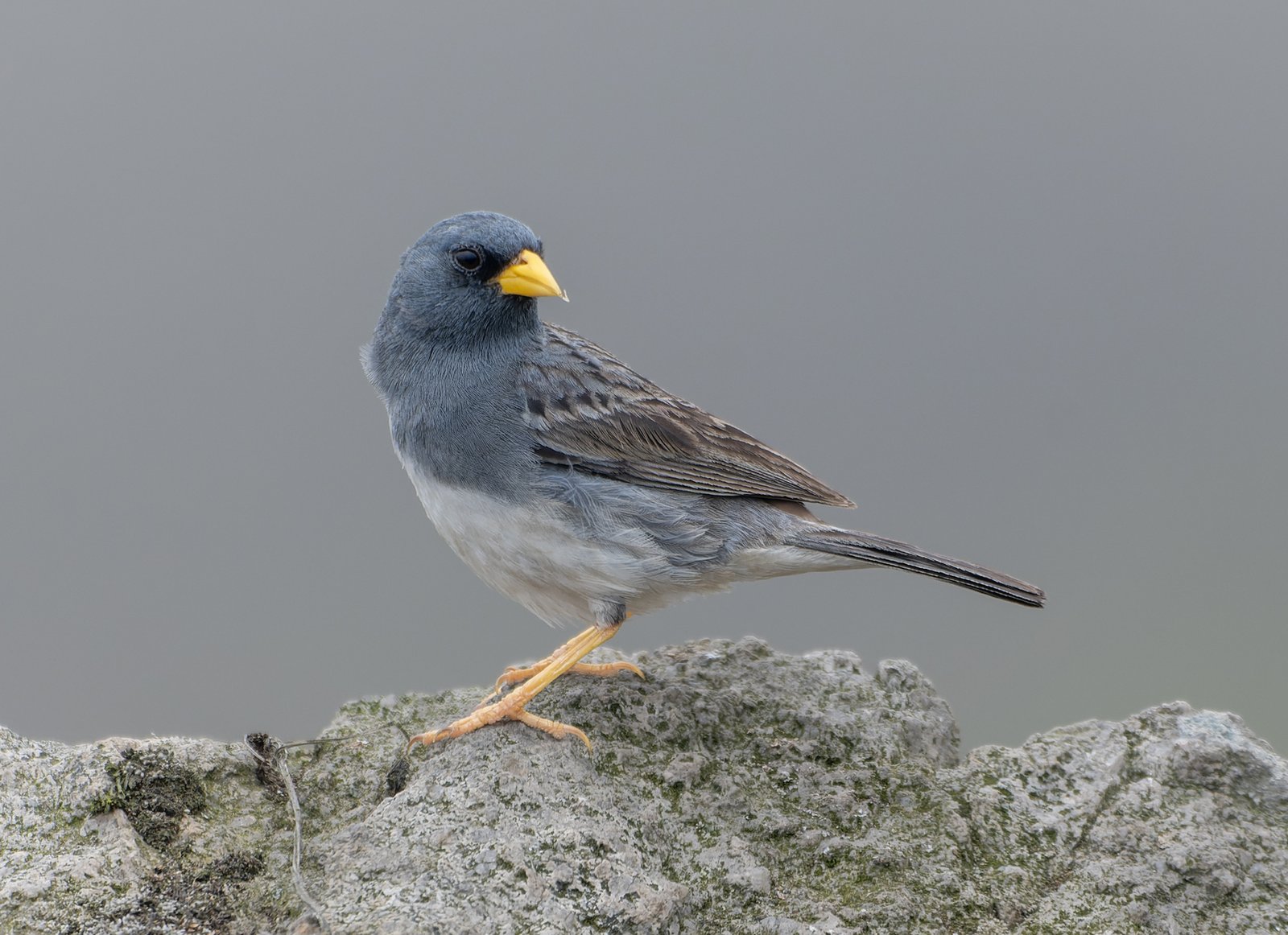
The Band-tailed Sierra Finch is a small sierra finch of dry, open country in the Andes from Ecuador to Chile and Argentina. The white band across the middle of the tail is visible mainly in flight. The male often sings in a short song flight, gliding down with the tail spread.
Voice
The song is a short, dry series of chirping and buzzy notes, often during the song flight. The call is a soft chip.
No recording with a suitable Creative Commons licence is available for this species yet.
Identification
14 cm, with a pointed, orange-yellow bill and orange-yellow legs. The male has a grey head and breast, a brownish-grey, dark-streaked back and a white belly; the tail is dark with a broad white band. The female is brown with dark streaks, also on the breast, and has the same tail band and a paler yellow bill. Young birds resemble the female.
Confusion species
Ash-breasted Sierra Finch Geospizopsis plebejus has a dark bill and no white tail band. Band-tailed Seedeater Catamenia analis also has a white band in the tail, but is plainer grey, with a thicker, yellowish bill and a chestnut vent. Mourning Sierra Finch Rhopospina fruticeti is larger, with a black breast and white wing bars.
Habitat
Dry, open country with scattered shrubs, cacti and grassland, fields, terraces and rocky slopes, roughly between 1500 and 4000 m; in southern Peru locally lower in the coastal valleys and lomas. It forages on the ground for seeds. The nest is a cup of grass, hidden among stones or under a grass tussock.
Where the bird is most at home, classified by the vegetation units of the Andes and the west coast.


Range and movements
In Ecuador in the dry inter-Andean valleys and in the south (Loja). In Peru widespread in the Andes and on the west slope, locally down to the coast. In Bolivia in the west, in the dry valleys and on the altiplano. Absent from Colombia and the Galápagos. Outside the guide area in Chile and western Argentina.
- Resident
- dark = core range, pale = thinly spread
How and when to look
In dry, open country with small fields and shrubs, look for small finches that show a white tail band as they flush.
Conservation status
Least Concern. Widespread and locally common; it tolerates small-scale farming.
Scientific name
Rhopospina alaudina | (Kittlitz, 1833) (GBIF: Porphyrospiza alaudina)
Kittlitz described the species in 1833 as Fringilla alaudina; because it was later moved to another genus, the author and year stand in brackets. The genus Rhopospina was introduced in 1851 by Cabanis. The genus name combines Greek rhōps, 'bush', and spinos, 'finch'. The species name comes from Latin alaudinus, van alauda, 'lark-like'. The specimen the first description was based on came from Valparaíso, Chile.