All species › Passerines › Tanagers and allies › Lesson's Seedeater
Lesson's Seedeater | Sporophila bouvronides
Lessons dikbekje | Semillero de Lesson | Estrela-do-norte
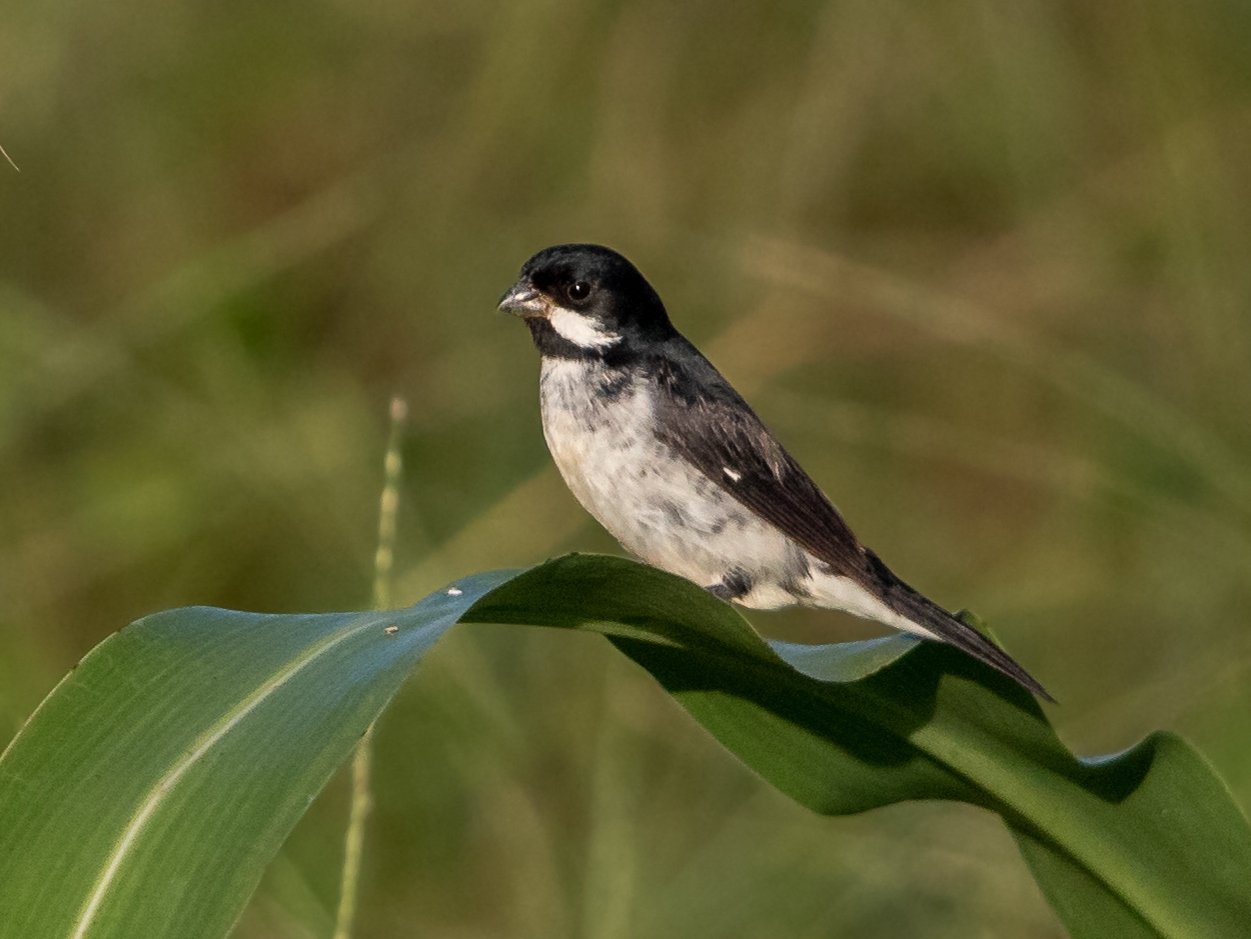
Lesson's Seedeater is a small black-and-white seedeater that breeds in the rainy season in northern South America and then moves to Amazonia. It was long treated as a subspecies of Lined Seedeater; the male lacks that species' white crown stripe. Outside the breeding season it travels in flocks, often with other seedeaters.
Voice
The song often begins with a few harsh notes and runs into a fast, rolling trill, sometimes ending in a short whistled note. The call is a short chip.
Recording: JAYRSON ARAUJO DE OLIVEIRA — CC BY-NC-SA 4.0 · xeno-canto
Identification
10–11 cm, with a short, thick bill, black in the male. The male is black above, with a broad white malar stripe along a black throat, a white wing speculum and a white rump; the underparts are whitish. The crown is black, sometimes with a few white feathers. The female is olive-brown above and paler buff-brown below, with a dark bill that is paler at the base. Young males at first resemble the female.
Confusion species
Male Lined Seedeater Sporophila lineola has a clear white crown stripe; females of the two species cannot be separated with certainty in the field. Yellow-bellied Seedeater Sporophila nigricollis has a black head without a white malar stripe and yellowish underparts. Double-collared Seedeater Sporophila caerulescens is grey above, with a black breast band. Black-and-white Seedeater Sporophila luctuosa has a black throat and breast without a malar stripe and lives in the Andes.
Habitat
Grassland, pasture, rank growth and scrub, usually near water; in the breeding season also forest edges and clearings. Outside the breeding season mainly in tall grass and rank growth on river banks, river islands and clearings in the Amazonian lowlands, mostly below 500 m. It eats mainly grass seeds. The nest is a small cup low in scrub.
Where the bird is most at home, classified by the vegetation units of the Andes and the west coast.


Range and movements
In Colombia a breeding bird in the north-east, in the Caribbean lowlands and the llanos; outside the breeding season in Amazonia in the south-east. In Ecuador and Peru outside the breeding season in the Amazonian lowlands, east of the Andes. In Bolivia outside the breeding season in the north. Absent from the Galápagos. Outside the guide area the species breeds in Venezuela, the Guianas and on Trinidad and winters in northern Amazonian Brazil.
- Resident
- Summer visitor (c. Apr–Sep)
- Winter visitor (c. Oct–Mar)
- Passage (Mar–Apr, Oct–Nov)
- dark = core range, pale = thinly spread
How and when to look
Search the Amazonian lowlands of Ecuador and Peru on river islands and in tall grass along rivers, in the months the species is present, among mixed seedeater flocks. On males, check for the lack of a white crown stripe.
Conservation status
Least Concern. The species benefits from open, man-made habitats; its migration is only partly understood.
Scientific name
Sporophila bouvronides | (Lesson, 1831)
Lesson described the species in 1831 as Pyrrhula bouvronides; because it was later moved to another genus, the author and year stand in brackets. The genus Sporophila was introduced in 1844 by Cabanis. The genus name combines Greek sporos, 'seed', and philos, 'fond of'. The species name comes from the French name Bouvreuil bouvron for the Lined Seedeater (Sporophila lineola), with Greek -idēs, 'resembling'; Lesson (1831) called this species 'Bouvreuil faux bouvron'. The specimen the first description was based on came from Trinidad, Trinidad and Tobago.