All species › Waders, gulls and terns › Sandpipers and allies › Pectoral Sandpiper
Pectoral Sandpiper | Calidris melanotos
Gestreepte strandloper | Correlimos pectoral | Maçarico-de-colete
The Pectoral Sandpiper is a medium-sized sandpiper of wet grasslands and shallow shores that breeds on the tundra of North America and northeast Siberia and winters in southern South America. Males are clearly larger than females and inflate an air sac in the throat during their display flight. In the guide area it migrates in small groups through the lowlands and over Andean lakes.
Voice
A low, rolling krrrt or trrrit, often when flushed.
Recording: JAYRSON ARAUJO DE OLIVEIRA — CC BY-NC-SA 4.0 · xeno-canto
Identification
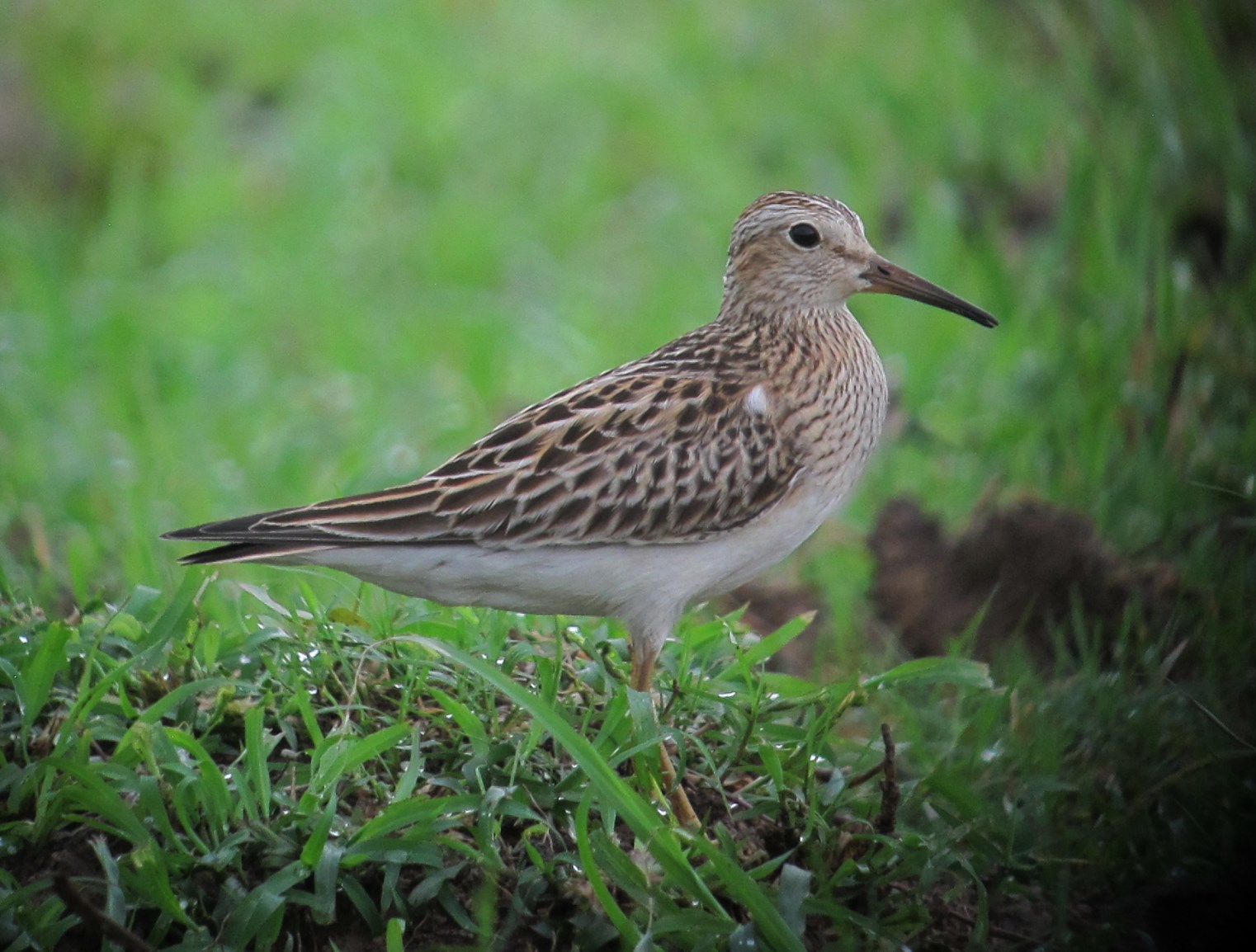
19–23 cm, a sturdy sandpiper with a rather short, slightly decurved bill with a pale base and yellowish green legs. Upperparts brown with black centres and rufous and buffy fringes; often two white V-lines on the back. Breast densely streaked brown and sharply demarcated from the white belly. Crown streaked rufous, with an indistinct pale supercilium. Juveniles are brighter rufous and buffy above. Males are larger than females, with a darker breast. In flight an indistinct wing bar and a rump with a black central stripe and white sides.
Confusion species
Buff-breasted Sandpiper Calidris subruficollis has plain buffy underparts without streaks, a short black bill and yellow legs. Baird's Sandpiper Calidris bairdii is smaller, with black legs, longer wings and a less sharply demarcated breast. Least Sandpiper Calidris minutilla looks like a scaled-down version but is much smaller, with a thinner bill. Sharp-tailed Sandpiper Calidris acuminata, a very rare vagrant, has a more rufous crown, a more distinct supercilium and no sharp border on the breast.
Habitat
Wet grasslands, marsh edges, flooded pastures, rice fields and muddy shores of lakes and rivers, from the lowlands to lakes and bofedales in the Andes above 4000 m; less often on tidal flats. It feeds in the vegetation along the water, picking and probing for insects and their larvae, spiders and small crustaceans. It does not breed in the guide area.
Where the bird is most at home, classified by the vegetation units of the Andes and the west coast.


Range and movements
In Colombia a passage migrant throughout most of the country, mainly in the llanos and along the coasts, also on Andean lakes. In Ecuador a passage migrant on the coast, in the Andes and in the Amazonian lowlands. In Peru a passage migrant along the coast, on puna lakes and in the Amazonian lowlands. In Bolivia a passage migrant and local winter visitor, mainly in the savannas of Beni and Santa Cruz and on the altiplano. On the Galápagos a scarce passage migrant. Breeds on the tundra of Alaska, northern Canada and northeast Siberia and winters mainly on the grasslands and wetlands of Argentina, Uruguay, Paraguay and southern Brazil.
- Resident
- Summer visitor (c. Apr–Sep)
- Winter visitor (c. Oct–Mar)
- Passage (Mar–Apr, Oct–Nov)
- dark = core range, pale = thinly spread
How and when to look
From August to November and in March and April on flooded pastures, rice fields and marsh edges; birds often hide in short grass and fly up calling when disturbed. Look for the sharp border between the streaked breast and the white belly.
Conservation status
Least Concern. The population is large, but counts point to a decline, probably through the loss of wet grasslands on the wintering and stopover grounds.
Scientific name
Calidris melanotos | (Vieillot, 1819)
Vieillot described the species in 1819 as Tringa melanotos; because it was later moved to another genus, the author and year stand in brackets. The genus Calidris was introduced in 1804 by Merrem. The genus name comes from Greek kalidris or skalidris, a term used by Aristotle for an unidentified grey waterside bird. The specific name comes from Greek melas, 'black', and nōton, 'back', so 'black-backed'. The specimen the first description was based on came from Paraguay.