All species › Waders, gulls and terns › Sandpipers and allies › Baird's Sandpiper
Baird's Sandpiper | Calidris bairdii
Bairds strandloper | Correlimos de Baird | Maçarico-de-bico-fino
Baird's Sandpiper breeds on the high-Arctic tundra of North America and northeast Siberia and migrates to southern South America. Many birds follow the chain of the Andes and winter on lakes and pools of the puna and altiplano, up to above 4000 m. In the guide area it is therefore mainly a sandpiper of the high mountains.
Voice
A low, rolling krrrt or kreep, mainly when flushed.
Recording: Stanislas Wroza — CC BY-NC-SA 4.0 · xeno-canto
Identification
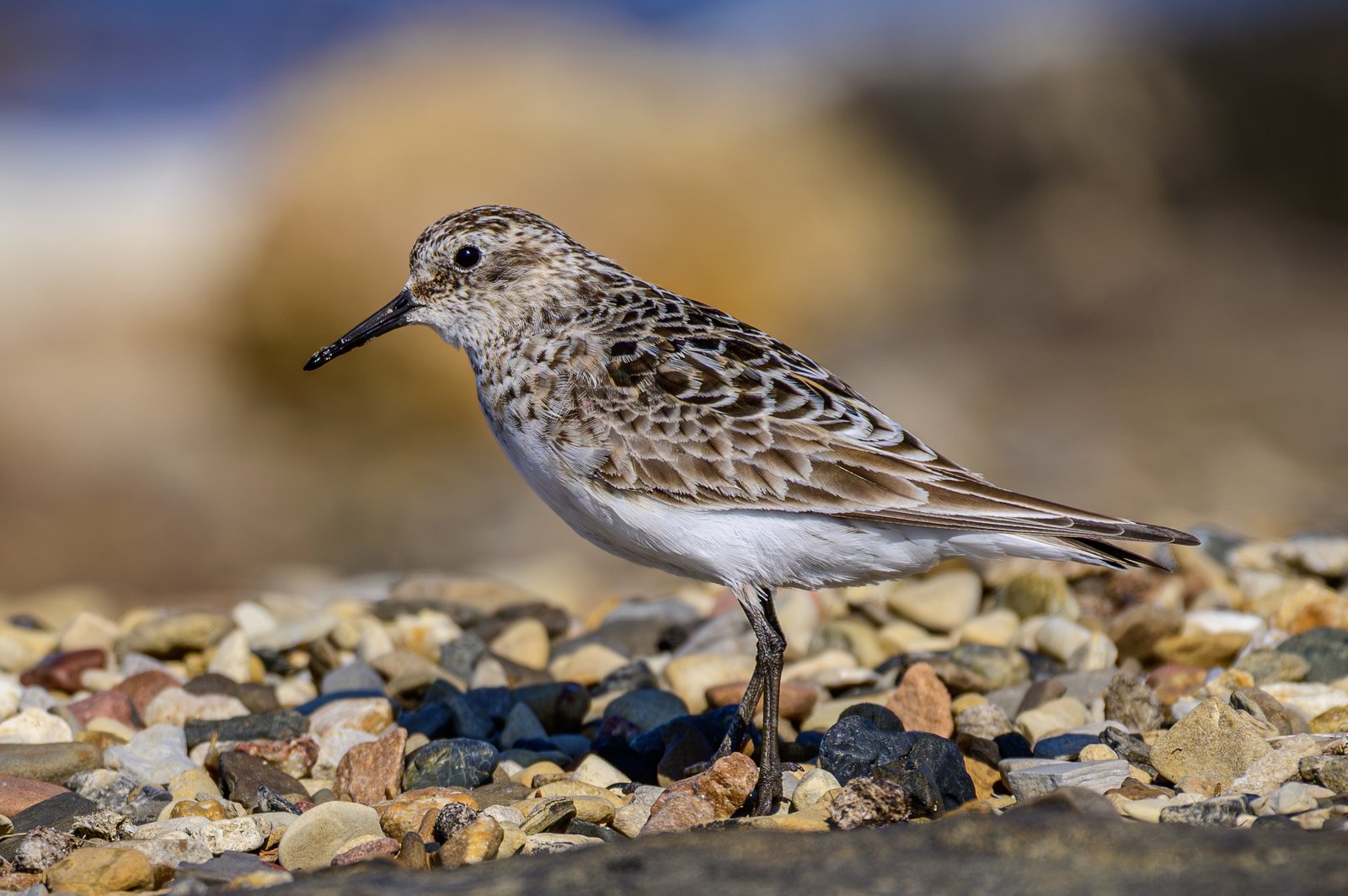
15–18 cm, a slender small sandpiper with long wings that extend well beyond the tail, giving the bird an elongated, low-slung look. Bill straight, thin and black; legs black. Upperparts greyish brown to buffy brown with dark centres and pale fringes, giving the back a scaly look. Breast buffy with fine streaks, demarcated from the white belly. Juveniles, most numerous from August to October, have a neatly scaled, buffy back. In flight a narrow, indistinct wing bar and a rump with a dark central stripe. The sexes are alike.
Confusion species
White-rumped Sandpiper Calidris fuscicollis also has long wings but is greyer, with a completely white rump, a finely streaked breast that continues onto the flanks and a reddish brown base to the lower mandible. Pectoral Sandpiper Calidris melanotos is larger, with yellowish green legs and a sharply demarcated, densely streaked breast. Least Sandpiper Calidris minutilla is smaller, with yellowish green legs and shorter wings; Semipalmated Sandpiper Calidris pusilla has a shorter, blunt-tipped bill and shorter wings.
Habitat
Edges of lakes and pools, bofedales, wet puna and salt lakes on the altiplano, mainly between 3000 and 4600 m; on passage also on coastal mudflats and lowland shores. It feeds with short runs, picking insects, fly larvae and small crustaceans from the surface; it probes less often. It does not breed in the guide area.
Where the bird is most at home, classified by the vegetation units of the Andes and the west coast.


Range and movements
In Colombia a scarce passage migrant, mainly in the Andes and on the coast. In Ecuador a passage migrant on Andean lakes, scarce on the coast. In Peru a passage migrant and winter visitor on puna lakes and in bofedales, on passage also on the coast. In Bolivia a passage migrant and winter visitor on the altiplano, scarce in the lowlands. On the Galápagos a rare visitor. Breeds in northern Alaska, Canada and Greenland and in northeast Siberia, and winters mainly in the high Andes from Peru to Argentina and in Patagonia.
- Resident
- Winter visitor (c. Oct–Mar)
- Passage (Mar–Apr, Oct–Nov)
- dark = core range, pale = thinly spread
How and when to look
Mainly from August to October, in smaller numbers until April, on the shores of puna lakes such as Lake Titicaca and in bofedales above 3500 m, often in small groups among other shorebirds; look for the long wing tips and the buffy, scaly back.
Conservation status
Least Concern. The world population is large and appears stable; the species depends less on coastal wetlands than many other sandpipers.
Scientific name
Calidris bairdii | (Coues, 1861)
Coues described the species in 1861 as Actodromas (Actodromas) Bairdii; because it was later moved to another genus, the author and year stand in brackets. The genus Calidris was introduced in 1804 by Merrem. The genus name comes from Greek kalidris or skalidris, a term used by Aristotle for an unidentified grey waterside bird. The specific name honours Spencer Fullerton Baird (1823–1887), American ornithologist and Secretary of the Smithsonian Institution. The specimen the first description was based on came from Fort Resolution, Great Slave Lake, Canada.