All species › Waders, gulls and terns › Sandpipers and allies › Sanderling
Sanderling | Calidris alba
Drieteenstrandloper | Correlimos tridáctilo | Maçarico-branco
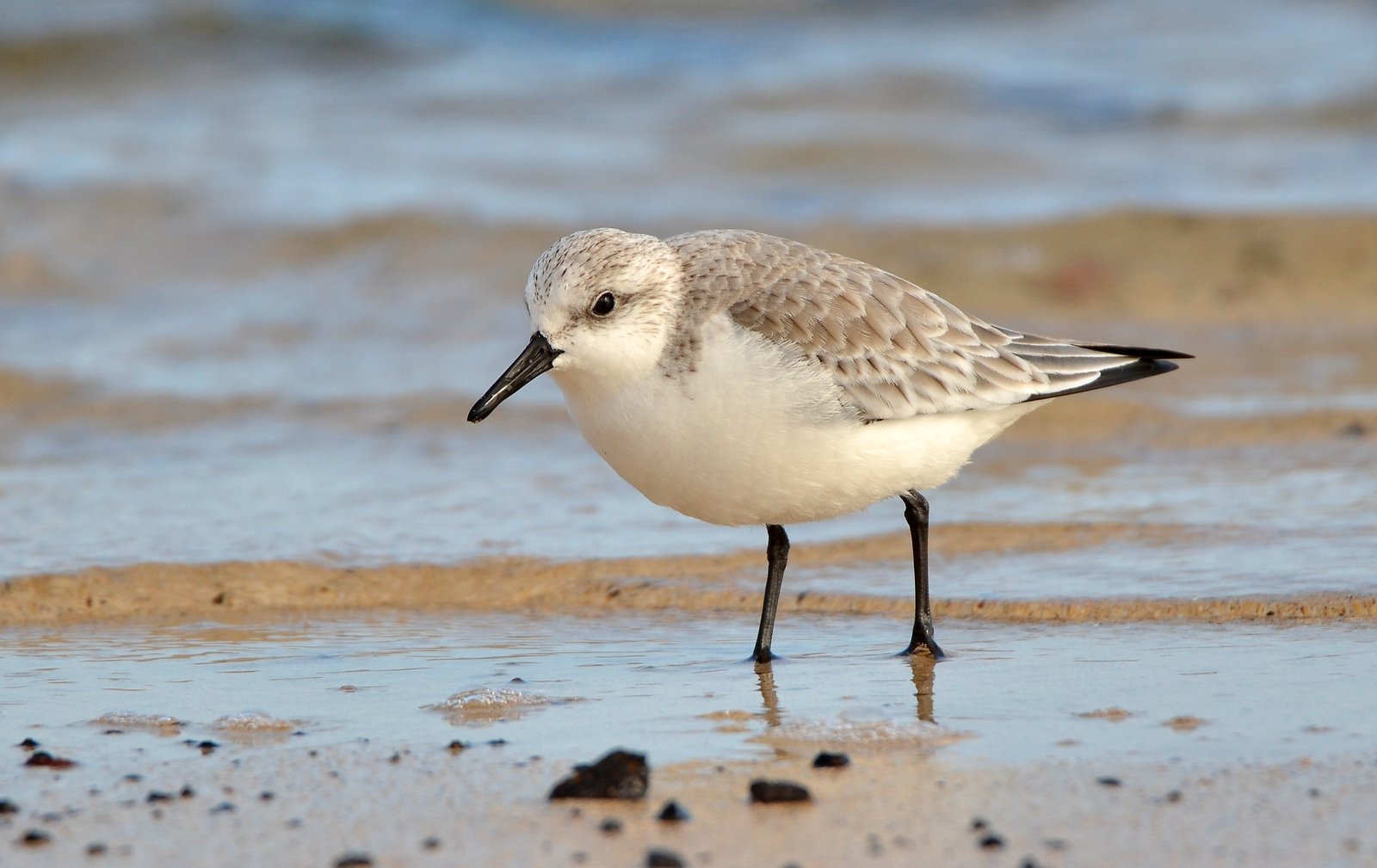
The Sanderling breeds on the high Arctic tundra and winters on sandy beaches over almost the entire world. Flocks run with rapid steps after the retreating waves and flee up the beach from the next wave. In the guide area it is a common winter visitor along the Pacific coast and in the Galápagos.
Voice
A short, sharp kwit or plit, often in flight; flocks give a soft twittering.
Recording: Daan van der Hoeven — CC BY-NC-SA 4.0 · xeno-canto
Identification
18–21 cm, a stocky sandpiper with a straight, rather short, black bill and black legs without a hind toe. In non-breeding plumage the palest sandpiper: pale grey above, pure white below, with a whitish face and a blackish mark at the shoulder. In breeding plumage, partly seen in April and May, the head, breast and upperparts are rufous with black spots. Juveniles have black-and-white chequered upperparts and pale buff breast sides. In flight a broad white wing bar on a dark wing. The sexes are nearly alike.
Confusion species
Western Sandpiper Calidris mauri and Semipalmated Sandpiper Calidris pusilla are smaller and darker greyish brown, with a hind toe, and feed more often on mud than in the surf. Dunlin Calidris alpina, a very rare vagrant, has a longer, tip-drooping bill and a darker breast. Red Knot Calidris canutus is larger, with a longer bill and greenish legs.
Habitat
Sandy beaches along the open coast, also tidal flats, river mouths and the edges of rocky shores; almost only at sea level, rarely on migration at inland lakes. It runs in the swash zone and picks small crustaceans, worms and molluscs from the wet sand. It does not breed in the guide area.
Where the bird is most at home, classified by the vegetation units of the Andes and the west coast.


Range and movements
In Colombia a winter visitor on the Pacific and Caribbean coasts. In Ecuador a common winter visitor along the whole coast. In Peru a common winter visitor along the whole coast. In the Galápagos a common winter visitor on the beaches of most islands. In Bolivia only a rare passage migrant at inland lakes. Breeds on the high Arctic tundra of North America, Greenland and Siberia and winters along coasts throughout the world, in the Americas south to Tierra del Fuego.
- Resident
- Winter visitor (c. Oct–Mar)
- Passage (Mar–Apr, Oct–Nov)
- dark = core range, pale = thinly spread
How and when to look
From September to April on almost any sandy beach along the coasts of Ecuador and Peru and in the Galápagos; flocks run with the waves in the swash zone and fly low over the water to the next spot.
Conservation status
Least Concern. The world population is large, but disturbance of beaches and the loss of roosts along the flyways can cause local declines.
Scientific name
Calidris alba | (Pallas, 1764)
Pallas described the species in 1764 as Trynga alba; because it was later moved to another genus, the author and year stand in brackets. The genus Calidris was introduced in 1804 by Merrem. The genus name comes from Greek kalidris or skalidris, a term used by Aristotle for an unidentified grey waterside bird. The specific name comes from Latin albus, 'white'. The specimen the first description was based on came from North Sea coast.