All species › Waders, gulls and terns › Sandpipers and allies › Buff-breasted Sandpiper
Buff-breasted Sandpiper | Calidris subruficollis
Blonde ruiter | Correlimos canelo | Maçarico-acanelado
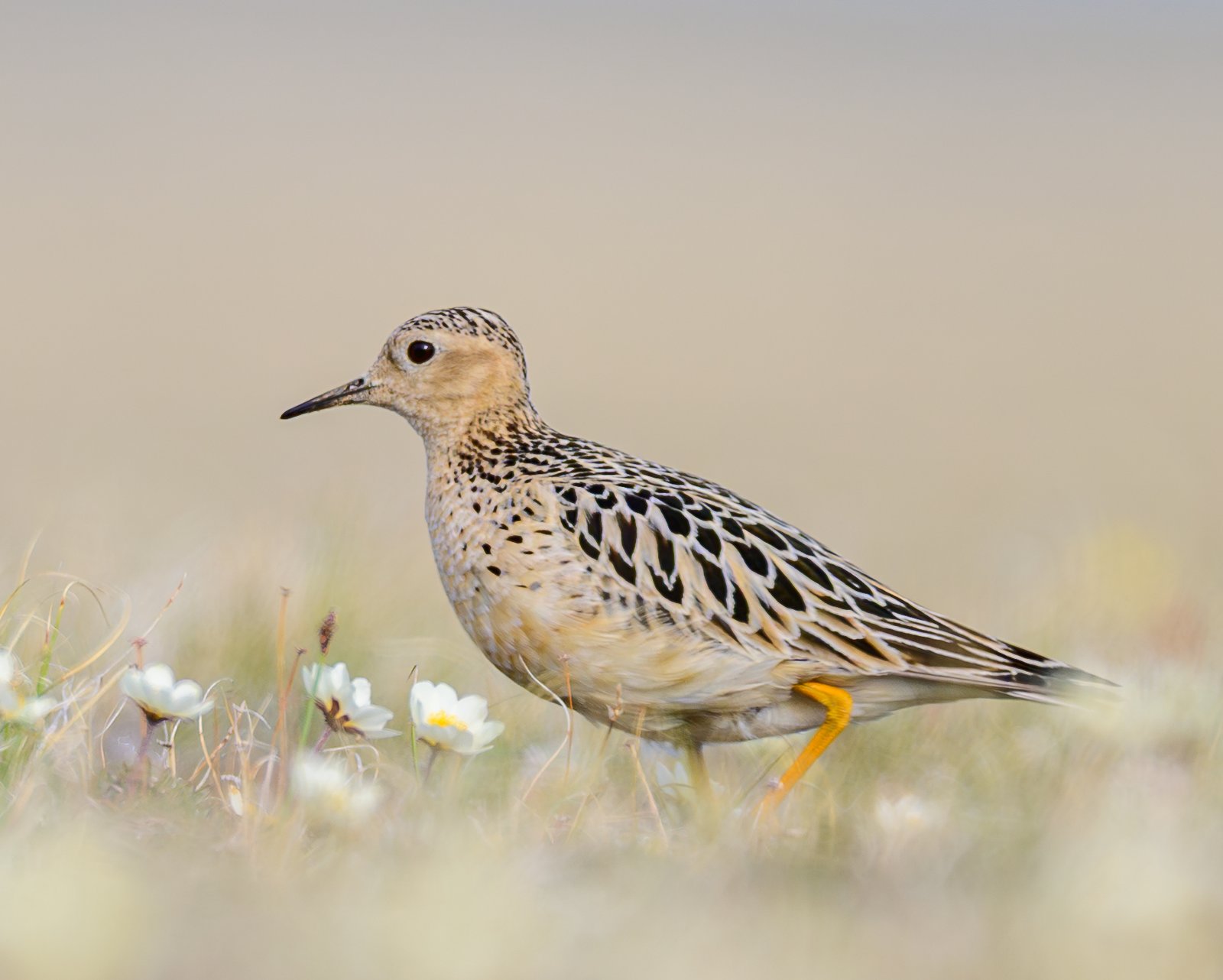
The Buff-breasted Sandpiper is a sandpiper of short grassland that breeds on the tundra of Alaska and northern Canada and winters on the pampas of Argentina, Uruguay and southern Brazil. Males display on a communal lek by raising the wings to show the white underwings. In the guide area it is a scarce passage migrant in spring and autumn, mainly over the lowlands east of the Andes.
Voice
Mostly silent. In flight sometimes a low, soft prrreet or a short tik.
Recording: Paul Kelly — CC BY-NC-SA 4.0 · xeno-canto
Identification
18–21 cm, a slender sandpiper with a small, round head, a short, thin, dark bill, large dark eyes in a plain face and yellow legs. The face, neck and underparts are plain warm buff, with small dark spots on the sides of the breast. The upperparts are dark with broad buff fringes, giving a scaly pattern. In flight there is no wing bar, and the underwings are pure white with a dark edge to the primaries. Males are slightly larger than females; juveniles are slightly paler below, with finer scaling.
Confusion species
Pectoral Sandpiper Calidris melanotos has a densely streaked breast sharply demarcated from the white belly. Upland Sandpiper Bartramia longicauda is much larger, with a long neck and a long tail. Females and juveniles of Ruff Calidris pugnax, a very rare vagrant, are larger, with a longer bill and white patches on either side of the rump. Baird's Sandpiper Calidris bairdii has black legs and a white belly.
Habitat
Short grassland, pastures, airfields, playing fields, exposed river sandbars and bare shores of lakes and lagoons; mainly in the lowlands, locally also in the Andes. It walks and picks insects and spiders from the ground. It does not breed in the guide area.
Where the bird is most at home, classified by the vegetation units of the Andes and the west coast.


Range and movements
In Colombia a scarce passage migrant in the lowlands east of the Andes, rare elsewhere. In Ecuador a scarce passage migrant mainly in the Amazonian lowlands, rare in the Andes and on the coast. In Peru a scarce passage migrant in the Amazonian lowlands, rare on the coast and in the Andes. In Bolivia a passage migrant in the lowlands, mainly in the savannas of Beni and Santa Cruz. In the Galápagos at most a very rare vagrant. Breeds on the tundra of Alaska and northern Canada and winters on the grasslands of Argentina, Uruguay and southern Brazil.
- Passage (Mar–Apr, Oct–Nov)
- dark = core range, pale = thinly spread
How and when to look
In September and October and again in March and April on short grassland, airfields and exposed sandbars in the lowlands east of the Andes, often together with American Golden-Plovers; the birds often allow a close approach.
Conservation status
Vulnerable. The world population is small and declining, mainly through the loss of natural grassland on the wintering grounds and along the migration route; in the early 20th century the species was heavily hunted.
Scientific name
Calidris subruficollis | (Vieillot, 1819)
Vieillot described the species in 1819 as Tringa subruficollis; because it was later moved to another genus, the author and year stand in brackets. The genus Calidris was introduced in 1804 by Merrem. The genus name comes from Greek kalidris or skalidris, a term used by Aristotle for an unidentified grey waterside bird. The specific name comes from Latin sub, 'somewhat', rufus, 'red', and collis, 'neck', so 'reddish-necked'. The specimen the first description was based on came from Paraguay.