All species › Waders, gulls and terns › Sandpipers and allies › Stilt Sandpiper
Stilt Sandpiper | Calidris himantopus
Steltstrandloper | Correlimos zancolín | Maçarico-pernilongo
The Stilt Sandpiper is a long-legged sandpiper that breeds on the tundra of Alaska and northern Canada and winters mainly in the interior of South America. It feeds like a small dowitcher, belly-deep in water, with rapid vertical jabs of the bill. In the guide area it is a passage migrant and locally a winter visitor, mainly on salt pans and shallow lagoons.
Voice
A soft, low tew or a short, rattling kirr, often in flight.
Recording: Andrew Spencer — CC BY-NC-SA 4.0 · xeno-canto
Identification
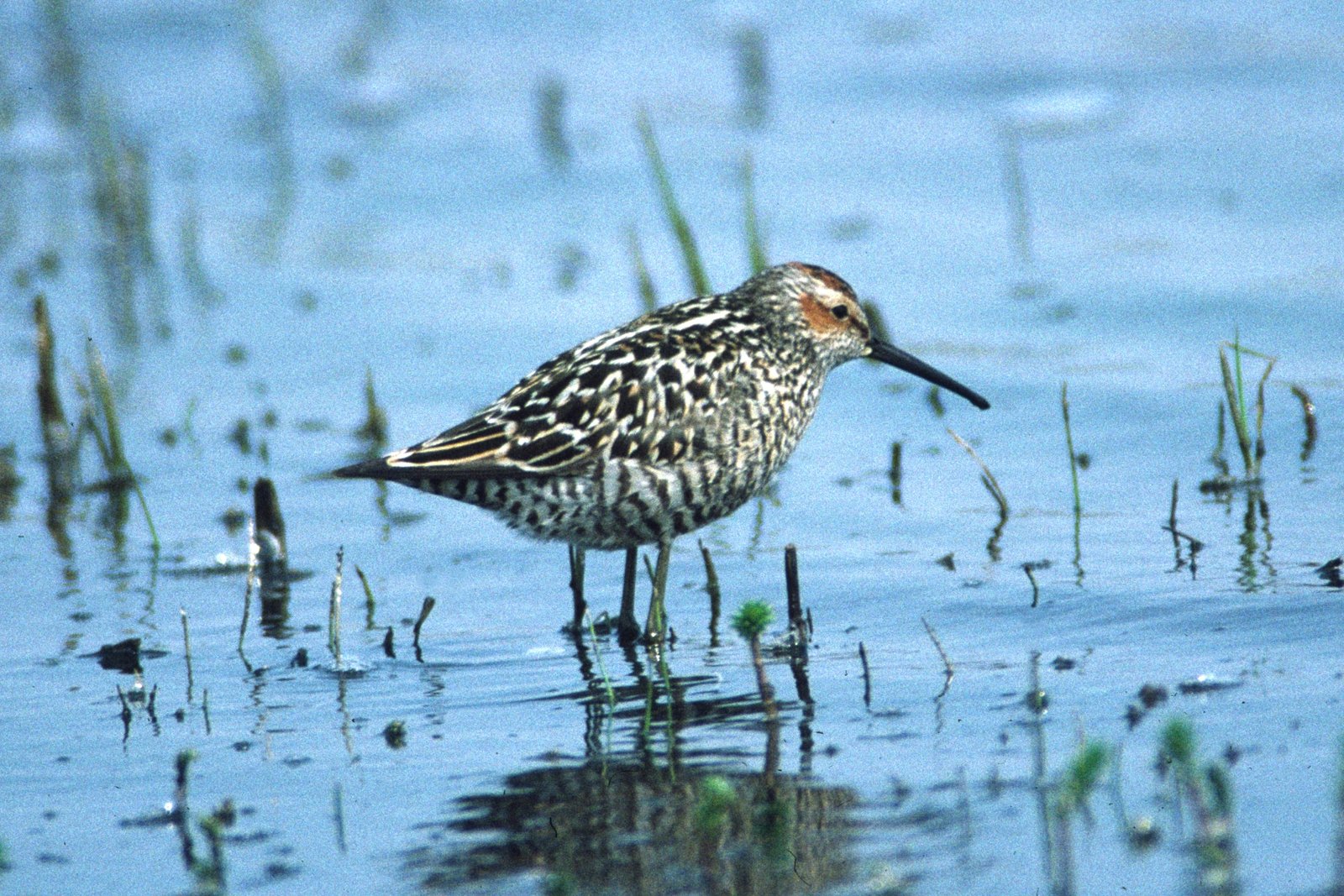
20–22 cm, a slender sandpiper with long, greenish yellow legs and a long, dark bill that droops slightly at the tip and is a little thickened there. In non-breeding plumage grey above and white below, with a white supercilium and a faintly streaked grey breast. In breeding plumage, partly seen in April, a rufous ear patch and densely barred underparts. Juveniles have dark upperparts with pale fringes and a pale buff breast. In flight a white rump and a dark wing without an obvious wing bar; the legs project beyond the tail. The sexes are nearly alike.
Confusion species
Lesser Yellowlegs Tringa flavipes has a straight, thin bill and bright yellow legs and picks rather than probes. Short-billed Dowitcher Limnodromus griseus is larger and stockier, with a much longer, straight bill and a white wedge on the back. Curlew Sandpiper Calidris ferruginea, a very rare vagrant, has black legs and a white wing bar. Wilson's Phalarope Phalaropus tricolor has a needle-thin, straight bill and often swims.
Habitat
Shallow fresh and brackish lagoons, salt pans, shrimp farms, flooded pastures and rice fields; mainly in the lowlands, on migration also on lakes in the Andes. It wades belly-deep and probes the bottom with a sewing-machine action for insect larvae, worms, small snails and seeds. It does not breed in the guide area.
Where the bird is most at home, classified by the vegetation units of the Andes and the west coast.


Range and movements
In Colombia a passage migrant and locally a winter visitor on the Caribbean coast, in the llanos and in the Andean valleys, scarce on the Pacific coast. In Ecuador a winter visitor and passage migrant mainly on the coast, especially on the salt pans of Santa Elena and around the Gulf of Guayaquil, rare in the Andes and the Amazonian lowlands. In Peru a scarce passage migrant and winter visitor on the coast, rare inland. In Bolivia a passage migrant and winter visitor in the lowlands, mainly in the savannas of Beni and Santa Cruz, rare on the altiplano. A rare visitor to the Galápagos. Breeds on the tundra of Alaska and northern Canada and winters mainly in the interior of Bolivia, Paraguay, Brazil and Argentina.
- Resident
- Summer visitor (c. Apr–Sep)
- Winter visitor (c. Oct–Mar)
- Passage (Mar–Apr, Oct–Nov)
- dark = core range, pale = thinly spread
How and when to look
From September to April on the salt pans and shrimp farms of coastal Ecuador, often among Lesser Yellowlegs and Wilson's Phalaropes; look for the continuous vertical probing with the head under water.
Conservation status
Near Threatened. Counts on the flyways indicate a decline, probably through the loss of wetlands on the wintering grounds and changes on the tundra.
Scientific name
Calidris himantopus | (Bonaparte, 1826)
Bonaparte described the species in 1826 as Tringa himantopus; because it was later moved to another genus, the author and year stand in brackets. The genus Calidris was introduced in 1804 by Merrem. The genus name comes from Greek kalidris or skalidris, a term used by Aristotle for an unidentified grey waterside bird. The specific name comes from Greek himantopous, 'strap-leg', after the long legs, as in the genus Himantopus. The specimen the first description was based on came from Long Branch, New Jersey, United States.