All species › Waders, gulls and terns › Sandpipers and allies › Surfbird
Surfbird | Calidris virgata
Brandingloper | Correlimos de rompientes | Maçarico-da-arrebentação
The Surfbird is a stocky sandpiper of rocky shores that breeds on the alpine tundra of Alaska and north-western Canada and winters along the entire Pacific coast of the Americas, south to Chile. In the guide area it lives on rocks in the surf, where it picks food from the stones between the waves.
Voice
Mostly silent in the guide area. When flushed sometimes a soft, high kee-wee or a short squeak; flocks give a soft twittering among themselves.
Recording: Davyd Betchkal — CC BY-NC-SA 4.0 · xeno-canto
Identification
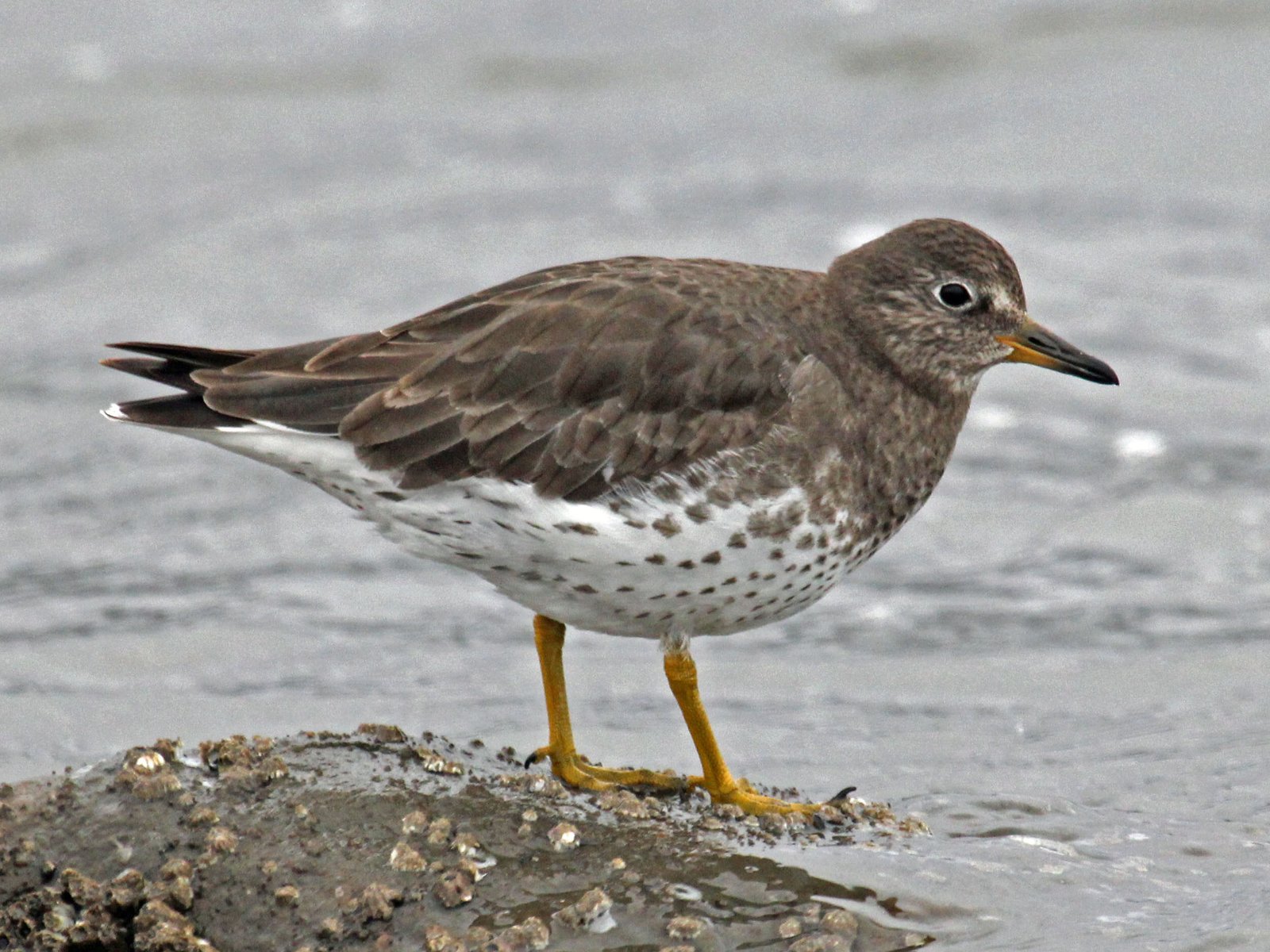
23–26 cm, a stocky, rather large sandpiper with a short, blunt bill with a yellow base and short yellow legs. In non-breeding plumage the head, breast and upperparts are plain dark grey, with a faint pale supercilium, and the underparts are white with grey spots on the flanks. In breeding plumage, partly seen as early as April, the head and breast are streaked and spotted black and white and the scapulars have rufous spots. In flight a clear white wing bar and a white tail with a black, triangular terminal band. Juveniles resemble non-breeding adults, with pale fringes to the upperpart feathers. The sexes are alike.
Confusion species
Ruddy Turnstone Arenaria interpres lives on the same rocks but is smaller, with a black-and-white breast pattern, orange legs and a pied black-and-white flight pattern. Wandering Tattler Tringa incana is slimmer, with a longer, dark bill and a plain grey tail and wings without a white bar. Red Knot Calidris canutus is paler grey, with a longer, dark bill and greenish legs, and feeds on sand and mud rather than on rocks.
Habitat
Rocky shores, rocky outcrops on sandy beaches, breakwaters and harbour jetties in the splash zone of the surf, almost only at sea level. It picks and pulls small mussels, barnacles, snails and other invertebrates from the rocks. It does not breed in the guide area.
Where the bird is most at home, classified by the vegetation units of the Andes and the west coast.


Range and movements
In Colombia a scarce winter visitor on the Pacific coast. In Ecuador a scarce winter visitor on rocky shores of the mainland, mainly on the Santa Elena Peninsula. In Peru a fairly common winter visitor along the whole coast. In the Galápagos a regular winter visitor in small numbers. Absent from Bolivia. Breeds on the alpine tundra of Alaska and Yukon and winters along the Pacific coast from Alaska to southern Chile.
- Resident
- Winter visitor (c. Oct–Mar)
- Passage (Mar–Apr, Oct–Nov)
- dark = core range, pale = thinly spread
How and when to look
From September to April on rocky headlands and breakwaters along the coasts of Peru and Ecuador, often with Ruddy Turnstones and Wandering Tattlers. The birds stay close to the surf and fly up only when a wave breaks over the rock.
Conservation status
Least Concern. The size of the population is poorly known because the species lives scattered along rocky shores; oil pollution and disturbance of roosts are possible threats.
Scientific name
Calidris virgata | (Gmelin, 1789)
Gmelin described the species in 1789 as Tringa virgata; because it was later moved to another genus, the author and year stand in brackets. The genus Calidris was introduced in 1804 by Merrem. The genus name comes from Greek kalidris or skalidris, a term used by Aristotle for an unidentified grey waterside bird. The specific name comes from Latin virgatus, 'striped'. The specimen the first description was based on came from Prince William Sound, Alaska, United States.