All species › Waders, gulls and terns › Sandpipers and allies › Red Knot
Red Knot | Calidris canutus
Kanoet | Correlimos gordo | Maçarico-de-papo-vermelho
The Red Knot is a stocky sandpiper that makes one of the longest migrations of any bird, between the high Arctic and southern South America. On migration it travels in large flocks between a limited number of traditional stopover sites. In the guide area it is a scarce passage migrant and winter visitor along the Pacific coast.
Voice
A low, short knut or wut-wut; in flocks a soft murmuring.
Recording: Arend Wassink — CC BY-NC-SA 4.0 · xeno-canto
Identification
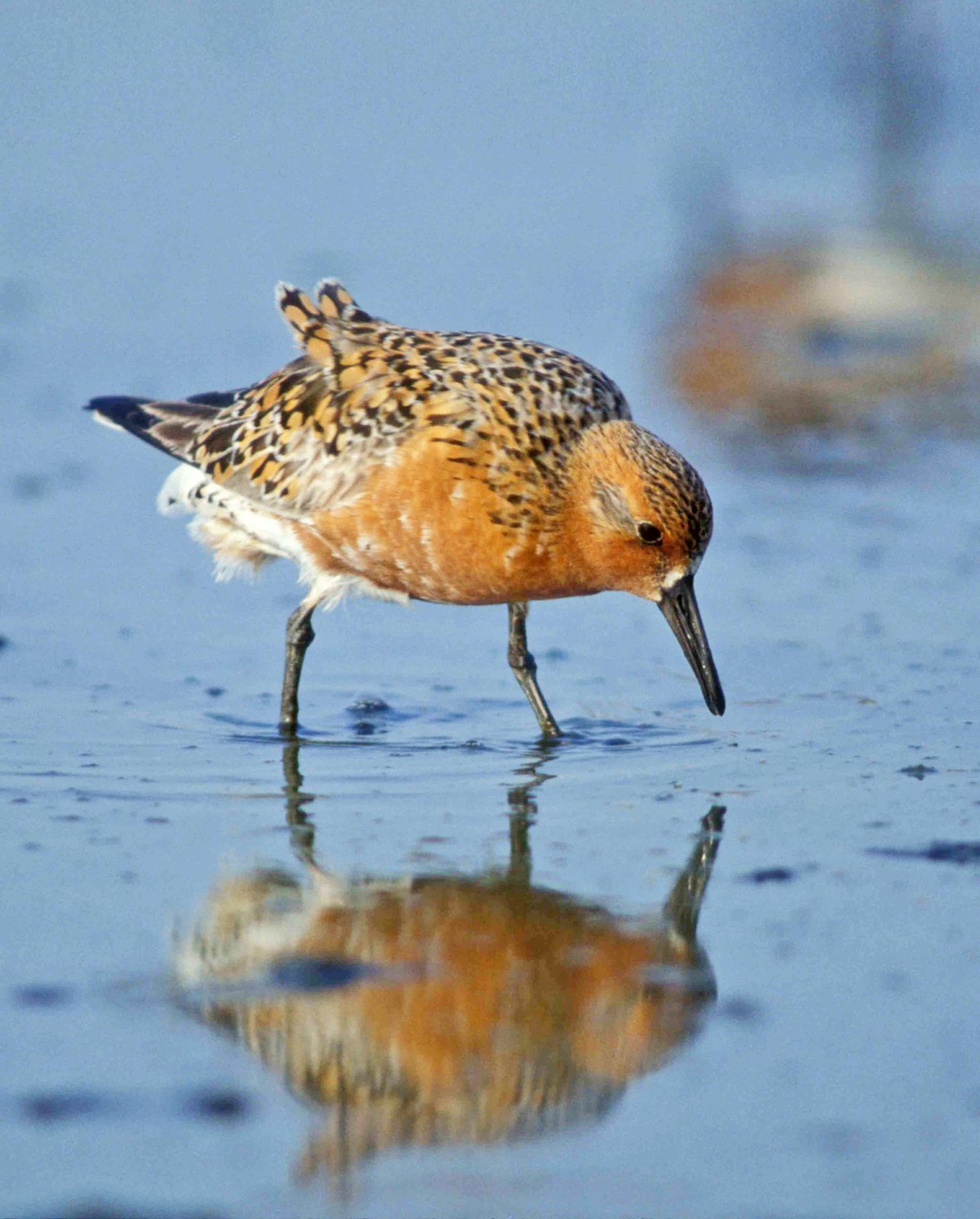
23–26 cm, a stocky, short-legged sandpiper with a straight black bill about as long as the head and short, greenish-grey legs. In non-breeding plumage plain pale grey above, with a pale supercilium, a finely streaked grey breast, fine barring on the flanks and a white belly. In breeding plumage, from April, the face, neck and underparts are rufous and the upperparts scaled black, rufous and grey. In flight a narrow white wing bar and a pale grey, finely barred rump. Juveniles have fine pale fringes with a dark inner edge on the upperparts and a faintly buff-tinged breast. The sexes are nearly alike; the female is slightly paler in breeding plumage.
Confusion species
Short-billed Dowitcher Limnodromus griseus has a much longer bill and a white wedge on the back that shows in flight. Sanderling Calidris alba is smaller and paler, with a dark mark at the bend of the wing, and runs back and forth with the waves. Grey Plover Pluvialis squatarola has a shorter, thick bill, a large head and black axillaries. Surfbird Calidris virgata has a shorter, blunt bill with a yellow base, yellow legs and a white tail with a black terminal band.
Habitat
Mudflats, sandy beaches, lagoons, salt pans and shrimp farms along the coast. It picks and probes in mud and sand, mainly for small molluscs that it swallows whole, and also for crustaceans and worms. At high tide it roosts in dense flocks. It does not breed in the guide area.
Where the bird is most at home, classified by the vegetation units of the Andes and the west coast.


Range and movements
In Colombia a rare passage migrant along the Pacific and Caribbean coasts. In Ecuador a scarce passage migrant and winter visitor along the coast, mainly at the Santa Elena salt pans. In Peru a scarce passage migrant and winter visitor along the coast. A rare visitor to the Galápagos. There are only a few records from Bolivia. Breeds on the high Arctic tundra; American birds winter mainly on the coasts of Tierra del Fuego and Patagonia, in the south-eastern United States, in northern Brazil and locally along the Pacific coast.
- Resident
- Summer visitor (c. Apr–Sep)
- Winter visitor (c. Oct–Mar)
- Passage (Mar–Apr, Oct–Nov)
- dark = core range, pale = thinly spread
How and when to look
On migration in October–November and April–May at the Santa Elena salt pans (Ecuador) and on mudflats and beaches of northern Peru; usually single birds or small groups among other shorebirds. In April and May some birds already wear the rufous breeding plumage.
Conservation status
Near Threatened. The world population is declining; the subspecies rufa, which migrates through South America, has fallen by about three quarters since the 1980s, mainly through the reduced supply of horseshoe crab eggs in Delaware Bay, the loss of roost sites and changes on the Arctic breeding grounds.
Scientific name
Calidris canutus | (Linnaeus, 1758)
Linnaeus described the species in 1758 as Tringa Canutus; because it was later moved to another genus, the author and year stand in brackets. The genus Calidris was introduced in 1804 by Merrem. The genus name comes from Greek kalidris or skalidris, a term used by Aristotle for an unidentified grey waterside bird. The specific name refers to King Canute (Cnut) of England, Denmark and Norway (c. 995–1035); Linnaeus (1758) followed Ray's Canuti avis, 'Canute's bird'. According to legend Canute regarded the bird as a delicacy; some authors see the name as imitating its short, grunting call. The specimen the first description was based on came from Sweden.