All species › Waders, gulls and terns › Sandpipers and allies › Ruddy Turnstone
Ruddy Turnstone | Arenaria interpres
Steenloper | Vuelvepiedras común | Vira-pedras
The Ruddy Turnstone is a stocky, boldly patterned shorebird that, as its name says, turns over stones, shells and seaweed with its short, wedge-shaped bill in search of food. It breeds around the entire North Pole and winters on coasts across the world. In the guide area it is a common winter visitor to rocky shores, beaches and harbours, including on the Galápagos.
Voice
A rapid, rattling tuk-a-tuk-tuk and a short kuk, mainly in flight and during squabbles.
Recording: David Darrell-Lambert — CC BY-NC-SA 4.0 · xeno-canto
Identification
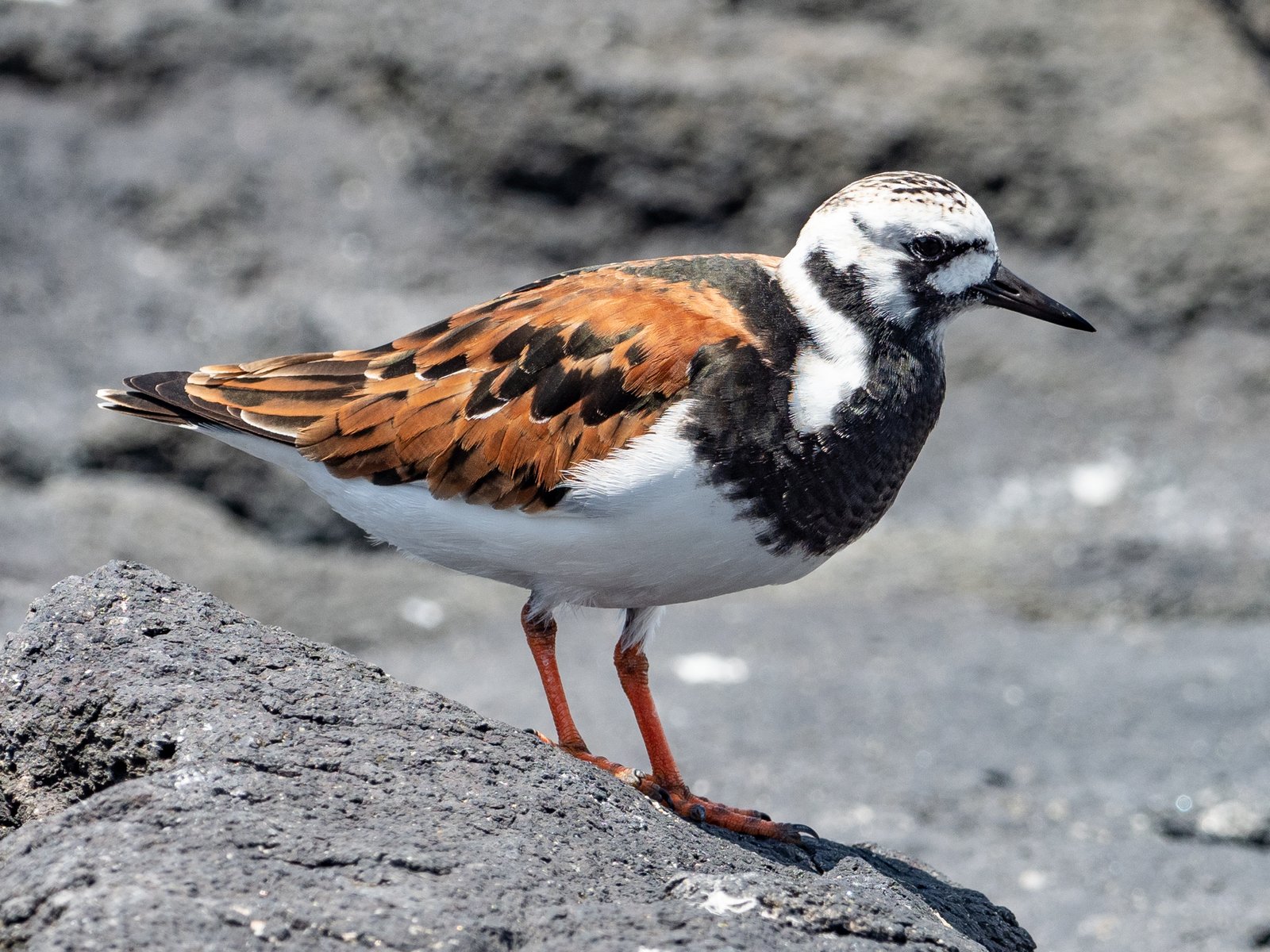
21–25 cm, a stocky shorebird with a short, wedge-shaped black bill with a slightly upturned tip and short, orange-red legs. In breeding plumage, from March–April, the upperparts are chestnut and black, the head and breast white with a black pattern and the belly white; the female is duller and browner. In non-breeding plumage brown, with a dark, irregular breast patch, a white belly and duller orange legs. In flight a pied pattern of white back, white wing bar, white patch at the base of the wing, white rump and black tail band. Juveniles are browner, with pale scaling on the upperparts.
Confusion species
Surfbird Calidris virgata, which uses the same rocky shores, is greyer, without a black breast patch, with yellowish-green legs and a white tail with a black terminal band. Wandering Tattler Tringa incana is plain grey, longer-billed and longer-legged. In non-breeding plumage a turnstone can vanish among seaweed on a dark rock, but the pied flight pattern is distinctive.
Habitat
Rocky shores, breakwaters, jetties, sandy beaches with wrack, mudflats, guano islands and harbours; on the Galápagos lava coasts and beaches among sea lions. Almost only by the sea. It flips stones, shells and seaweed with its bill and eats the crustaceans, worms and insects beneath; it also takes carrion, fish scraps and sometimes seabird eggs. It does not breed in the guide area.
Where the bird is most at home, classified by the vegetation units of the Andes and the west coast.


Range and movements
In Colombia a winter visitor along the Caribbean and Pacific coasts. In Ecuador and Peru a winter visitor along the whole coast. On the Galápagos a common winter visitor to the shores of almost all islands. In Bolivia a rare visitor inland. Breeds circumpolarly on Arctic tundra and coasts and winters on coasts almost throughout the world, in the Americas south to southern South America.
- Resident
- dark = core range, pale = thinly spread
How and when to look
From September to April on rocky shores, breakwaters and in harbours, for example at Salinas (Ecuador), in the port of Callao and on the quays of Puerto Ayora on Santa Cruz (Galápagos); around fish markets and landing stages it often allows a close approach.
Conservation status
Near Threatened. The world population is declining, mainly through the loss of mudflats and food along the flyways, such as the reduced supply of horseshoe crab eggs in Delaware Bay, and through changes on the Arctic breeding grounds.
Scientific name
Arenaria interpres | (Linnaeus, 1758)
Linnaeus described the species in 1758 as Tringa Interpres; because it was later moved to another genus, the author and year stand in brackets. The genus Arenaria was introduced in 1760 by Brisson. The genus name comes from Latin arenarius, 'inhabiting sand', from arena, 'sand'. The specific name comes from Latin interpres, 'interpreter, messenger'; on Gotland in 1741 Linnaeus confused a dialect word for the redshank with the Swedish word for 'interpreter'. The specimen the first description was based on came from Gotland, Sweden.