All species › Passerines › New World blackbirds, troupials and allies › Peruvian Meadowlark
Peruvian Meadowlark | Leistes bellicosus
Peruaanse weidespreeuw | Pastorero peruano | Polícia-inglesa-peruana
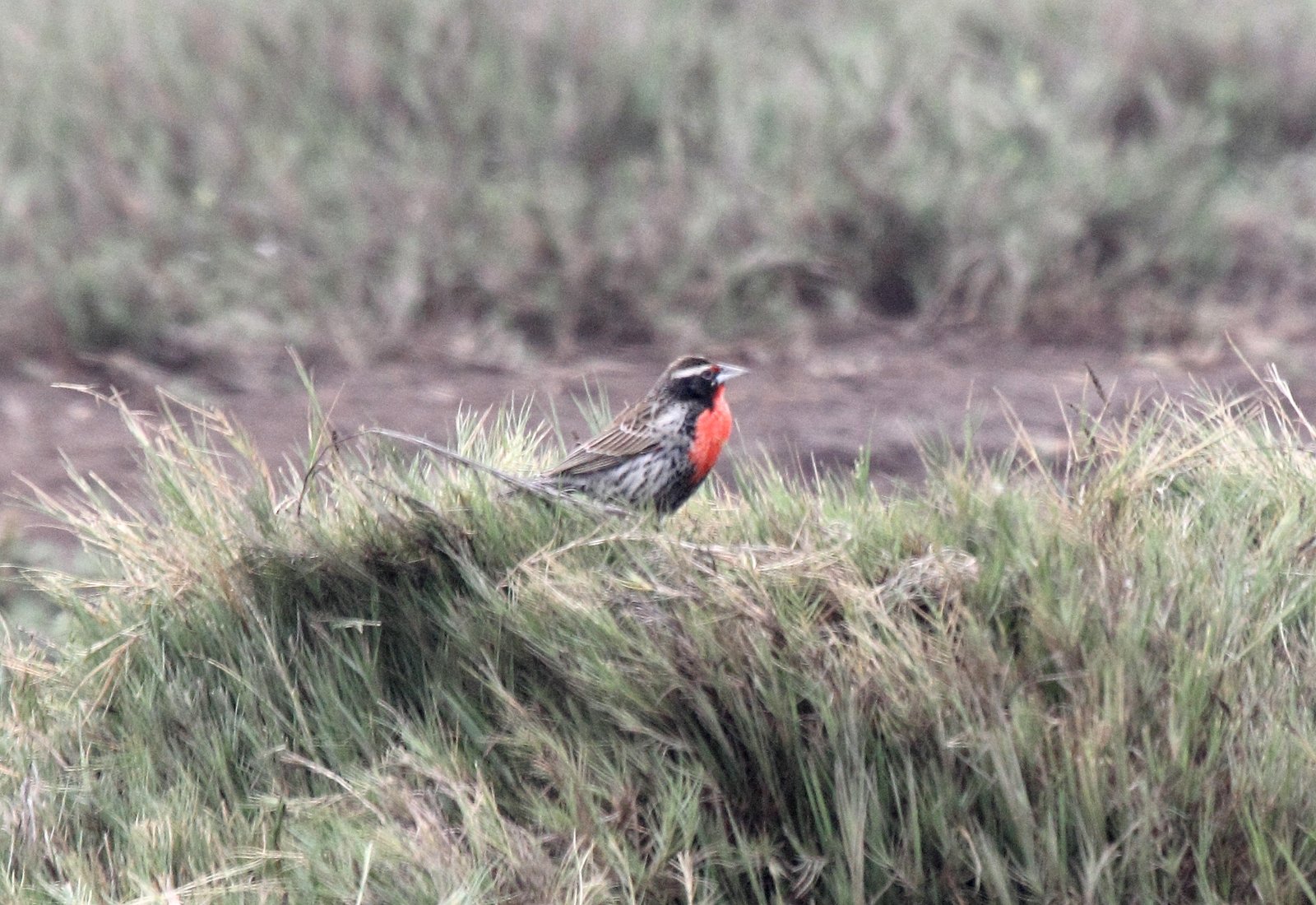
The Peruvian Meadowlark is the meadowlark of the arid west coast: it lives in the irrigated fields, pastures and lomas of the coastal desert and climbs the western Andean valleys high up the slopes. The male has a red throat and breast and sings from posts or in a short display flight.
Voice
The song is a short, scratchy phrase ending in a buzzy, drawn-out sound, given from a raised perch or during a short flight upwards. The call is a dry chek and a rattling chatter.
Recording: Nicole Alfaro Ponce — CC BY-NC-SA 4.0 · xeno-canto
Identification
20–22 cm, with a long, pointed bill and a short tail. The male is dark brown with blackish and pale brown streaks on the upperparts; the throat, breast and upper belly are bright red, and the flanks and lower belly blackish. An eyebrow runs from red in front of the eye to white behind it; the bend of the wing is red. The female is paler and more heavily streaked, with a pale throat, a pale eyebrow and a smaller, pinkish-red patch on the breast and belly. Juveniles are streaked buff, with little or no red.
Confusion species
Red-breasted Meadowlark Leistes militaris lives east of the Andes and is smaller, and the male is more uniformly black, without a white eyebrow. Long-tailed Meadowlark Leistes loyca of Chile and Argentina, outside the guide area, is larger, with a longer tail. West of the Andes there are no other meadowlarks in the guide area.
Habitat
Irrigated fields, pastures, rice fields, rank vegetation along canals, lomas and open scrub on the coastal plain and in the western valleys, from sea level to about 2500 m, locally higher. Forages on the ground for insects and seeds. The nest is a grass cup on the ground, hidden in a grass tussock.
Where the bird is most at home, classified by the vegetation units of the Andes and the west coast.


Range and movements
In Ecuador in the arid south-west, from the coast into the Andean valleys in the south. In Peru along the entire coast and on the western slopes of the Andes, locally also in dry inter-Andean valleys. Absent from Colombia, Bolivia and the Galápagos. Outside the guide area only in the far north of Chile.
- Resident
- dark = core range, pale = thinly spread
How and when to look
Check field edges, irrigation canals and pastures in the coastal valleys for red-breasted males on posts and clods; they sing a lot in the early morning.
Conservation status
Least Concern. The species benefits from the expansion of irrigated agriculture in the coastal desert.
Scientific name
Leistes bellicosus | (de Filippi, 1847) (GBIF: Sturnella bellicosa)
De Filippi described the species in 1847 as Sturnella bellicosa; because it was later moved to another genus, the author and year stand in brackets. The genus Leistes was introduced in 1825 by Vigors. The genus name comes from Greek lēistēs, 'robber' or 'plunderer'. The species name is Latin bellicosus, 'aggressive, martial', from bellum, 'war'. The specimen the first description was based on came from Lima, Peru.