All species › Passerines › New World blackbirds, troupials and allies › Yellow-billed Cacique
Yellow-billed Cacique | Amblycercus holosericeus
Geelsnaveltroepiaal | Cacique pico claro | Guaxe-de-bico-amarelo
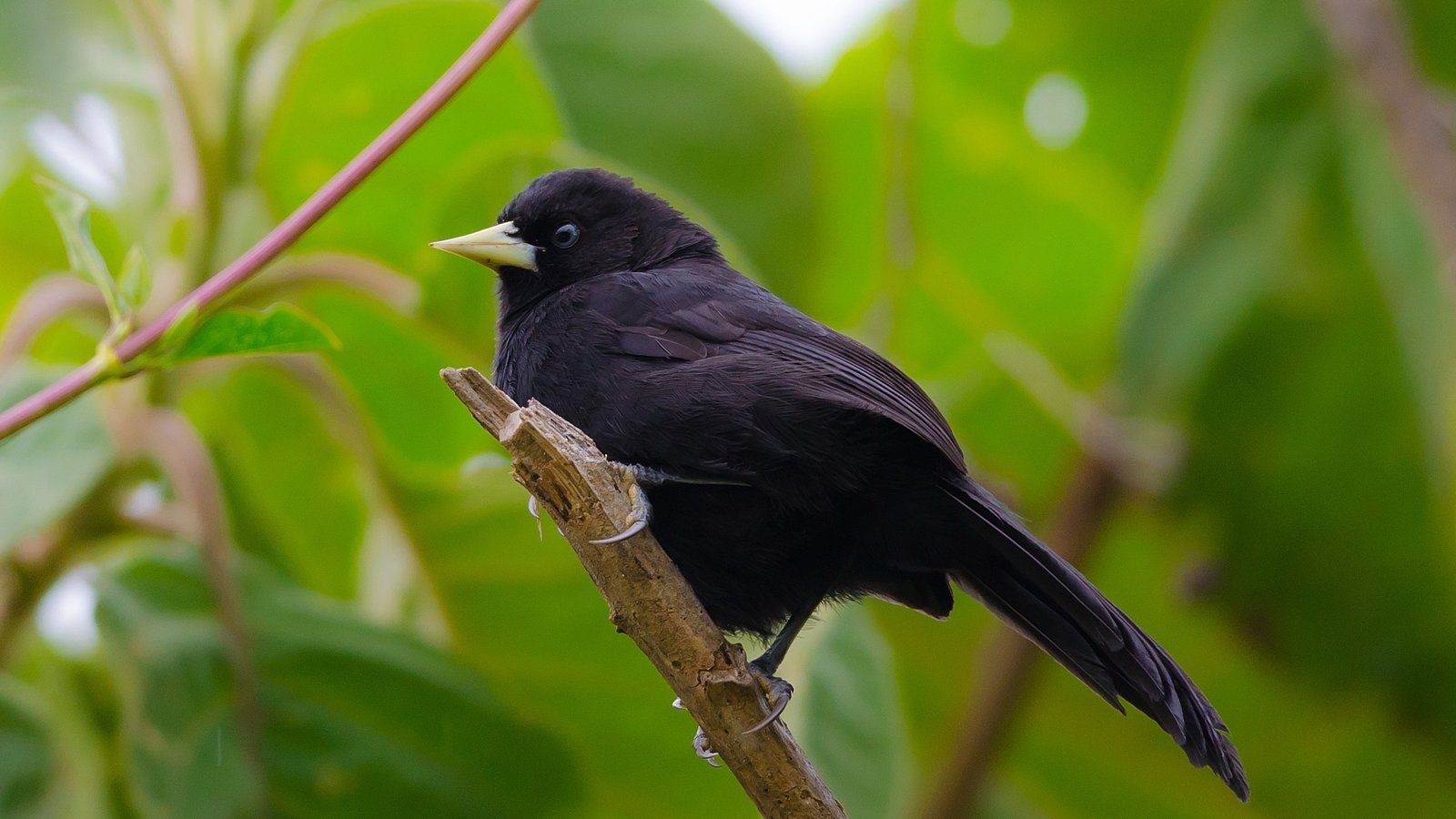
The Yellow-billed Cacique is an all-black cacique with a pale, ivory-yellow bill that lives hidden in dense thickets and bamboo. It is heard more often than seen: pairs keep in contact with loud whistles and rattling duets. Two forms occur in the guide area: a lowland form in the north and west and a form of the bamboo stands high in the Andes.
Voice
Loud, clear whistles, such as a repeated wee-oo or pee-pee-pee, and rattling and grating sounds; pairs often duet from cover. The call is a harsh chak.
Recording: Marcela Morales sánchez — CC BY-NC-SA 4.0 · xeno-canto
Identification
22–25 cm; the Andean form is slightly smaller than the lowland one. Entirely dull black, without gloss and without yellow or red in the plumage. The bill is long, pointed and pale ivory-yellow to greenish white; the eye is pale yellow in adults and dark in juveniles. The tail is fairly long and rounded. The sexes are alike; the female is smaller.
Confusion species
Solitary Cacique Cacicus solitarius of the eastern lowlands is larger, with a dark eye and glossy black plumage, and lives in riverside scrub. Scrub Blackbird Dives warczewiczi of western Ecuador and Peru has a black bill and lives in open country. Shiny Cowbird Molothrus bonariensis has a short, black, conical bill and a purplish-blue gloss. Mountain Cacique Cacicus chrysonotus has a yellow rump.
Habitat
In the lowlands dense undergrowth at forest edges, scrub and secondary forest; in the Andes mainly stands of bamboo (Chusquea) in cloud forest and at forest edges, roughly between 2000 and 3300 m. Forages low in the vegetation for insects, which it extracts with its bill from bamboo stems, rolled leaves and dead wood. The nest is an open cup, low in dense vegetation.
Where the bird is most at home, classified by the vegetation units of the Andes and the west coast.


Range and movements
In Colombia the lowland form in the north and west and the Andean form in all three Andean ranges. In Ecuador the lowland form in the west and the Andean form on both slopes of the Andes. In Peru the lowland form only in the far north-west and the Andean form along the eastern slope and locally in the north of the western slope. In Bolivia the Andean form in the Yungas. Absent from the Galápagos. Outside the guide area in Venezuela and from southern Mexico through Central America.
- Resident
- dark = core range, pale = thinly spread
How and when to look
Listen in bamboo at forest edges in the Andes for the whistles and duets, and wait for a bird to show itself in a gap; in the shade the pale bill is the first thing to stand out.
Conservation status
Least Concern. The species is widespread, although the Andean form depends on bamboo in and around cloud forest, which is cleared locally.
Scientific name
Amblycercus holosericeus | (Deppe, 1830)
Deppe described the species in 1830 as Sturnus holosericeus; because it was later moved to another genus, the author and year stand in brackets. The genus Amblycercus was introduced in 1851 by Cabanis. The genus name comes from Greek amblus, 'blunt', and kerkos, 'tail'. The species name comes from Latin holosericeus, 'all silk', for the silky plumage. The specimen the first description was based on came from Alvarado, Veracruz, Mexico.