All species › Swifts › Hummingbirds › Pink-throated Brilliant
Pink-throated Brilliant | Heliodoxa gularis
Rozekeelbriljantkolibrie | Brillante gorgirrosado | Brilhante-de-garganta-rosa
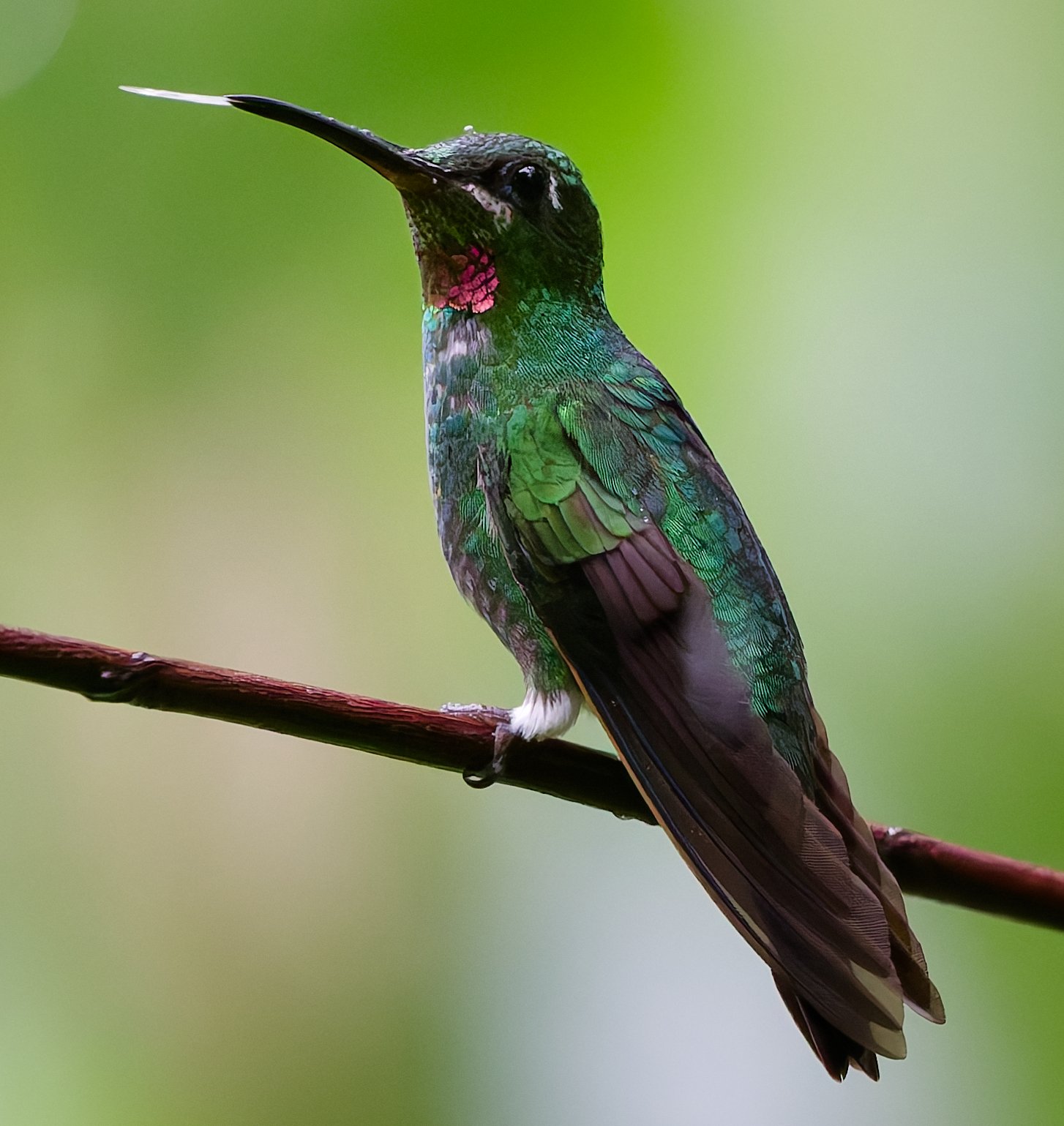
The Pink-throated Brilliant is a scarce and local brilliant of foothill forest at the eastern base of the Andes in Colombia, Ecuador and Peru. The male wears a small, glittering pink patch on the throat. The species lives in the forest interior and is seen less often than its relatives.
Voice
A sharp, repeated tseep or tchik; poorly known.
Recording: Dušan M. Brinkhuizen — CC BY-NC-SA 3.0 · xeno-canto
Identification
11–12 cm, with a straight black bill of medium length and a small white spot behind the eye. The male is dark green above, with a glittering green forehead and a small, glittering pink patch in the centre of the throat; the breast is glittering green, the belly greyish and the undertail coverts white. The tail is bronzy green and slightly forked. The female resembles the male, but is duller, with a smaller pink patch and more grey on the underparts.
Confusion species
Fawn-breasted Brilliant Heliodoxa rubinoides also has a small pink throat patch in the male, but has buff underparts and lives higher. Violet-fronted Brilliant Heliodoxa leadbeateri has a violet forehead in the male and a more deeply forked, dark tail. Gould's Jewelfront Heliodoxa aurescens has a rufous breast band. Black-throated Brilliant Heliodoxa schreibersii is darker, with a black throat and a long, deeply forked tail.
Habitat
The interior and edges of humid foothill forest and lower montane forest, often on ridges, roughly between 300 and 1100 m. It feeds in the lower and middle strata at flowers, often along a regular route, and catches small insects. Little is known about its breeding biology.
Where the bird is most at home, classified by the vegetation units of the Andes and the west coast.


Range and movements
In Colombia at the eastern base of the Andes in the south. In Ecuador in the foothills of the eastern slope. In Peru at the eastern base of the Andes in the north. Absent from Bolivia and the Galápagos. Does not occur outside the guide area.
- Resident
- dark = core range, pale = thinly spread
How and when to look
In foothill forest at the eastern base of the Andes in Ecuador, along forest trails on ridges. The species rarely comes to feeders; flowering shrubs in the forest interior offer the best chance.
Conservation status
Least Concern. The species is scarce and local; deforestation of the foothills affects its habitat.
Scientific name
Heliodoxa gularis | (Gould, 1860)
Gould described the species in 1860 as Aphantochroa ? gularis; because it was later moved to another genus, the author and year stand in brackets. The genus Heliodoxa was introduced in 1850 by Gould. The genus name combines Greek hēlios, 'sun', with doxa, 'glory' or 'splendour'. The species name comes from Latin gula, 'throat', referring to the pink throat patch. The specimen the first description was based on came from Río Napo.